
NATIONAL HARBOR, Md.—The fundamental mission of the U.S. Air Force—to fly and maintain advanced aircraft—is undergoing a significant strategic shift. Protecting the very air bases from which these operations launch is now being elevated to an equally critical, foundational component of airpower. This renewed focus, termed “point defense,” gained paramount urgency following a series of sophisticated attacks on U.S. and allied air bases across the Middle East during a conflict designated Operation Epic Fury.
The vulnerabilities exposed by these incidents, particularly in the wake of Iranian assaults, became a central topic at the Air & Space Forces Association’s (AFA) 2026 Air, Space and Cyber conference held in September. While the Iranian attacks, such as the March 27 air raid on Prince Sultan Air Base in Saudi Arabia, did not completely cripple operations, they inflicted substantial damage. Reports confirm that multiple critical refueling aircraft and an E-3 Sentry AWACS (Airborne Warning and Control System) command and control plane sustained damage. Beyond the matériel losses, the attacks caused injuries and significantly disrupted ongoing air operations.
The severity and impact of these incidents compelled U.S. Air Force leadership to re-evaluate its defensive posture. Consequently, air base defense—or “point defense,” referring to the protection of specific, fixed locations—has been re-prioritized. This commitment translates into tangible investments: new defensive weapons systems are being procured, and a dedicated career field is being established within the Air Force to train and deploy personnel specifically for these roles.
During the AFA conference, Air Force Secretary Troy E. Meink and Chief of Staff Gen. Kenneth S. Wilsbach outlined new initiatives designed to improve oversight of point defense acquisitions. This comes amid a rapid expansion within the counter-drone industry, driven by escalating demand from the Pentagon in response to the evolving threat landscape. General Wilsbach emphatically stated that point defense would no longer be considered a peripheral task or a “side hustle.” Instead, he declared it a “core function of air and space power,” signaling a fundamental reorientation of the service’s strategic priorities.
The heightened emphasis on point defense is the culmination of a series of evolving threats and critical lessons learned. The Air Force began to seriously ramp up its point defense strategy in late 2023, following repeated sightings of unidentified drones flying over Langley Air Force Base, Virginia. This incident underscored a growing vulnerability that the U.S. military, alongside its global allies, had been grappling with as it observed the rapidly advancing drone warfare tactics emerging from the conflict in Ukraine. A pivotal moment came in June 2025, when Operation Spider Web, a bold Ukrainian drone attack, successfully struck strategic bomber bases deep inside Russian territory. This operation served as a stark demonstration to Air Force leaders of just how vulnerable their own far-flung air bases could be to similar, low-cost drone threats.
However, it was the direct experience of a shooting war with Iran and the “hard lessons” derived from Operation Epic Fury that truly elevated point defense to its current level of critical importance. This re-evaluation culminated in a decision at the service’s semiannual Corona summit in June 2026, making it a key focus for this year’s AFA event, according to retired Air Force Lt. Gen. David Deptula, who now serves as the dean of the Mitchell Institute for Aerospace Studies. “The reason why it was announced at AFA is because a decision had been made at the previous Corona to make point defense a mission function of the Air Force,” Deptula explained. The conference “was the first opportunity to really make a big splash” with this significant policy change.
Multiple Air Force generals echoed this sentiment during the conference, underscoring the necessity of this increased emphasis after witnessing the impact of Iranian drone and missile attacks on air bases during Epic Fury. Gen. Adrian L. Spain, head of Air Combat Command, stated that Epic Fury “laid bare some of those things that have been in front of us for a while, and it just reminded us that we have to get after some of these things.” He emphasized the operational imperative: “Our bases are under attack; we have to continue to generate air power in spite of that. We have to be able to be resilient under attack, and we have to be able to sustain the force under those kinds of pressures to win.”
Lt. Gen. Christopher J. Niemi, the Air Force’s chief modernization officer, confirmed that the service had identified the need to “increasingly protect our assets at air bases with investments in point defense” more than a year ago, but that this effort “accelerated … because of some of the experiences that we had over there.”
Prior to Epic Fury, the Air Force’s primary strategy for operating in contested environments was Agile Combat Employment (ACE). This doctrine emphasizes dispersing forces from large, static main operating bases to a network of smaller, ad hoc airfields. The goal of ACE is to complicate adversary targeting, increase survivability, and allow forces to “fight through” attacks by making them harder to find and hit. During Epic Fury, this strategy was put into practice. Al Udeid Air Base in Qatar, a major U.S. air hub, was largely evacuated before the Feb. 28 launch of Epic Fury, with aircraft and most personnel relocated to other sites within the region and back in the United States. When Iranian forces subsequently attacked Al Udeid, destroying the Combined Air Operations Center (CAOC), the facility was empty. This marked the first time the Al Udeid CAOC had not participated in air combat operations since the 1990s, with Epic Fury’s air operations being commanded remotely from Shaw Air Force Base in South Carolina.
General Spain acknowledged the utility of ACE, explaining, “ACE was really birthed out of necessity, [because] I cannot protect these forces any longer.” However, he also highlighted the inherent tension between dispersal and the desire for robust, localized defense. “But if I could perfectly protect all my forces at a location, I would not move. There’s no reason to move. I’m only creating turbulence for myself if I do that.” This “turbulence,” he elaborated, impacts every aspect of an air operation, from “a logistics problem I’ve got to worry about” to “a fuel problem I’ve got to worry about” and “a [command and control] problem I have to worry about when I move around more.” Spain concluded that Iran’s demonstrated ability to threaten a base signifies a return to “a time well before 9/11, where we were preparing to fight a peer adversary in an existential way. We see what that looks like through the experience of [Epic Fury].”
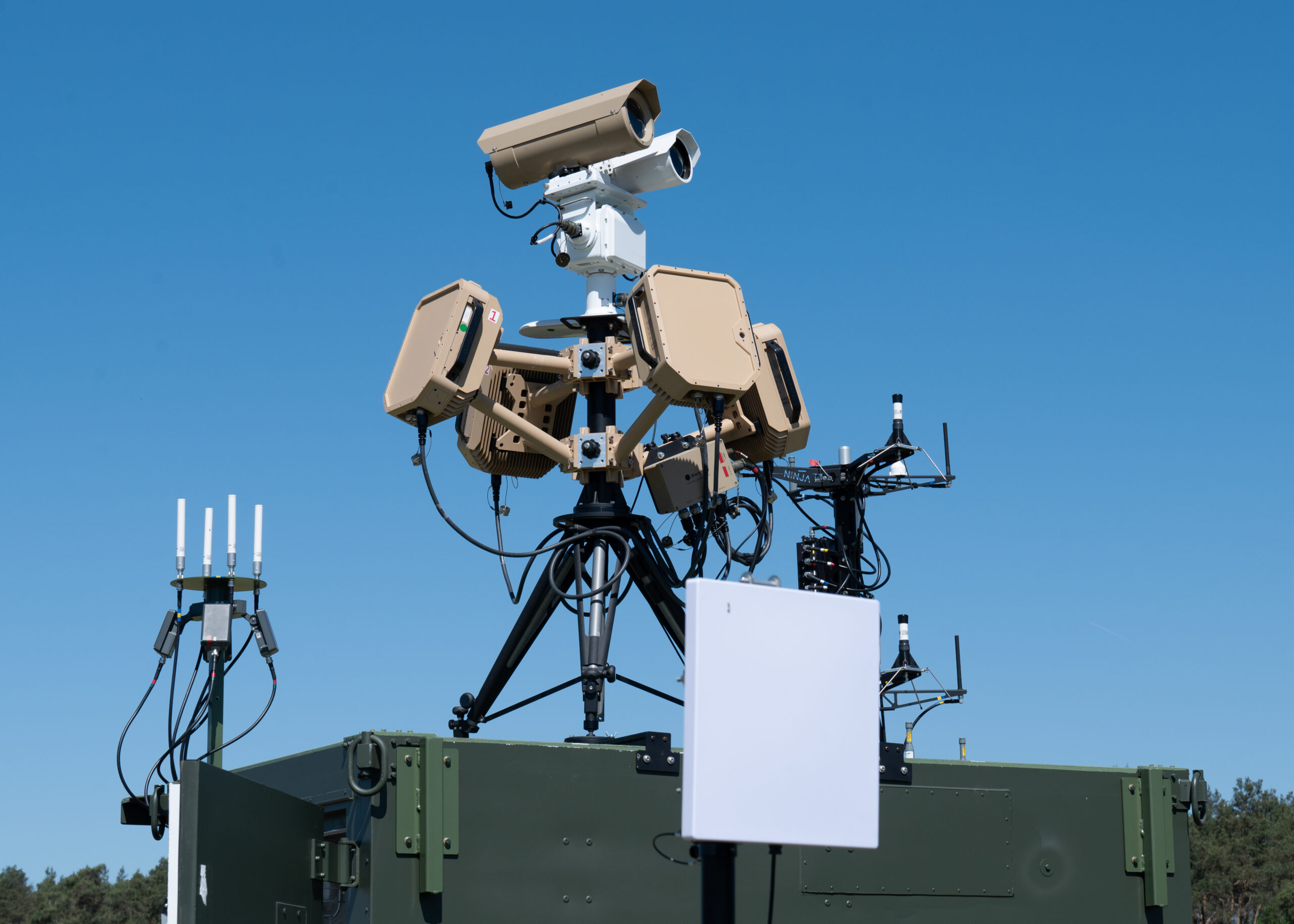
Air base defense has historically been a complex issue for Air Force leaders, often entangled in inter-service responsibilities. Under the 1948 Key West Agreement, which delineates the roles and missions of the U.S. armed forces, the Army is ostensibly responsible for protecting air bases from missile attacks. This is why systems like the Patriot ballistic missile defense system are Army assets. However, the proliferation of low-cost, readily available attack drones, such as the Iranian Shahed variants, has dramatically expanded the scale and scope of air base threats. The Army’s capacity to defend numerous, geographically dispersed air bases has struggled to keep pace with this evolving landscape. Recognizing this gap, the Air Force published new doctrine in April 2025, titled “Point Defense of Air Bases,” which explicitly assumes a more active and direct role for Airmen in defending their own installations. This includes evaluating emerging technologies, as shown in the image below, during exercises like Technology Readiness Experimentation (T-REX).
Adding to the vulnerability is the notable lack of hardened shelters and other passive defenses at many forward-deployed bases. Investment in such robust protective structures has historically been a low budgetary priority compared to funding for new aircraft or major research initiatives. Lt. Gen. Deptula argues that this vulnerability is a direct consequence of the Air Force being consistently underfunded, leading to calculated risks and difficult budgetary choices. “How come hardened aircraft shelters weren’t in place at Prince Sultan Air Base? How come the command-and-control facility at Al Udeid—that the joint force air component commander has been operating from since 2001—wasn’t built underground?” Deptula questioned. “The answer is money, because it costs more money. The United States military took the risk, understanding that there were threats out there, they were willing to take the risk and not to spend the money to build hardened aircraft shelters, to build underground facilities.”
Why This Matters
The U.S. Air Force’s decision to designate air base point defense as a “core function” marks a profound shift in military doctrine and strategy, with far-reaching implications. First, it acknowledges a new reality in modern warfare: that even sophisticated military installations are no longer sanctuaries. The proliferation of relatively inexpensive, easily deployable drones and precision-guided missiles has leveled the playing field, allowing non-peer adversaries to pose significant threats to high-value assets. This necessitates a comprehensive and multi-layered defense that goes beyond traditional air superiority.
Second, this shift impacts global power projection. The ability of the U.S. to operate effectively from forward bases is fundamental to its geopolitical influence and its capacity to respond to crises. If these bases are continuously vulnerable, it complicates military planning, increases operational risk, and potentially limits the reach of American airpower. The tension between the Agile Combat Employment strategy—which disperses forces to mitigate risk—and the renewed focus on defending fixed bases highlights a critical dilemma in adapting to new threats.
Third, it will reshape inter-service responsibilities and budgetary priorities. The Air Force’s explicit assumption of a more active role in point defense represents a departure from the traditional division of labor under the Key West Agreement, where missile defense was largely an Army responsibility. This will require new investments in technology, personnel, and training, potentially diverting funds from other areas. The debate over whether to invest in active defenses (weapons to shoot down threats) versus passive defenses (hardened structures) reflects a broader discussion about long-term resilience versus immediate operational needs.
Finally, for allies and partners, the U.S. Air Force’s enhanced point defense capabilities offer both reassurance and a blueprint. As the threat of drone and missile attacks grows globally, the lessons learned and technologies developed by the U.S. will likely influence defensive strategies worldwide. This evolution underscores a critical inflection point in military strategy, where adapting to ubiquitous, low-cost threats is as vital as maintaining a technological edge in traditional warfare.
U.S. Air Force Accelerates Drone Defense Efforts Amid Evolving Global Threat
The United States Air Force is significantly escalating its efforts to defend its bases against increasingly sophisticated drone attacks, establishing new career fields, specialized units, and overhauling acquisition strategies. This urgent pivot comes as military leaders acknowledge the growing capability of unmanned aerial systems (UAS) to pose substantial threats to critical infrastructure and personnel globally.
Lt. Gen. Daniel H. Tulley, head of Air Mobility Command, emphasized the heightened sense of urgency within the Air Force. “Now that ‘the threat has shown itself to be highly capable,’” he stated, “‘resources are going to have to be allocated to increase our ability to defend our bases.’” Tulley’s concerns are rooted in firsthand experience, having commanded the 379th Air Expeditionary Wing at Al Udeid Air Base from 2019 to 2021, where he witnessed the vulnerability of installations to such threats. He noted that while the problem was recognized previously, the urgency has “dramatically increased,” drawing parallels to unspecified “Operation Spiderweb” incidents in Russia as a cautionary tale for maintaining vigilance.
In response, the Air Force is implementing a multi-faceted approach. One key initiative is the establishment of a new career field specifically for “point defense specialists.” This decision, announced in late June following a “Corona meeting” (a high-level Air Force strategy session), aims to professionalize and specialize personnel in countering drone threats. The Air Force anticipates designating airmen with this new specialty within the next two years.
As an immediate solution, the service has already created “point defense flights.” These specialized units, each comprising approximately 20 airmen, are trained for rapid deployment to potential hotspots to defend air bases against drone assaults. These flights represent a proactive measure to address immediate vulnerabilities while the long-term career field development is underway.
Beyond personnel, the Air Force, in collaboration with the Air Staff and the Point Defense Task Force, and working alongside the Pentagon’s Joint Interagency Task Force 401 (JIATF 401), is actively identifying and fielding new technologies. However, officials acknowledge that developing an adequate point defense capability will be a multi-year endeavor. “Would I like to get there a lot faster? Yes, but I think we’re getting there,” Lt. Gen. Tulley commented, adding, “I’d like to look back in two years and say, ‘We’re done,’ but I don’t know if we’ll quite be there yet.”
The primary system currently relied upon for countering drones is the Small Unmanned Air Defense Systems (SUADS). This versatile system is designed to identify and track enemy missiles or drones of various sizes. It employs electronic warfare capabilities to disable incoming drones and utilizes both electronic warfare and kinetic effectors (physical projectiles) to stop missiles. Its adaptability allows it to interface with commercial counter-drone systems and other air defense networks based on operational requirements.
SUADS is available in two configurations: one for fixed air bases and another pallet-deployable variant for rapid response missions. The Air Force has earmarked over $1.5 billion for SUADS in its fiscal year 2027 budget request, with the majority of this funding allocated to the system’s missile defense components. Despite this significant investment, the total expenditure on additional counter-drone systems acquired with JIATF 401’s assistance remains opaque, as these purchases are not itemized in budget requests. Both Air Force and JIATF 401 officials have declined to provide specific funding details for these additional acquisitions, citing the need for greater oversight over the acquisition process.
The global counter-drone market underscores the escalating demand for such capabilities. Currently valued at approximately $9 billion, it is projected to surge to around $30 billion by 2031. The U.S. segment alone is expected to grow from $2.5 billion to $8.6 billion by 2030, according to MarketsandMarkets.com, a business intelligence firm. Brig. Gen. Matthew Ross, Director of JIATF 401, highlighted this trend during an industry discussion, noting, “What that means is that demand is going up really quickly,” but cautioned that while his agency is acquiring “additional arrows to put into the quiver of our warfighters,” current supplies are not yet meeting this demand.
To streamline and improve the efficiency of counter-drone acquisitions, the Air Force is also exploring organizational reforms. This includes establishing a senior portfolio acquisition executive (PAE) dedicated to managing the point defense enterprise. PAEs are a relatively new construct within the Pentagon, introduced through recent acquisition reforms to consolidate authority and enhance success by allowing leaders to manage multiple programs within a single mission area, with the flexibility to move funds and adjust requirements as needs evolve. The Department of the Air Force currently employs 26 PAEs, with 17 in the Air Force and nine in the Space Force.
Currently, counter-drone acquisition efforts fall under the Air Force PAE for Electronic Systems, Lea Kirkwood. Separate from this, offensive drone acquisitions are managed by the service’s PAE for Intelligence, Surveillance, Reconnaissance & Special Operations Forces. Kirkwood acknowledged the complexity, stating that the Department of the Air Force is “looking at how do we need to look at our structure to say ‘how can we best support the [Pentagon], the DRPM UxS, and then also within the DAF, both from the offensive and the defensive perspective’—you know, what’s the best way to get after this?” This comes as the Pentagon recently established the Direct Reporting Portfolio Manager for Unmanned Systems (DRPM UxS) to accelerate the development, procurement, and fielding of autonomous capabilities at scale.
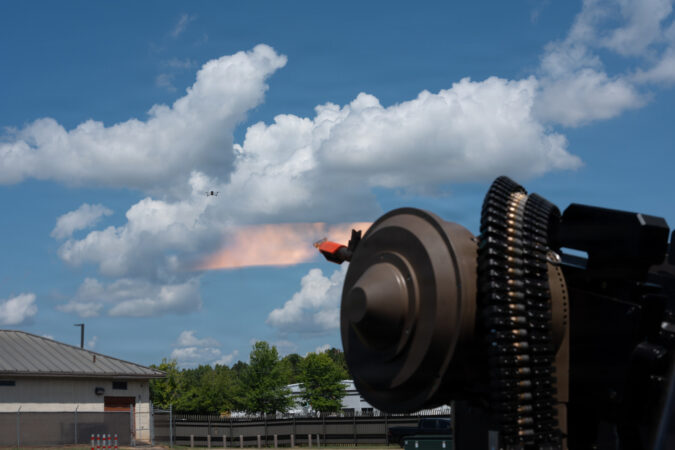
U.S. Air National Guard photo by Airman 1st Class Andre Bordlee
Furthermore, the Air Force is developing a formal “point defense weapon system,” as articulated by Wilsbach. This system is envisioned to act as a consolidated management framework for various counter-drone technologies, encompassing sensors, radars, command and control architecture, and both kinetic and non-kinetic effectors used to disable or destroy incoming drones. Michael Sheehy, director of future operations under the Air Force deputy chief of staff for operations, explained during a JIATF 401 industry meeting that this system aims to bring these capabilities “under a single umbrella,” moving away from an “ad hoc approach.” Crucially, it will create a single point for funding within the Air Force, with a dedicated program element code, ensuring that resources are directed efficiently to this critical area.
Sheehy observed a “vast difference” in the volume of counter-drone innovations displayed at recent conferences compared to previous years, reflecting the rapid evolution of the field. He emphasized the necessity of an “enterprise level approach” to manage the proliferation of capabilities. “The Air Force ‘owes it to our wing commanders to provide that kit, provide that training, provide that organization that is professionalized to get after this really difficult problem,’” he concluded, underscoring the comprehensive commitment to address the evolving drone threat.
Why This Matters
The U.S. Air Force’s intensified focus on counter-drone capabilities is a critical indicator of a profound shift in modern warfare and global security dynamics. The proliferation of relatively inexpensive, yet highly effective, unmanned aerial systems (UAS) presents a significant challenge to traditional military defenses and strategic installations worldwide. This development has several far-reaching implications:
Firstly, it highlights a fundamental change in military vulnerability. Historically, large, fixed military bases were considered secure, protected by layers of sophisticated air defenses against conventional aircraft or missile threats. Drones, however, can exploit gaps in these defenses, offering adversaries a low-cost, high-impact means to conduct surveillance, reconnaissance, and even precision strikes. The recognition that “the threat has shown itself to be highly capable” signifies that this is no longer a theoretical concern but an operational reality that demands immediate and substantial investment.
Secondly, this shift drives a new arms race in defense technology. As adversaries develop more advanced and autonomous drones, military forces must rapidly innovate to counter them. The focus on systems like SUADS, along with undisclosed acquisitions, points to a continuous cycle of development and counter-development that will shape defense spending and technological priorities for years to come. The projected growth of the global counter-drone market to $30 billion by 2031 underscores the economic significance of this technological competition.
Thirdly, the establishment of new career fields and specialized units reflects a critical adjustment in human capital and military doctrine. Creating “point defense specialists” and rapidly deployable “point defense flights” means the Air Force is not just investing in hardware but also in the specialized training and professionalization of its personnel to operate these new systems effectively. This signifies a recognition that expertise in countering UAS threats is now a core component of modern military readiness.
Finally, the organizational reforms, such as the creation of Portfolio Acquisition Executives (PAEs) and a “point defense weapon system,” aim to streamline procurement and management of these complex capabilities. This move reflects an effort to overcome bureaucratic hurdles and ensure that cutting-edge technology reaches warfighters efficiently. The transparency challenges in tracking some counter-drone acquisitions, however, also highlight the ongoing tension between rapid defense innovation and accountability for public funds.
In essence, the Air Force’s proactive measures against drone threats are a microcosm of broader global security trends, illustrating how technological advancements are reshaping warfare, driving massive defense investments, and requiring continuous adaptation in military strategy, personnel, and organizational structures to maintain deterrence and protect critical assets in an increasingly complex threat landscape.