
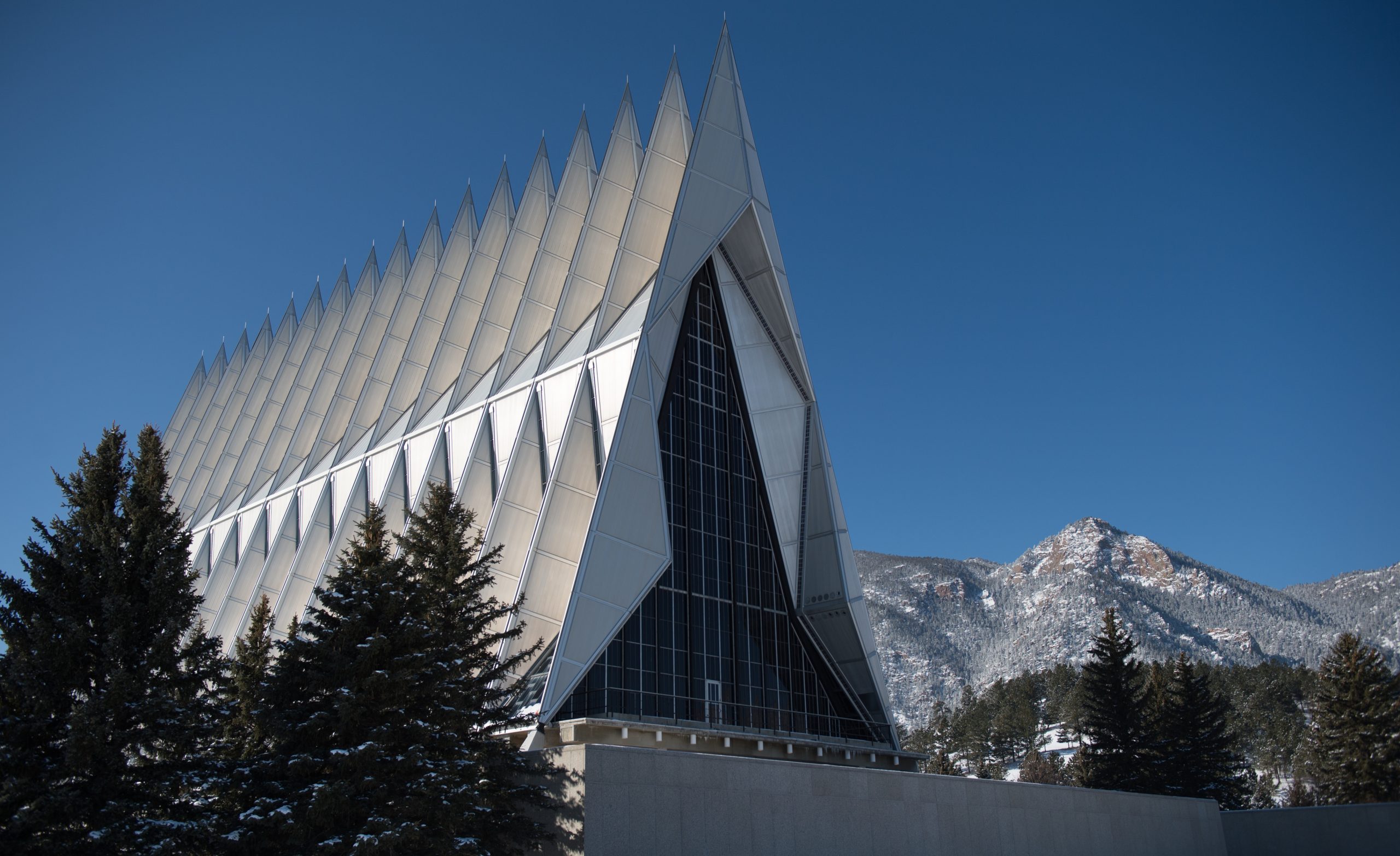
The U.S. Air Force Academy’s (USAFA) Board of Visitors, a congressionally mandated oversight committee, has issued a series of recommendations in its semiannual report, released October 15, urging the academy to address key issues ranging from the prolonged renovation of its iconic Cadet Chapel to the career implications of assignments for military officers and its academic accreditation. Among the most prominent proposals is a call to partially reopen the Cadet Chapel ahead of schedule, specifically its lower level, by December 2027.
The Cadet Chapel, a National Historic Landmark designed by architect Walter Netsch Jr. and opened in 1962, is renowned for its distinctive architectural style, featuring 17 spires formed by tetrahedrons. However, it has been closed since 2019 for extensive repairs necessitated by leaks and water damage. The renovation project, initially estimated at $158 million and slated for completion by 2023, has faced significant challenges. Costs have more than doubled to $335 million, attributed to unforeseen issues such as asbestos removal, pushing the projected completion date back to August 2028. For the past seven years, the chapel has been enveloped by a protective “big white box,” a structure colloquially known among cadets and widely criticized as an “eyesore” by locals, alumni, and even former President Donald Trump, who called for an investigation into the project last October.
Earlier this year, the Air Force Civil Engineer Center provided an updated timeline, signaling that the deconstruction of the “box” would commence in August 2027 and conclude by January 2028. This would allow chaplains to re-enter the facility by April 2028, with a full public reopening anticipated for August 2028. While local media initially hailed this revised schedule as commendable progress, the USAFA Board of Visitors believes further acceleration is possible and necessary.
The board’s report expresses “deep concern that the spiritual and character development of an entire generation of future officers is being compromised by the extended renovation timeline of the Cadet Chapel.” To mitigate this, the board advocates for the reopening of the chapel’s lower level by December 2027, even as construction continues on the upper sections. A white paper appended to the report frames the impending removal of the “box” as a “strategic opportunity” to allow cadets at least partial access, thereby re-emphasizing the building’s spiritual significance. Specific recommendations to achieve this include accelerating the “box” removal by one month, prioritizing repairs for the lower level, establishing secure and isolated access points for cadets, and updating relevant legal and administrative frameworks.
The lower level of the chapel houses Catholic and Jewish worship spaces, while the upper level contains a Protestant chapel. The board’s white paper suggests that these lower chapels could be “dynamically time-shared” to “provide an immediate, centralized home for worship for all faith groups across the cadet wing” while the upper chapel’s renovations are finalized.
Officer Assignments and Academic Accreditation
Beyond the chapel, the Board of Visitors’ report addresses several aspects of USAFA’s function as an academic and military institution. One recommendation urges the Air Force to “elevate the value” of assignments to USAFA, deeming them a “career-enhancing duty” for both Air Force and Space Force officers. The report highlights a prevailing issue where Career Field Managers (CFMs) often view such assignments negatively, perceiving them as a “tax” because officers temporarily depart from their primary specialties. This reluctance frequently hinders officers from pursuing valuable instructional or administrative roles at the academy.
To counteract this, the board proposes that the academy, in conjunction with the Air Force Personnel Center, implement incentives for personnel accepting USAFA assignments. They also recommend an analysis of promotion rates for officers who have served as instructors to determine whether these assignments positively or negatively impact career advancement. Over 2,000 Airmen and Guardians are stationed at USAFA, fulfilling roles ranging from faculty to administrative and support functions. In recent years, the proportion of uniformed faculty has increased, partly in response to a wave of civilian staff departures following federal workforce reductions.
Related to its academic standing, the board’s report calls for USAFA to terminate its relationship with the Higher Learning Commission (HLC), its current accrediting institution. Instead, the board recommends that USAFA align with other service academies and the Air Force’s degree-granting institutions—such as the Air Force Institute of Technology and Air University—under a single, unified accreditor. A working group within the board specifically favors joining the new Commission for Public Higher Education (CPHE). This commission was established by public university systems in six states, whose political leaders have expressed concerns about perceived liberal bias and excessive bureaucracy within existing accrediting bodies. The board’s working group asserts that CPHE “guarantees an apolitical baseline and alignment with requirements specific to the military education system.”
Previous Recommendations Awaiting Action
The Board of Visitors, currently chaired by Representative August Pfluger (R-Texas), a former F-22 pilot and USAFA alumnus, has a history of proactive recommendations. Its previous report, released in February, advocated for a 10 percent increase in the cadet wing’s size and the construction of a new “tri-complex” of buildings. This proposed complex would house an “Air, Space, and Cyber Education Center” and serve as a new “home” base for the U.S. Space Force.
However, the majority of the recommendations from that February report remain open, awaiting legislative action from Congress. Potential decisions on these matters could be included in the 2027 National Defense Authorization Act (NDAA), but the measure is currently stalled and unlikely to be resolved until after the upcoming midterm elections.
Why This Matters
The recommendations put forth by the U.S. Air Force Academy’s Board of Visitors carry significant implications for the institution, its cadets, the broader military, and American taxpayers. The Cadet Chapel, beyond its architectural splendor, serves as a spiritual cornerstone for cadets, fostering character development and morale. Its extended closure, coupled with substantial cost overruns, highlights challenges in major government construction projects and can impact public trust and perceptions of stewardship over taxpayer funds. Expediting even partial access, as the board suggests, could directly address the “spiritual and character development” concerns for future officers, ensuring their holistic well-being during their formative years at the academy. Furthermore, it could restore a sense of normalcy and pride in a landmark that has been an “eyesore” for too long.
The debate over officer assignments to USAFA touches on critical aspects of military talent management. If serving at the academy is not recognized as a career-enhancing move, it risks deterring top-tier officers from contributing their expertise to cadet education. This could diminish the quality of instruction and mentorship, ultimately affecting the caliber of future Air Force and Space Force leaders. Incentivizing these roles is crucial for maintaining USAFA’s academic and leadership excellence, ensuring that the best minds are shaping the next generation of military professionals.
The recommendation to change USAFA’s academic accreditor, moving from the Higher Learning Commission to the Commission for Public Higher Education, is particularly noteworthy. Accreditation is fundamental to an institution’s credibility, ensuring academic standards and the transferability of credits for graduates. The board’s rationale, citing a desire for an “apolitical baseline” and alignment with military education, reflects a broader national discourse about perceived political biases in higher education and its oversight. This move could potentially set a precedent for other military institutions, influencing the future landscape of accreditation for specialized federal academies and universities. It raises questions about academic autonomy, political influence in educational standards, and how military-specific educational needs are best served.
Finally, the unresolved recommendations from the February report, such as expanding the cadet wing and creating a new “Air, Space, and Cyber Education Center” with a Space Force home, underscore USAFA’s strategic importance in national defense. These proposals envision the academy as a central hub for developing leadership and expertise critical to future warfare domains. The delay in congressional action on these long-term visions could impact the nation’s readiness and strategic positioning in an increasingly complex global security environment. Taken together, these recommendations reflect ongoing efforts to ensure the U.S. Air Force Academy remains a premier institution capable of producing the leaders necessary to meet evolving national security challenges.