
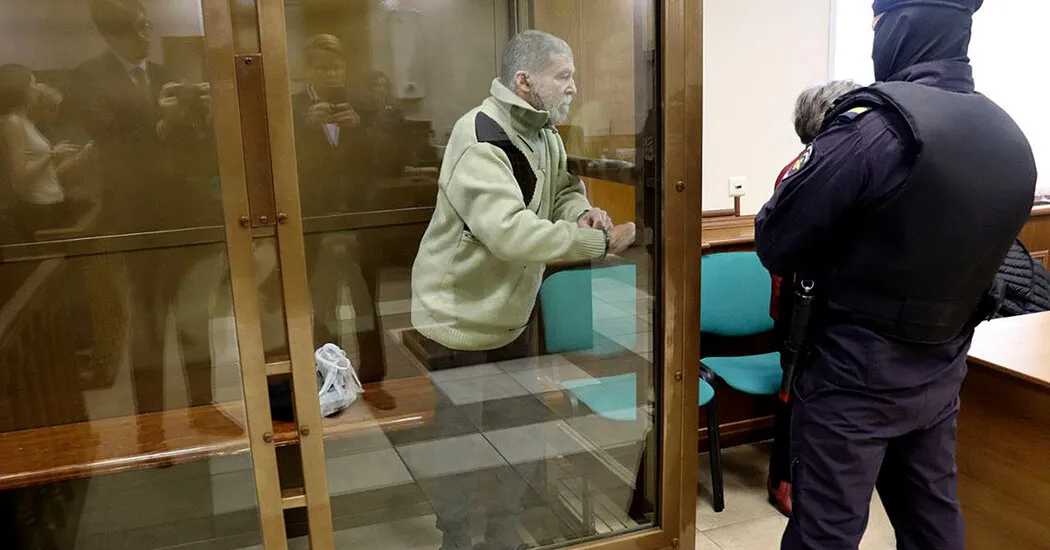
St. Petersburg, Russia – An American citizen, Stephen James Hubbard, who had been detained in Russia for over four years on charges the U.S. State Department deemed fabricated, was released on Wednesday following a direct appeal from President Trump to Russian President Vladimir V. Putin. The release occurred during a visit by Trump administration envoy Steve Witkoff to St. Petersburg, where he met with President Putin to discuss potential peace negotiations for the conflict in Ukraine.
During his interaction with the Russian leader, Mr. Witkoff publicly thanked President Putin for Mr. Hubbard’s release, describing him as a “humanitarian.” “You talk so much about my president, President Trump, being a humanitarian,” Mr. Witkoff reportedly told Mr. Putin. “You are a humanitarian also, sir, and I salute that.”
Mr. Hubbard, a 74-year-old retired teacher, was accused by Russia of being a Ukrainian mercenary. His detention and subsequent conviction by a Russian court in October 2024 on charges of mercenary activity, for which he received a sentence of almost seven years in a penal colony, were consistently disputed by U.S. officials. The State Department designated Mr. Hubbard as wrongfully detained in January 2025.
The diplomatic exchange took place against a backdrop of complex and evolving U.S.-Russia relations under the Trump administration. President Putin is currently subject to an arrest warrant from the International Criminal Court (ICC) for alleged war crimes related to the full-scale invasion of Ukraine, an institution for which President Trump has previously expressed disdain. Mr. Trump himself has faced scrutiny for his public remarks, which have at times echoed Kremlin narratives and shown an affinity for authoritarian leaders.
The release of Mr. Hubbard marks a significant event in what has been described as a period of intensified engagement between the U.S. and Russia, coinciding with a perceived shift in the Trump administration’s posture towards Ukraine. Over the past several days, the American president has announced intentions for the United States to purchase Russian diesel fuel and to suspend the imposition of new sanctions against Russia. Furthermore, Mr. Trump has publicly suggested that Ukraine should replace its current president, Volodymyr Zelensky.
Ukrainian officials have reported a series of changes in U.S. support, including intermittent interruptions to intelligence sharing, reduced access to Starshield (the military iteration of the Starlink satellite internet service), and a suspension of deliveries for Patriot interceptors, which are critical for Ukraine’s defense against Russian ballistic missiles. These reported changes have occurred amidst ongoing efforts by the Trump administration to pursue negotiations aimed at resolving the conflict in Ukraine.
Mr. Witkoff’s diplomatic activities, particularly his repeated visits to Moscow and interactions with President Putin, have drawn criticism from observers in Kyiv, who have characterized his demeanor as overly deferential. Similar critiques were leveled against President Trump when he hosted President Putin in Alaska in the summer of 2025, an event that was seen by some as ending years of diplomatic isolation for the Russian leader following the invasion of Ukraine.
The Trump administration has consistently articulated its view that building a relationship with the Russian leader is essential for fostering negotiations to bring an end to the prolonged war.
President Trump confirmed Mr. Hubbard’s release on Wednesday, stating on Truth Social that he had made the request to President Putin last week and that Mr. Hubbard was “on his way back home and will soon be with his family.” The American president further asserted that Russia had not required any concessions in return for the release, describing it as an “unprecedented situation” and emphasizing, “There was no ‘swap’ necessary for this release.”
For President Putin, the release of Mr. Hubbard, who reportedly endured torture, starvation, and isolation in the Russian penal system, came at minimal apparent cost. However, the gesture is perceived to have generated significant goodwill with President Trump, reinforcing the latter’s argument that his personal relationship with the Russian leader is uniquely capable of facilitating an end to the conflict.
Mr. Witkoff’s remarks in St. Petersburg were delivered at the commencement of talks focusing on new proposals for a peace agreement to conclude the war initiated by Russia’s invasion of Ukraine in February 2022. He informed President Putin that he had brought “some papers” containing “some ideas about the different elements of some sort of peace deal,” which the Russian leader could review “at your leisure later.”
President Trump had previously hinted at his efforts to secure Mr. Hubbard’s release during a Tuesday press conference, prior to the teacher’s actual freedom. However, he did not publicly address the broader context of Russia’s policy of detaining foreign citizens, often seen as leverage in international relations.
Notably, concurrently with the meeting between Mr. Putin and Mr. Witkoff, Russia’s security services announced the arrest of a German citizen on charges similar to those levied against Mr. Hubbard. This incident suggests a continued pattern of detaining foreign nationals, even as one American is released.
In the days leading up to his release, as Mr. Hubbard was transferred from a penal colony and prepared for repatriation, his utility to President Putin reportedly shifted. He transitioned from being a pawn in potential negotiations to a symbolic demonstration of renewed diplomatic engagement with the U.S. president.
Mr. Hubbard’s health is described as fragile, a consequence of his prolonged detention. The Trump administration prioritized his release since becoming aware of his case, according to his lawyers. Upon his return to the United States, he is scheduled to be flown to a State Department facility in Texas for comprehensive medical evaluation and treatment.
Mr. Hubbard was reportedly abducted by Russian soldiers in eastern Ukraine shortly after the 2022 invasion. Russian sentencing documents claimed he was given the call signs “Samurai” and “Ninja” and that he manned a checkpoint on a bridge. U.S. officials and Mr. Hubbard’s family have consistently dismissed these claims as highly improbable.
A Michigan native, Mr. Hubbard had led an itinerant life, including years teaching English in Japan and a period in Cyprus, where one of his sons resides, before settling in Izium, Ukraine, near Kharkiv. He chose to remain in Ukraine after a relationship ended there.
He was approximately 70 years old when Russia launched its full-scale invasion. Text messages exchanged with his son in Japan indicated that Mr. Hubbard did not fully grasp the severity of the conflict’s onset and showed no evidence of any involvement with the Ukrainian military. He provided daily updates on his routine, including attending church and challenges in obtaining food, although he once mentioned purchasing caviar “for nutrition.”
Russian authorities stated they arrested him in April 2022 inside an acquaintance’s home.
Ukrainian prisoners of war who were held alongside Mr. Hubbard later recounted to The New York Times the severe conditions he endured. They described repeated torture specifically because he was an American, including beatings, prolonged forced standing, insufficient food, and inadequate medical care. In interviews following their own releases, these former prisoners expressed grave concerns for Mr. Hubbard’s survival.
In October 2024, a Russian court found Mr. Hubbard guilty of being a mercenary and sentenced him to nearly seven years in a penal colony.
Unlike many other Americans detained within the Russian prison system, Mr. Hubbard was held in the general population, according to his legal representatives. At various times, his family lost contact with him, and the U.S. Embassy was denied consular access.
Following his designation as wrongfully detained by the State Department in January 2025, efforts to secure his release intensified. Martin De Luca, a former federal prosecutor renowned for his role in securing the release of another American from Russian detention in February 2025, became involved in Mr. Hubbard’s case.
EPAM Law, a Moscow-based firm that collaborated with Mr. De Luca on the previous release, located Mr. Hubbard at the IK-12 penal colony in Mordovia, a region often referred to as “prison land.” In May 2025, Mr. Hubbard was permitted a brief phone call with his son, Joseph Coleman, who lives in Cyprus.
Mr. Coleman recounted the minute-long conversation, noting that his father initially sounded upbeat. “But then somewhere in the middle it turned and you could you could hear the frustration in his voice,” Mr. Coleman recalled. “You could hear maybe a slight lack of hope.”
In September, Mr. Coleman, a Greek Orthodox priest, penned a heartfelt letter to President Putin, emphasizing their shared Orthodox faith and pleading for his father’s freedom. On Tuesday night, anticipating his father’s return, Mr. Coleman expressed his eagerness to reunite and provide support. “I don’t want to be stressful to him,” Mr. Coleman said. “I want to be in his presence and make sure he’s healthy and he’s well and, you know, if he wants to talk, we’ll talk.”
Valerie Hopkins contributed reporting.
Why This Matters
The release of Stephen James Hubbard from Russian detention carries significant implications for international diplomacy, human rights, and the ongoing conflict in Ukraine. Firstly, it underscores the complex and often transactional nature of relations between the United States and Russia. While President Trump asserted that no “swap” or concession was made, the goodwill generated by Mr. Hubbard’s release provides a diplomatic win for President Putin, potentially validating the Trump administration’s strategy of direct engagement and personal appeals to the Russian leader, even amidst widespread international condemnation of Russia’s actions in Ukraine.
Secondly, the circumstances surrounding Mr. Hubbard’s detention and release highlight the precarious situation of foreign nationals in Russia, particularly those in areas affected by the conflict. The State Department’s designation of Mr. Hubbard as “wrongfully detained” and the reports of his torture and mistreatment raise serious human rights concerns. Russia’s simultaneous arrest of a German citizen on similar charges, as Mr. Hubbard was being released, suggests a continued pattern of using foreign citizens as diplomatic leverage, creating a climate of risk for anyone visiting or residing in Russia or Russian-occupied territories.
Thirdly, this event provides insight into the Trump administration’s evolving foreign policy direction regarding the conflict in Ukraine. The envoy’s public praise of President Putin as a “humanitarian,” alongside President Trump’s recent calls for Ukraine to replace its president, announcements regarding Russian diesel purchases, and reported curtailments of military and intelligence support to Ukraine, signal a potential shift towards de-escalation with Russia at the expense of unwavering support for Kyiv. This approach contrasts sharply with the policies of many Western allies and could have profound consequences for Ukraine’s defense capabilities and its broader geopolitical standing.
Finally, the episode reinforces President Trump’s long-held belief that his personal relationships with foreign leaders, including those considered adversaries, are key to resolving international disputes. His assertion that he alone possesses the ability to negotiate with President Putin to end the war is central to his political narrative. The release of Mr. Hubbard, regardless of its underlying mechanics, provides tangible (though potentially isolated) evidence for this claim, which could influence public opinion and future diplomatic strategies, particularly concerning the war in Ukraine and the broader international order.