
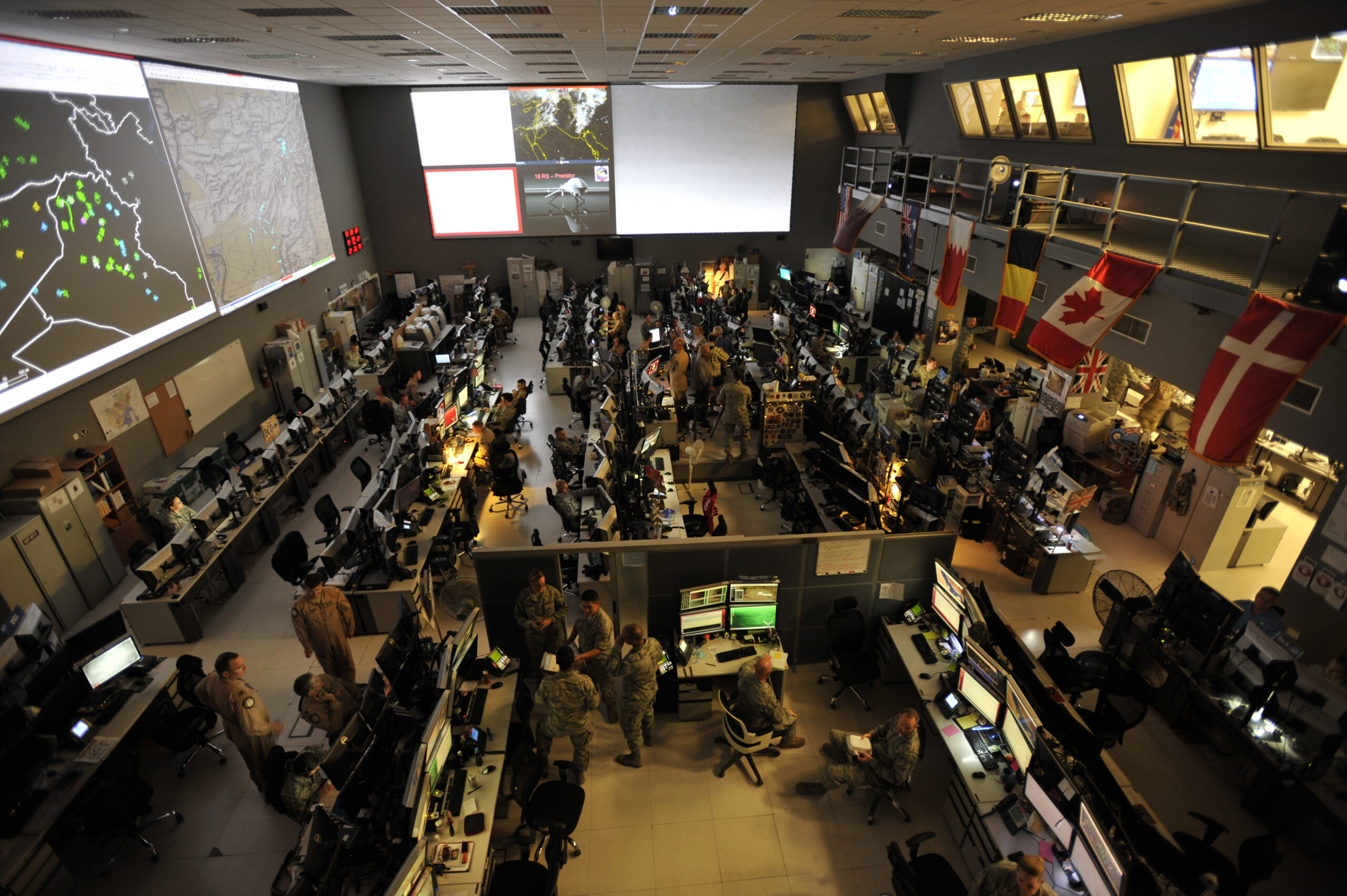
WASHINGTON D.C.– The United States Air Force is embarking on a significant modernization effort for its critical Air Operations Centers (AOCs), often described as the “combat brains” of its global operations. After decades of relying on isolated, vendor-locked systems, the program office responsible for these command and control hubs is now integrating them into a new, unified cloud-based system known as the Dynamic Unified Net-enabled Environment, or DUNE.
Col. Brian Viola, the recently appointed commander of Kessel Run – a government-led, vendor-managed program office under the portfolio acquisition executive for command, control, communications, and battle management – detailed this strategic shift in a recent interview with Air & Space Forces Magazine. His team is focused on standardizing the global access to cloud-based applications and software updates for AOCs, ensuring real-time availability and interoperability across the force.
Launched this spring, DUNE represents a pivotal step in merging cloud capabilities with existing on-premises systems. This integration aims to provide Air Operations Center operators, commanders, and their supported operational Air Force units with seamless access to essential tools and information, regardless of their physical location or the age of their local hardware.
“Evolving the architectural foundation is vital because the information our warfighters rely on depends on the integrity, speed, and agility of the underlying domain,” Viola stated. He emphasized the urgency of this transformation, adding, “We are rapidly entering the era of software-defined warfare, where tactical superiority belongs to the force that can iterate, secure and deploy code faster than the adversary can adapt.” This concept underscores a shift where software development and deployment speed become as crucial as traditional hardware advantages.
At its core, DUNE is designed to standardize the communication protocols between legacy and current software across the Air Operations Center’s diverse systems. This common operational environment is intended to break down technological silos that have historically hampered data flow and system integration.
While unconfirmed, the name “DUNE” has drawn comparisons to the popular science fiction franchise, a trend not uncommon within the Air Force, given that Kessel Run itself is named after a reference from Star Wars.
Standardizing Communication and Capabilities
A key challenge DUNE addresses is the current operational dilemma faced by AOC personnel. Previously, operators often had to choose between utilizing advanced, real-time cloud-based tools or relying solely on their frequently outdated, localized hardware. This forced choice created inefficiencies and limited the scope of available resources at critical moments.
“The ability to rapidly integrate new mission capabilities, enable distributed command and control, and incorporate new technologies depends on the architecture beneath them,” Col. Viola explained, highlighting the foundational nature of DUNE’s architectural overhaul.
DUNE is an overarching initiative that builds upon Kessel Run’s existing Applications Transformation project, or AppTX. AppTX was introduced to facilitate the large-scale migration of legacy software applications to cloud environments, with companies like Parsons, General Dynamics Information Technology, and Astrion competing for related task orders. DUNE expands this effort by specifically tackling the complexities of Data Definition Language (DDL).
DDL, a type of programming language, is crucial because it allows for the creation, modification, or deletion of database structures without altering the underlying data. In the context of AOCs, DDL enables disparate legacy infrastructure and software to “speak” with newer applications and systems, effectively dismantling the “stovepipes” that have isolated information and capabilities. This capability is particularly vital given the Pentagon’s intensified push to integrate artificial intelligence (AI) into its systems, which heavily relies on seamless data exchange.
Without DDL and the standardization it brings, Viola warned, “you’re going to have to work with what you have.” This means an Airman in an AOC would be limited to tools and solutions available only within their local network, at the tactical edge, without the broader, updated resources of the cloud.
The goal is to move away from highly customized solutions for each of the Air Force’s 21 AOCs. “We don’t want to necessarily have every AOC be a snowflake that we have to go, ‘this is tailored for you now, AOC 1, and this is tailored for the 613th [AOC], this is tailored for the 607th [AOC],” Viola commented. He stressed that such bespoke tailoring “sucking away from the innovation we really want to get after” by consuming resources that could otherwise be dedicated to developing advanced capabilities.
Project DUNE aims to facilitate the continuous delivery of cloud-based capabilities and applications, making them accessible to on-premises solutions. While these integrated solutions may not possess the full “elasticity” of pure cloud environments, they are designed to provide a resilient and reliable operational capability for users.
Looking beyond DUNE, Col. Viola outlined plans to develop the “Revolutionary AOC” in collaboration with industry partners. This future effort will bring together operators, mission partners, engineers, and acquisition teams to work through operational scenarios, identify existing gaps, and continuously refine the system architecture for future combat requirements.
The ongoing work on DUNE and other initiatives within PAE C3BM and Kessel Run precedes Col. Viola’s tenure. Air & Space Forces Magazine previously reported in February on Kessel Run’s launch of its “next generation” AOC effort, which seeks to integrate AI, machine learning, data fusion, and cloud-based software into these critical centers.
The Air Force operates 21 AOCs globally, which it designates as weapon systems in their own right under the nomenclature AN/USQ-163 Falconers. In 2022, SAIC was awarded a $374 million contract extending through mid-2027 to sustain and modernize these AOCs. The current Falconer system is at Increment 10.1, with a 10.2 (also known as Block 20) upgrade currently in progress.
Why This Matters
The U.S. Air Force’s transition to a unified, cloud-based system for its Air Operations Centers (AOCs) through initiatives like DUNE represents a fundamental shift in how modern airpower is commanded and controlled. This modernization is critical for several reasons, impacting operational efficiency, strategic advantage, and the future trajectory of warfare.
Firstly, the move away from isolated, “vendor-locked” systems directly enhances operational effectiveness. By standardizing software communication and enabling seamless integration between legacy and cloud-based tools, AOC operators gain real-time access to more comprehensive data and advanced applications. This accelerates decision-making processes, improves coordination across dispersed units, and allows for more agile responses to rapidly evolving threats. In a conflict scenario, the ability to rapidly disseminate critical intelligence and command directives can be the difference between success and failure.
Secondly, this initiative is pivotal for maintaining a strategic advantage in an era increasingly defined by “software-defined warfare.” As Col. Viola highlighted, future conflicts will favor forces that can iterate, secure, and deploy code faster than adversaries. DUNE’s architecture provides the foundation for such rapid innovation, making it easier to integrate emerging technologies like artificial intelligence (AI) and machine learning (ML). This not only keeps the U.S. Air Force at the technological forefront but also allows for continuous adaptation against sophisticated peer competitors who are also investing heavily in digital warfare capabilities.
Finally, the standardization championed by DUNE fosters greater resilience and cost-efficiency. By reducing the need for unique, tailored solutions for each AOC, the Air Force can streamline maintenance, training, and cybersecurity efforts. A unified architecture also enhances the overall security posture by allowing for consistent updates and patches across the entire system. This long-term investment in a robust, interconnected digital infrastructure is essential for ensuring the Air Force’s ability to execute its global missions effectively and securely into the future, safeguarding national security interests in an increasingly complex geopolitical landscape.