
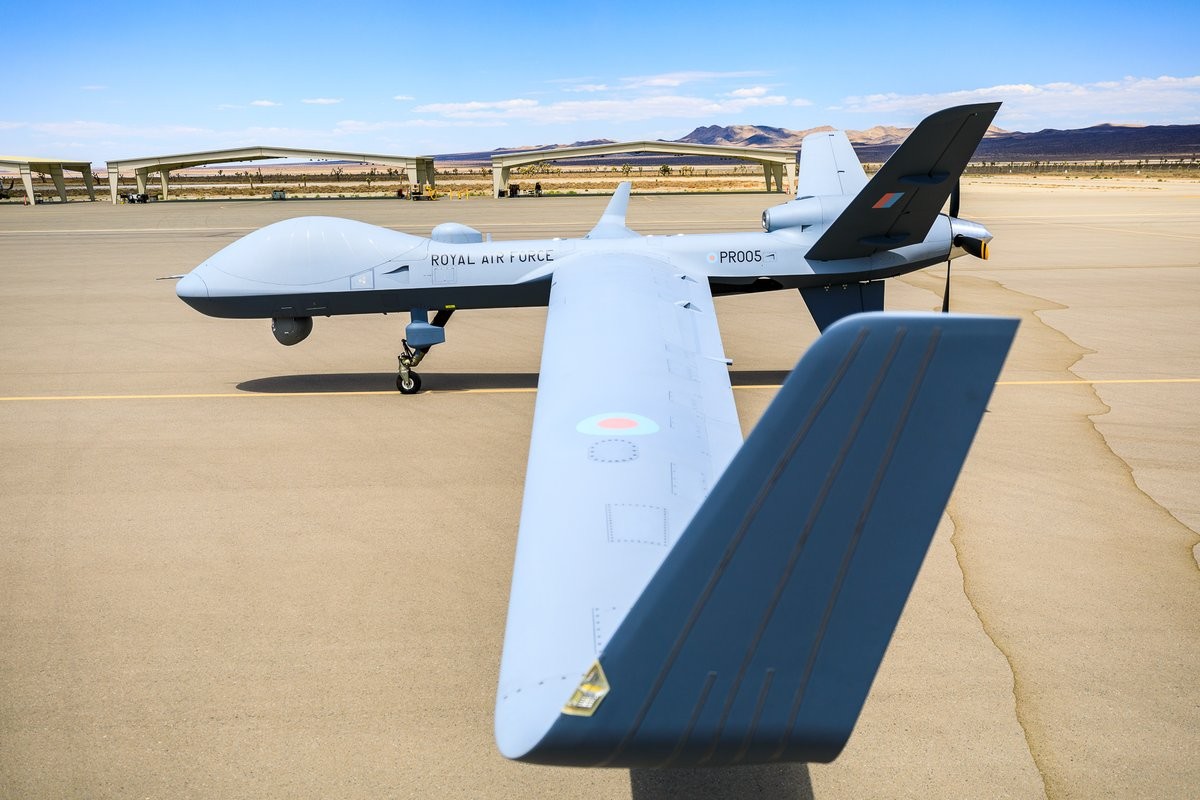
RAF Drone Operation Over English Channel Clarified Amid Parliamentary Inquiry
A recent operation by a Royal Air Force (RAF) Protector RG-1 uncrewed aerial system (UAS) over the English Channel on October 14 has been confirmed by the Ministry of Defence (MoD) as being in support of “Defence aims,” explicitly stating it was not tasked to assist the Home Office. The clarification came in response to a parliamentary question, shedding light on the roles and responsibilities of military assets in domestic airspace, particularly in sensitive areas like the English Channel.
The query was raised by Ben Obese-Jecty, the Conservative Member of Parliament for Huntingdon, who sought to understand the rationale behind the aircraft’s deployment to support Home Office operations in the Channel on the specified date. His question underscored ongoing public and political scrutiny regarding government surveillance activities related to irregular migration across one of the world’s busiest shipping lanes.
In her official response, Louise Sandher-Jones, the Minister for the Armed Forces, affirmed the MoD’s consistent approach to maritime security. “The Ministry of Defence regularly and routinely monitors our waters to protect UK interests, contribute to domestic maritime security, and act as a deterrent against potentially malign activities,” Minister Sandher-Jones stated. She then definitively clarified the nature of the mission: “The deployment the hon. Member refers to was conducted in support of Defence aims, not in support of the Home Office.” This distinction is crucial, as it delineates military operations focused on national security from civilian enforcement responsibilities, which are typically managed by departments such as the Home Office.
The aircraft in question, the Protector RG-1, represents a significant upgrade in the RAF’s intelligence, surveillance, target acquisition, and reconnaissance (ISTAR) capabilities. It is the RAF’s variant of the General Atomics MQ-9B SkyGuardian, a highly advanced medium-altitude, long-endurance (MALE) UAS. The United Kingdom has committed to acquiring sixteen of these state-of-the-art drones, which are designed to replace the venerable MQ-9A Reaper fleet. The Reaper had served for two decades, primarily in combat and surveillance roles over Afghanistan, Iraq, and Syria, before its retirement.
The Protector RG-1 boasts impressive specifications that make it a formidable asset for extended surveillance missions. With a wingspan of approximately twenty-four metres, it can remain airborne for more than thirty hours, operating at altitudes exceeding forty thousand feet. Its payload capabilities are extensive, including the capacity to carry Brimstone 3 missiles and Paveway IV bombs, alongside a sophisticated suite of sensors. These include advanced electro-optical and infrared sensors for detailed imagery and thermal detection, as well as a maritime search radar specifically designed to identify and track vessels across vast expanses of water.
A key operational advantage of the Protector RG-1 over its predecessor is its enhanced certification. Built to a rigorous NATO airworthiness standard, it is equipped with a sophisticated detect and avoid (DAA) system, lightning protection, and de-icing capabilities. This comprehensive certification permits the Protector RG-1 to operate safely within unsegregated British airspace, meaning it can fly alongside civil air traffic without requiring a dedicated, reserved block of sky. This contrasts sharply with the MQ-9A Reaper, which necessitated segregated airspace or a designated danger area for every domestic sortie, significantly limiting its flexibility and increasing planning complexity for operations over the UK mainland or its territorial waters. The Protector fleet is based at RAF Waddington in Lincolnshire, with operations controlled remotely from ground control stations located at the base, operated by 31 Squadron.
The MoD’s emphasis on “Defence aims” for the Protector’s deployment highlights the broader spectrum of threats and interests that the military is tasked with safeguarding in the Channel. These aims typically encompass counter-terrorism, counter-smuggling of illicit goods, protecting critical national infrastructure, and maintaining sovereign control over UK waters, extending beyond the specific issue of irregular migration. The use of advanced military assets in such a context, therefore, is framed as a matter of national security rather than purely immigration enforcement.
In parallel, surveillance of small boat crossings in the English Channel, specifically related to the Home Office’s remit for border security and immigration enforcement, has been primarily outsourced to a commercial operator. Since 2020, the Portuguese company Tekever has been operating its AR5 maritime surveillance aircraft over the Channel under a series of Home Office contracts. This framework, valued at up to £1 billion and renewed repeatedly, underscores the significant investment in aerial surveillance to monitor and deter illegal crossings. The AR5 is a twin-engine, fixed-wing aircraft capable of flying for more than twelve hours, equipped with a comprehensive sensor package including maritime and synthetic aperture radars, day and night cameras, and receivers for vessel identification and distress beacons.
Paul Webb, managing director of Tekever UK, has previously commented on the humanitarian aspect of their work, stating that “drones can identify humans in distress in a much faster way and help rescue teams.” This perspective highlights the dual-use nature of such technology, capable of both enforcement and humanitarian aid. Tekever has subsequently expanded its operations, selling similar uncrewed systems to the Portuguese government and contributing to the global security landscape by supplying uncrewed aircraft to Ukraine for various operational needs.
The parliamentary exchange and subsequent clarification underscore the complex interplay between military and civilian roles in border security, the strategic importance of advanced UAS technology, and the ongoing public debate surrounding surveillance and immigration policies in the English Channel.
Why This Matters
The parliamentary clarification regarding the RAF Protector RG-1’s mission over the English Channel holds significant importance for several reasons, touching upon governmental transparency, the delineation of military and civilian responsibilities, technological advancement, and the broader context of border security.
Firstly, **Transparency and Accountability in Government Operations** are paramount. Public funds are allocated for military assets like the Protector RG-1, and citizens have a right to understand how these assets are deployed, particularly in domestic contexts. The MP’s question and the Minister’s answer provide crucial insight into the government’s operational protocols and demonstrate a degree of accountability for the use of advanced military technology. Without such inquiries, the public would remain unaware of the precise nature of these high-tech deployments.
Secondly, the incident highlights the **Delineation of Military and Civilian Roles and Responsibilities**. The MoD’s emphatic statement that the Protector’s mission was for “Defence aims” and not in support of the Home Office is a key distinction. It underscores the principle that military assets are generally deployed for national security and defence, whereas civilian agencies like the Home Office are responsible for domestic law enforcement, including immigration and border control. Blurring these lines can raise concerns about the militarisation of civilian functions, resource allocation, and the appropriate scope of military involvement in domestic affairs. Maintaining clear boundaries ensures that each department operates within its designated mandate, preventing potential overreach or misallocation of resources.
Thirdly, the deployment of the Protector RG-1 showcases **Advancements in Uncrewed Aerial Systems (UAS) Technology and its Strategic Implications**. The Protector RG-1 represents a new generation of sophisticated drones, far more capable and flexible than its predecessor, the Reaper. Its ability to fly in unsegregated airspace marks a significant leap, allowing for greater integration into national airspace and reducing operational constraints. This technological prowess enables extended surveillance, detailed intelligence gathering, and a rapid response capability. Understanding its capabilities and deployment helps the public grasp how technology is reshaping modern defence, security, and potentially, humanitarian operations. It also sets a precedent for how these advanced systems might be used in the future, both domestically and internationally.
Finally, this event is deeply embedded in the **Ongoing Debate and Operational Challenges Surrounding Irregular Migration in the English Channel**. The Channel remains a focal point for attempts by migrants and asylum seekers to reach the UK by small boats, prompting extensive surveillance and interdiction efforts. While the RAF operation was clarified as distinct from Home Office tasks, the very nature of the parliamentary question reflects the intense public and political focus on these crossings. The continued reliance on both military and extensive commercial surveillance (as seen with Tekever’s contracts) underscores the scale of the challenge and the multi-faceted, resource-intensive approach the UK government is employing to manage its borders. The distinction between military and commercial surveillance also raises questions about the increasing **Commercialisation of Security Services**, where private companies play a significant and expanding role in areas traditionally handled by state entities, with financial implications that deserve scrutiny.