
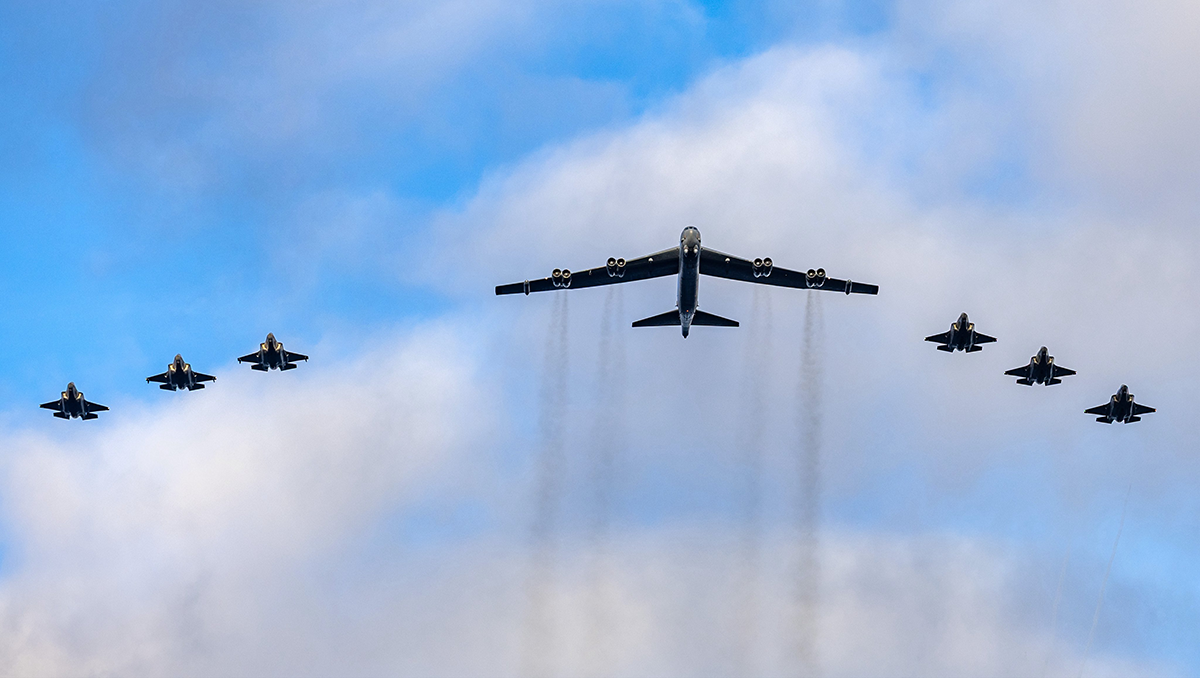
NATO Allies Conduct High North Escort Mission During US Nuclear Readiness Exercise
In a significant display of allied interoperability and strategic deterrence, British F-35B Lightning II fighter jets, operating from HMS Prince of Wales, and Norwegian F-35A Lightning II aircraft recently escorted a United States Air Force B-52 Stratofortress long-range strategic bomber over the High North. This joint mission took place as part of Exercise Global Thunder, an annual American nuclear readiness exercise.
The multinational formation was supported by a Royal Air Force (RAF) Voyager tanker aircraft, essential for extending the operational range of the fighter jets. The escort operation highlighted the coordinated efforts between NATO member states in defending the alliance’s northern flank, a region of increasing geopolitical importance.
HMS Prince of Wales, a Queen Elizabeth-class aircraft carrier, is currently deployed in the Arctic and North Atlantic as part of Operation Firecrest. This deployment, the second phase of the operation, sees the carrier operating under NATO command, accompanied by the Type 45 destroyer HMS Dauntless. The presence of the carrier strike group in these waters underscores the alliance’s commitment to maintaining a robust naval presence and projecting power in the High North.
United States Strategic Command (USSTRATCOM) describes Global Thunder as an annual exercise involving personnel and assets across its strategic enterprise, including its component and subordinate units. The stated objective of Global Thunder 27, the iteration during which this escort mission occurred, is “to enhance nuclear readiness and ensure a safe, secure, effective and credible strategic deterrent force.”
USSTRATCOM further clarified that Global Thunder is a regularly scheduled event, emphasizing that it “is not in response to actions by any nation, other actors or current world events.” The command also noted that, consistent with previous years, the exercise might involve “an increase in bomber and other aircraft flights throughout the exercise,” signaling a routine escalation of activity designed to test and validate operational procedures and readiness levels.
The United Kingdom’s participation in this American nuclear readiness exercise coincides with London’s preparations to re-establish an air-delivered nuclear role. The recent Defence Investment Plan confirmed the acquisition of twelve F-35A aircraft, a variant of the Joint Strike Fighter, and Britain’s formal entry into NATO’s nuclear mission. This move will restore an air-launched nuclear task to the Royal Air Force, a capability that was last held when the WE.177 free-fall nuclear bomb was withdrawn from service in 1998.
Further demonstrating an evolving nuclear posture and increased interoperability with allies, RAF Typhoons recently participated in Exercise Rummy over the Mediterranean. During this exercise, British Typhoons escorted French Rafale jets simulating a nuclear strike, marking the first time British forces have directly participated in a French nuclear exercise. These developments collectively indicate a renewed focus by the UK on its role within NATO’s broader nuclear deterrence framework.
Norway, a key partner in High North operations, operates a fleet of fifty-two F-35A aircraft from its Ørland and Evenes airbases. The close collaboration between Norway and the UK extends beyond air operations, with Norway frequently hosting Royal Marines for Arctic training and its naval forces working alongside the British carrier group throughout deployments such as Firecrest. This strong bilateral and multilateral cooperation is vital for NATO’s collective defense in the Arctic region, given Norway’s strategic geographical position.
Why This Matters
This joint escort mission during Exercise Global Thunder holds significant implications for international security, allied cohesion, and strategic deterrence. Firstly, it underscores the critical importance of the High North, a region increasingly contested due to melting Arctic ice opening new shipping routes, access to natural resources, and growing military presence, particularly from Russia. The coordinated actions of UK and Norwegian F-35s alongside a US strategic bomber demonstrate NATO’s resolve to defend its northern flank and project credible power in this strategically vital area.
Secondly, the exercise serves as a powerful display of NATO’s interoperability and collective defense capabilities. The seamless integration of air assets from different nations, operating from both land bases and an aircraft carrier, supported by an aerial refueling tanker, highlights the alliance’s ability to conduct complex, long-range operations. Such exercises are crucial for ensuring that allied forces can operate effectively together under various scenarios, reinforcing the principle of mutual defense.
Thirdly, the timing of the UK’s participation, concurrent with its re-entry into an air-delivered nuclear role, signals a significant evolution in its defense posture and its commitment to NATO’s nuclear deterrence mission. The acquisition of F-35A aircraft for this purpose and the recent participation in French nuclear exercises indicate a renewed emphasis on strategic capabilities and a broader contribution to alliance security, marking a substantial shift since the withdrawal of the RAF’s previous air-launched nuclear capability in 1998.
Finally, Exercise Global Thunder itself, as a US nuclear readiness exercise, sends an unambiguous message of deterrence. While USSTRATCOM states it is not in response to specific events, the regular demonstration of a “safe, secure, effective and credible strategic deterrent force” is fundamental to maintaining stability and preventing aggression. The involvement of key NATO allies in elements of this exercise amplifies the message that the alliance stands united and prepared to defend its interests and territories with a full spectrum of capabilities.