
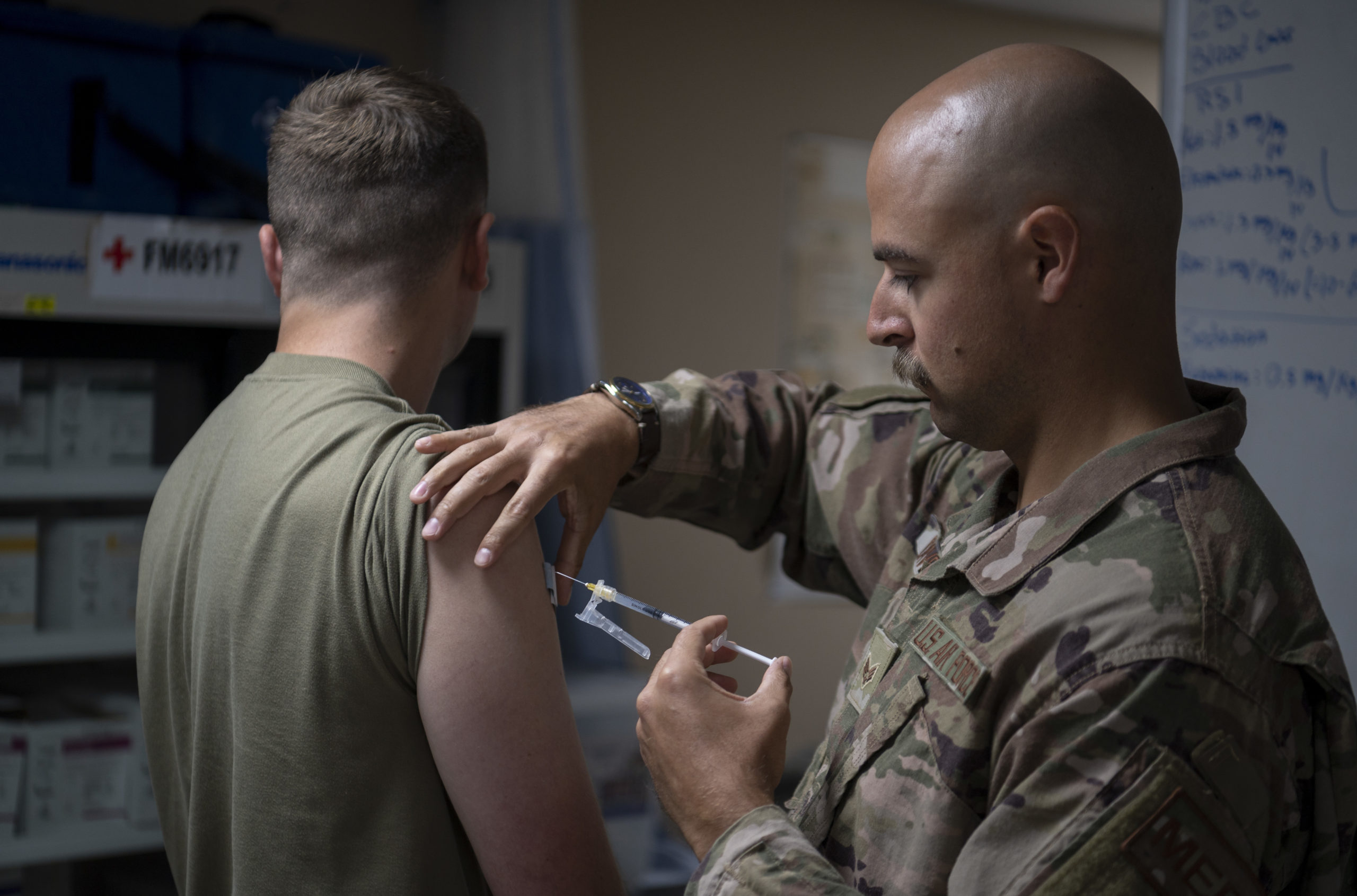
**Department of the Air Force Reinstates Mandatory Flu Vaccinations for Key Personnel Amid Readiness Concerns**
WASHINGTON D.C. – The Department of the Air Force (DAF) has reinstituted mandatory annual influenza vaccinations for specific categories of military and civilian personnel deemed “mission critical and high-risk populations.” This directive, detailed in an internal memo dated October 20, aims to “preserve force readiness” following a significant flu outbreak earlier this year at an Air Force basic training facility that resulted in one fatality.
The memo, signed by Assistant Secretary of the Air Force for Manpower and Reserve Affairs Richard Anderson, outlines six distinct population categories now required to receive annual seasonal influenza vaccinations. This policy change marks a partial reversal of a broader decision made in April by Defense Secretary Pete Hegseth, who had rescinded the general mandate for active-duty troops and trainees to receive the flu vaccine.
The categories mandated for vaccination include:
- Recruits, individuals in training environments, and personnel residing in congregate living facilities.
- Rapid deployment forces and those assigned to “no-fail” missions, where operational continuity is paramount.
- All deployed forces operating in various global theaters.
- Health care personnel who are in direct contact with patients or operate in medical facilities.
- Civilian personnel engaged in child development and youth services programs.
- Air Mobility Command aircrew members supporting U.S. Transportation Command taskings, enroute care personnel, and executive airlift personnel crucial for high-priority transportation missions.
The authenticity of the October 20 memo, which initially surfaced on an unofficial Air Force social media page, has been confirmed by an Air Force spokesperson. News of the directive was first reported by Air Force Times.
This new guidance emerges more than three months after a severe influenza outbreak at Joint Base San Antonio-Lackland, Texas, the primary site for Air Force Basic Military Training. The outbreak led to the death of one recruit and infected over 280 others, significantly disrupting training operations and raising concerns about communicable diseases within tightly packed military environments.
Under the new policy, service members in deploying units are instructed to align their vaccinations with their pre-deployment timelines. For all other personnel falling under the designated categories, vaccination must be completed annually by December 15. The memo explicitly states that for service members, “vaccinations are a requirement; failure to comply may result in administrative or disciplinary action under the Uniform Code of Military Justice.” However, it also advises commanders to consider applying the “lowest level of discipline,” taking into account the specific circumstances of noncompliance and the individual’s disciplinary history.
For civilian employees within the identified populations, compliance with the flu vaccination requirement is considered a condition of employment. The memo advises supervisors against taking immediate adverse action but instead to address noncompliance through established channels, consulting with the “Civilian Personnel Section/Human Resources in coordination with Labor and Employee Relations.”
The DAF’s move represents a distinct pivot from the broader policy announced by Defense Secretary Pete Hegseth in April. At that time, Hegseth publicly stated that he was rescinding the general mandate for annual flu vaccines across the military, arguing in a social media video that “the notion that a flu vaccine must be mandatory for every service member, everywhere, in every circumstance at all times is just overly broad and not rational.” The Pentagon subsequently approved the Department of the Air Force’s exception-to-policy request on June 11, paving the way for the recent mandate.
According to the memo, the DAF sought this exemption from the voluntary policy specifically “to protect mission-critical and high-risk populations.” The document underscores that “the mandatory vaccination for these select groups [is] deemed essential to preserve force readiness, prevent illness, minimize lost duty days, and ensure the successful execution of DAF missions.”
The policy includes provisions for individuals to request religious accommodations and medical exemptions from the flu vaccine mandate. Personnel whose requests are denied will be granted an opportunity to comply with the vaccination requirements. Furthermore, the memo offers detailed descriptions of each population category, clarifying specific instances where personnel might be excluded from the requirement. For example, individuals in the “recruits, training populations, and congregate living” category are exempt if they are assigned to single-occupancy dorm rooms, such as permanent party, unless their duties routinely place them in high-risk environments. Similarly, Air University and other non-technical training organizations primarily focused on professional military education, doctrine, or graduate studies are not included solely based on their resident education programs.
The exact percentage of Department of the Air Force military and civilian personnel affected by this renewed mandate remains unconfirmed. However, the context of previous vaccination rates highlights the potential impact. Following Secretary Hegseth’s decision to make the flu shot optional, only approximately 40 percent of Air Force trainees opted to receive it, according to an Associated Press report. This figure is slightly below the 46.5 percent of American adults who received the flu shot during the past flu season, as reported by the Centers for Disease Control and Prevention (CDC).
This policy change occurs against a backdrop of increasing vaccine hesitancy in recent years, a trend intensified by the COVID-19 pandemic. A previous mandate in 2021 requiring all service members to receive COVID-19 vaccinations generated significant political debate and ultimately led to the separation of around 8,000 service members who refused the Pentagon’s directive. While the Pentagon has since taken steps to facilitate the return of some of these separated individuals, the underlying tensions between individual choice and military health requirements persist.
**Why This Matters**
The Department of the Air Force’s decision to reinstate mandatory influenza vaccinations for specific personnel categories carries significant implications for military readiness, public health, and the broader debate over individual liberties within a uniformed service. This move underscores the critical balance military leadership must strike between ensuring the health and operational capability of its forces and respecting individual choices, especially in an era of heightened vaccine skepticism.
**Military Readiness and National Security:** The primary justification cited by the DAF—”to preserve force readiness, prevent illness, minimize lost duty days, and ensure the successful execution of DAF missions”—highlights the direct link between troop health and national security. Widespread outbreaks of preventable diseases like influenza can severely degrade the ability of military units to deploy, train, or sustain operations. The incident at Joint Base San Antonio-Lackland, which led to a fatality and hundreds of infections, serves as a stark reminder of how quickly a common illness can impact personnel availability and training pipelines, jeopardizing the foundational strength of the Air Force.
**Policy Precedent and Adaptation:** This partial reinstatement is a notable reversal of Defense Secretary Hegseth’s earlier, broader decision to make flu vaccines optional. It demonstrates that while overarching policies may be established, military branches can successfully argue for exceptions based on specific operational needs and risk assessments. This sets a precedent for how future health mandates might be tailored, focusing on “mission-critical” populations rather than universal application, particularly when faced with concrete threats to operational capability.
**Public Health Implications:** Military health policies do not exist in a vacuum. Large, mobile populations like service members, especially those deploying internationally or interacting with local communities, can influence broader public health. Preventing outbreaks within the military helps to contain the spread of diseases, reducing the risk of transmission to civilian populations both domestically and abroad. This is particularly relevant for healthcare personnel and those working with vulnerable populations like children, who are included in the mandate.
**Individual Rights Versus Collective Duty:** The reintroduction of a mandate, even a targeted one, reignites the complex ethical and legal debate surrounding individual autonomy versus the collective good within the military. Service members, by taking an oath, accept certain limitations on their personal freedoms for the sake of mission accomplishment and unit cohesion. However, the strong sentiments around vaccine mandates, amplified by the COVID-19 experience and the separation of thousands of service members, indicate that these decisions are not without controversy. The provisions for religious and medical exemptions, alongside the guidance for “lowest level of discipline,” reflect an attempt to balance these competing interests.
**Leadership and Trust:** For military leadership, navigating vaccine policies requires careful communication and transparency to maintain trust among service members and their families. The memory of the COVID-19 vaccine mandate’s fallout, including separations and subsequent efforts to allow returns, means that any new mandate is viewed through a lens of skepticism by some. The DAF’s explicit justification based on readiness and the targeted nature of this mandate are crucial elements in rebuilding or maintaining that trust.
Ultimately, the Department of the Air Force’s updated flu vaccine policy is a pragmatic response to a demonstrated threat to its personnel and operational readiness. It reflects the ongoing challenge of managing public health within a military context, balancing individual concerns with the imperative to maintain a healthy, deployable force capable of executing its global missions.