
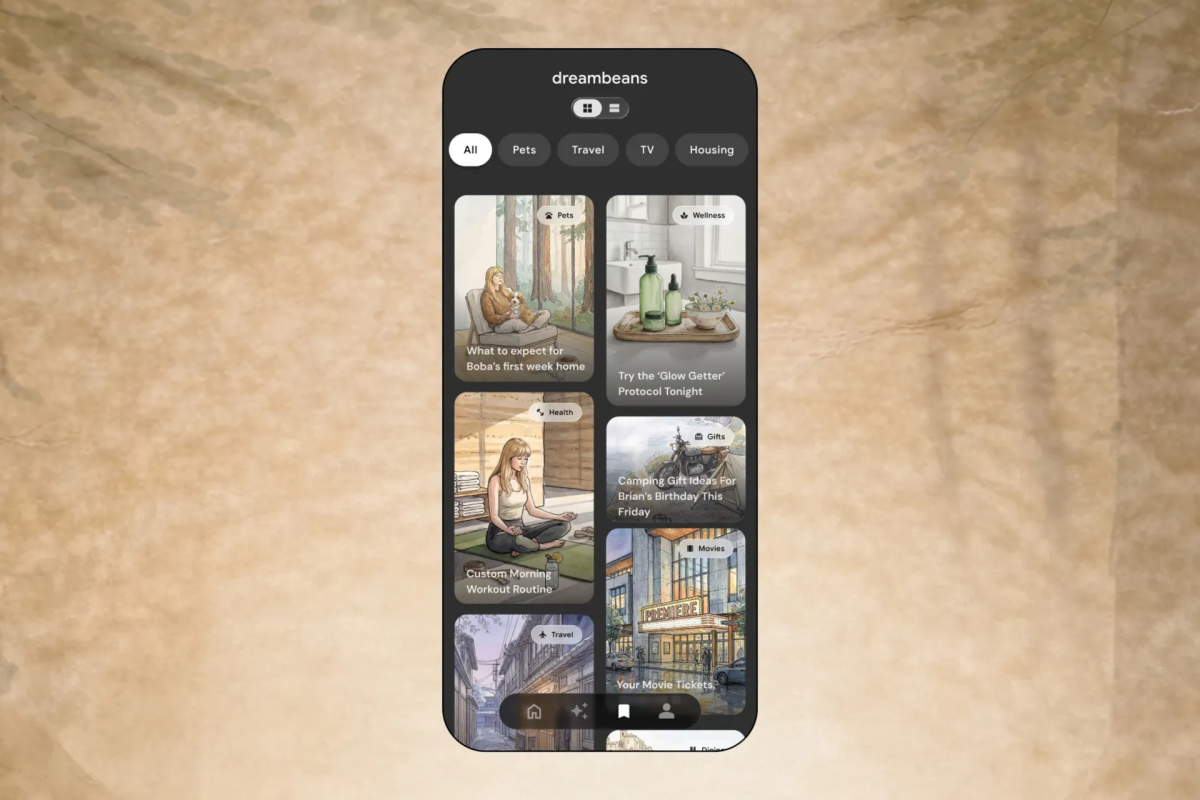
Google has launched its experimental AI app Dreambeans in India, its first market outside the U.S., as the company looks to tap the world’s second-largest internet market to bring personalized visual stories drawn from users’ digital activity to a broader audience.
**Key Takeaways:**
* **Global Expansion & Strategic Market:** Google’s experimental AI app, Dreambeans, has launched in India, marking its first international market beyond the U.S., signaling a strategic move to leverage India’s vast internet user base.
* **Proactive Personalized Storytelling:** Dreambeans autonomously generates personalized visual stories, complete with AI-generated illustrations and even animations via Veo, by drawing data from connected Google services like Gmail, Photos, and Calendar, requiring no user prompts.
* **Balancing Innovation with Privacy & Local Needs:** While offering extensive user controls over data access and content, the app faces challenges in privacy perception and linguistic limitations in a multilingual market like India, where mixing languages is common.
Google Dreambeans: Weaving AI Stories in India
Google’s ambitious foray into personalized artificial intelligence has taken a significant step forward with the international launch of its experimental AI app, Dreambeans, in India. This move positions the world’s second-largest internet market as the crucial testing ground for Google’s vision of ambient, proactive AI that crafts visual narratives from users’ digital lives. The expansion, less than two months after its wider U.S. rollout, underscores Google’s commitment to leveraging India’s vast and diverse user base for its next-generation AI innovations.
Available on both Android and iOS, Dreambeans now supports 13 Indian languages, including Hindi, Punjabi, Tamil, Telugu, and Bengali, alongside English. This comprehensive language support highlights Google’s intent to localize its AI experience for a market renowned for its linguistic diversity and high adoption of digital services.
The Magic Behind the Beans: What is Dreambeans?
Introduced initially in June, Dreambeans is an AI-powered application designed to create personalized, illustrated stories about users’ interests and daily activities. Its unique selling proposition lies in its proactive nature: unlike most generative AI tools, Dreambeans doesn’t require users to enter prompts. Instead, it intelligently sifts through information from connected Google services such – Calendar, Gemini, Gmail, Photos, Search, and YouTube – to automatically generate these narratives.
Initially, these stories featured static, AI-generated illustrations. However, Google has since enhanced the app by integrating its advanced Veo video-generation model, enabling select stories to come alive with animated images, further enriching the storytelling experience. This seamless integration across Google’s ecosystem aims to offer a deeply personal and effortless content creation experience.
Why India? A Strategic Beachhead for AI
Google’s decision to select India as Dreambeans’ inaugural international market is far from arbitrary. Product manager Gozde Oznur revealed during a press briefing that India stood out due to strong user interest, the widespread adoption of Google’s services across the country, and a significant overlap of users across key platforms like Gemini, Gmail, and Google Photos. This confluence of factors makes India an ideal environment to test and refine a product that relies heavily on integrated digital activity.
The sheer scale of India’s internet population, coupled with its rapid digital transformation, presents an unparalleled opportunity for Google to gather diverse user feedback and iterate on Dreambeans’ capabilities in a dynamic, high-growth environment. The ability to cater to such a wide array of local languages from the outset also demonstrates Google’s understanding of market nuances and its ambition for truly global AI adoption.
Early Traction and the Competitive Landscape
While the U.S. launch provided initial insights, Dreambeans’ journey has seen mixed results in terms of downloads. According to market intelligence firm Sensor Tower, the app recorded nearly 55,000 downloads in the U.S. since its June debut. A significant 63% of these downloads occurred in September, coinciding with its broader availability to all eligible U.S. users aged 18 and older. However, October saw an 84% month-over-month drop, settling at around 5,500 downloads.
Comparing Dreambeans to other prominent AI apps during their first 30 days post-launch reveals its niche positioning. While Meta’s Muse boasted 7.4 million downloads, ChatGPT saw 2.8 million, Grok Bot 362,000, and Claude 155,000, Dreambeans lagged with an estimated 29,000 downloads. This disparity highlights a crucial difference: Dreambeans is not a general-purpose AI chatbot but rather a specialized tool focused on personalized story generation, appealing to a specific segment of users interested in curated digital memories rather than broad query responses. Its success will likely be measured differently, focusing on engagement and retention within its target niche rather than sheer download volume.
Navigating Linguistic Nuances and Privacy Concerns
Despite the extensive language support, Dreambeans currently allows users to select only one language at a time for story generation. This poses a potential limitation in India, where multilingualism, particularly the fluid mixing of languages like Hindi and English (often dubbed ‘Hinglish’), is common. As Oznur explained, while the app can draw information from Google services in multiple languages, it cannot yet generate stories that blend them. This constraint could impact its broader appeal in a country where code-switching is a daily reality for millions.
Beyond language, Dreambeans’ deep integration with users’ Google accounts naturally raises questions about privacy and data access. The app leverages Google’s “Personal Intelligence” technology to tap into services like Gmail, Photos, and Calendar – repositories of highly sensitive personal information. While this enables hyper-personalization, it also necessitates trust and transparent user controls.
Google addresses these concerns by emphasizing user agency. Oznur affirmed that users retain control over which Google services connect to Dreambeans and can disconnect them at any time. Furthermore, users can delete their Dreambeans data from within the app, and information removed from underlying connected services is also purged from Dreambeans’ personalization system. The app also allows users to instruct it to avoid certain subjects, such as business-related information, and is restricted to personal Gmail accounts, not enterprise users, with generated stories visible only to the account holder.
However, the proactive nature of Dreambeans also carries the inherent risk of surfacing potentially upsetting memories. Oznur acknowledged that stories could, for instance, involve deceased individuals. She likened the app’s control features to those in Google Photos, where users can manage which memories appear, offering a mechanism to mitigate such sensitive instances.
The Road Ahead: Actionable AI
Looking to the future, Google is exploring ways to evolve Dreambeans beyond mere personalized stories. Oznur hinted at plans to make the app “more actionable,” transitioning from recommendations and narratives to actively helping users act on the app’s suggestions. This could imply deeper integration with other Google services to facilitate tasks directly inspired by the generated stories, marking a step towards truly ambient and assistive AI.
The launch of Dreambeans in India is more than just an app release; it’s a strategic experiment in Google’s broader AI ambitions. It represents a tangible step towards a future where AI isn’t just a tool for specific queries but an intelligent, ever-present assistant that understands and anticipates our lives, transforming our digital footprints into meaningful narratives and potentially, actionable insights. The success in a complex, diverse market like India will undoubtedly shape the global trajectory of personalized AI.
Bottom Line
Google’s Dreambeans brings a novel approach to personalized AI storytelling to India, showcasing a future where technology proactively curates our digital lives into engaging narratives. While its deep integration with Google services offers unparalleled personalization, successfully navigating the complexities of data privacy, user trust, and nuanced linguistic demands in a market like India will be crucial to its long-term viability and its role in Google’s grander vision for ambient, assistive artificial intelligence.
When you purchase through links in our articles, we may earn a small commission. This doesn’t affect our editorial independence.
{content}
Source:{feed_title}