
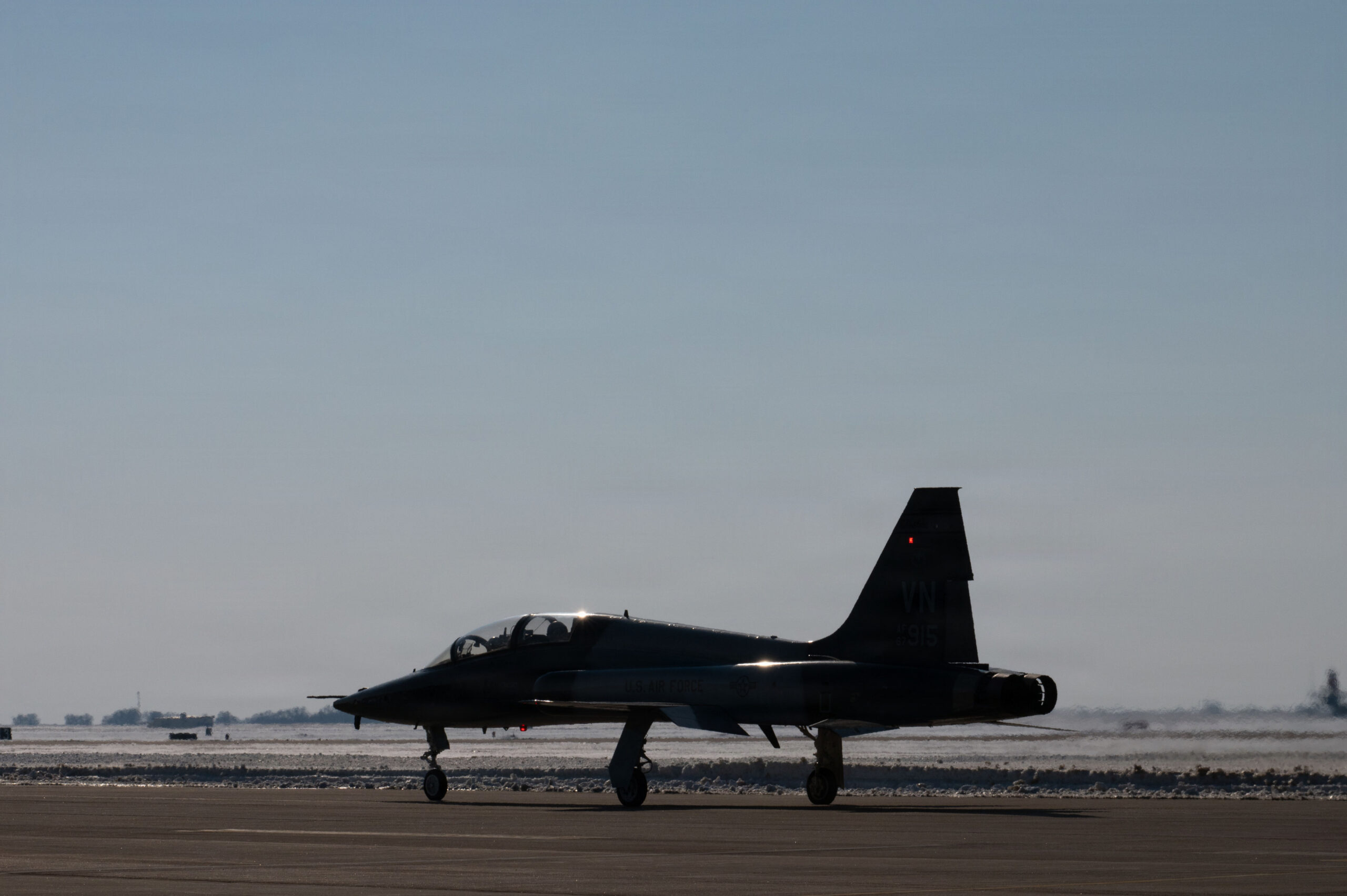
A critical maintenance oversight, specifically an improperly installed pin in a horizontal stabilizer, has been identified as the root cause of a U.S. Air Force T-38 Talon trainer jet crash in May, according to a detailed accident report released on October 30. The malfunction led to a weekslong suspension of flights for the T-38 fleet across various commands.
The investigation, conducted by the Air Force Accident Investigation Board, concluded that when the pin became disengaged during flight, it introduced a minute amount of instability, or “play,” into the system. This seemingly minor issue escalated rapidly, triggering severe aerodynamic flutter that ultimately caused both of the jet’s horizontal stabilizers to tear away from the aircraft. The T-38 was destroyed upon impact, resulting in an estimated loss of $11.3 million. Remarkably, both the U.S. Air Force instructor pilot and the international student pilot onboard successfully ejected from the crippled aircraft, sustaining only minor injuries.
Investigators pinpointed the responsibility for the catastrophic failure to contract personnel providing maintenance services for the T-38 fleet at Columbus Air Force Base, Mississippi. The report states that these contractors failed to conduct a mandatory check for “play” or “backlash” after installing a new actuator — a component crucial for stabilizer control — during unscheduled maintenance in the weeks preceding the crash. Furthermore, their supervisors were found to have overlooked this critical omission.
The president of the Accident Investigation Board emphasized the multiple opportunities missed to detect the error: “The contractors signing off the actuator installation, the work center supervisor, the Impoundment Official, Quality Assurance personnel, and the Impoundment Release Authority had the opportunity and capability to identify this missing required check, but did not.” The report unequivocally cleared the flight crew of any responsibility or contribution to the mishap.
The Critical “Tenth of an Inch”
The T-38’s horizontal stabilizers are essential for controlling the aircraft’s pitch, or its nose-up and nose-down motion. This control is facilitated by two actuators, one on each side, which work in opposition to twist internal steel torque tubes. This system is designed to keep the stabilizers under constant tension, preventing any unwanted movement or flutter.
According to technical documentation reviewed by investigators, even a tiny amount of looseness — specifically, more than 0.1 inches of “play” or “backlash” — in an actuator is enough to compromise this delicate balance. When this occurs, the torque tubes can lose their necessary tension, allowing the stabilizers to begin fluttering. The accident report described flutter as “an aerodynamic feedback loop where fast-moving air increasingly shakes an aircraft structure until it breaks,” a phenomenon that proved fatal for the T-38.
This precise scenario unfolded just before noon on May 12. The T-38 was part of a four-aircraft formation that had departed Columbus Air Force Base for a fighter-bomber fundamentals training sortie. As the group initiated a G-warmup turn, the instructor and student in the affected jet reported hearing a loud noise, immediately followed by intense shuddering. The student pilot experienced “strong vibrations and negative G, with the [student pilot] being lifted out of his seat,” according to the report.
The instructor pilot swiftly assumed control, attempting to level the aircraft. However, the cacophony of noises and violent shudders persisted, culminating in an “uncommanded pitch downwards with a spike in negative G.” Despite the instructor pulling the control stick fully back, the aircraft continued its uncontrolled descent, a clear indication that the horizontal stabilizers had detached. While the instructor pilot’s ejection was seamless, the student pilot’s leg restraints were found twisted, leading to reported pain in his left calf. The aircraft itself crashed in a rural area of Alabama, becoming a fiery wreck upon impact.
Maintenance Lapses Identified
The investigation revealed that the T-38 in question had been impounded approximately one month before the crash due to an “uncommanded 130-degree roll to the right.” During troubleshooting, maintenance personnel removed and reinstalled the aft fuselage, or “boattail.” It was then discovered that the right horizontal stabilizer’s range of motion, or “travel,” was outside specified limits.
Maintainers initially performed a backlash check on the right stabilizer. However, they subsequently determined that the left stabilizer’s actuator also exhibited “excessive play.” Although this actuator was removed, repaired, and reinstalled, the investigation found a critical procedural failure: personnel never conducted a follow-up backlash test on the left stabilizer after its reinstallation. Instead, maintenance teams proceeded with checks for the stabilizers’ overall travel limits and, after completing a few other minor repairs, released the T-38 from impound. On May 1, the aircraft successfully completed a restricted check flight, seemingly without issue.
While the accident investigation board did not definitively ascertain why the essential backlash check was omitted, it unequivocally attributed the lapse to systemic “compliance failures” across the entire maintenance team. Analysis conducted by the Air Force Research Laboratory on recovered components, including bolts, nuts, and pins, confirmed that these parts failed due to the extreme “overload” caused by the aerodynamic flutter. Notably, investigators were unable to recover the aft actuator pin for the left horizontal stabilizer. However, the fact that its “nut and stud remained riveted … with intact threads” led investigators to surmise that this particular pin had likely been under-torqued, allowing it to loosen during flight. The report did not offer a specific explanation for the presumed under-torquing of the pin.
Fleet-Wide Operational Pause
In the wake of the May 12 crash, the Air Force initiated a fleet-wide operational pause for all T-38 Talon trainer jets a week later, on May 19. This measure impacted units within Air Education and Training Command, Air Combat Command, Air Force Materiel Command, and Air Force Global Strike Command. The pause was a precautionary step to ensure the safety and integrity of the entire fleet.
The operational pause was lifted on May 28, following the commencement of detailed inspections across all T-38 aircraft. The Air Force aimed to return the jets to flight operations within days of the inspections. No further public updates regarding the comprehensive inspection findings or the full return-to-flight status have been provided since that time. The T-38, a supersonic trainer first introduced in the 1960s, serves as a foundational aircraft for training future fighter and bomber pilots. Its advanced age is frequently cited by Air Force officials as a significant factor in maintenance challenges, reinforcing the urgent need for its replacement by the modernized T-7A Red Hawk advanced trainer.
Why This Matters
The crash of the T-38 Talon and the subsequent findings of the accident investigation board hold significant implications beyond the loss of a single aircraft. Firstly, it underscores the critical importance of rigorous adherence to maintenance protocols in aviation, particularly within military operations where aircraft endure extreme stresses. The identification of a missed “backlash check” and an improperly installed, potentially under-torqued pin highlights that even seemingly minor procedural failures can have catastrophic consequences, jeopardizing both personnel and expensive assets.
Secondly, the incident raises questions about the oversight and accountability within contract-based maintenance programs. With an increasing reliance on private contractors for military aircraft upkeep, the Air Force must ensure robust quality assurance mechanisms are in place and that both contractor personnel and their supervisors meet the highest standards of diligence and compliance. The board’s finding that multiple individuals “had the opportunity and capability to identify this missing required check, but did not” points to a systemic issue that demands review and corrective action to prevent future occurrences.
Thirdly, this event brings into sharp focus the challenges associated with operating an aging military fleet. The T-38, a reliable workhorse since the 1960s, is nearing the end of its operational life. The incident reinforces the Air Force’s stated need to transition to newer platforms like the T-7A Red Hawk. Maintaining older aircraft can lead to increased costs, more frequent and complex maintenance, and a higher risk of component failures, ultimately impacting pilot training schedules and overall operational readiness. The $11.3 million loss of this T-38 represents not just the cost of the aircraft itself, but also the disruption to pilot training and the potential for lost operational hours across the fleet during the pause.
Finally, the successful ejection of both pilots, albeit with minor injuries, is a testament to the safety systems built into these aircraft. However, the near-fatal outcome serves as a stark reminder of the inherent dangers of military aviation and the absolute necessity of flawless execution at every stage, from design and manufacturing to maintenance and flight operations. Transparent investigations like this are crucial for learning from mistakes, implementing necessary reforms, and maintaining public trust in military aviation safety.