
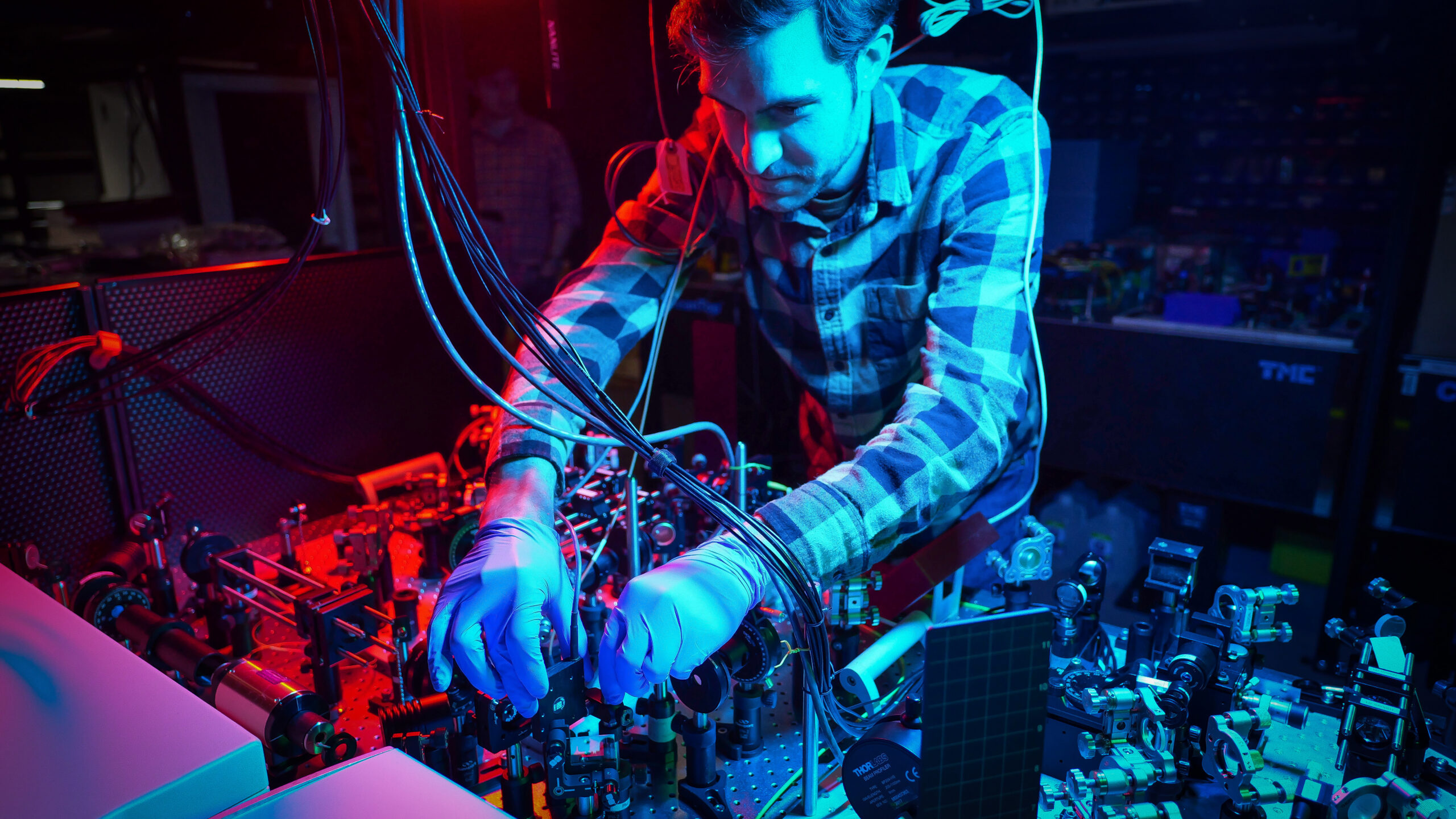
The Air Force Research Laboratory (AFRL) has awarded quantum computing firm IonQ a $7.5 million follow-on contract aimed at advancing quantum technology from tightly controlled laboratory environments to more practical, field-ready applications. The contract represents a significant step in the U.S. Air Force’s long-term strategy to leverage quantum capabilities for national security.
Announced in late October, this award builds upon previous work undertaken by IonQ for AFRL at the lab’s extreme computing facility in Rome, New York. It forms part of a larger, multi-phased contract, initially valued at $21.1 million, which commenced previously. This new agreement specifically covers Phase 2 of the program.
Under Phase 2, IonQ is tasked with developing critical optical, hardware, and software components. These elements are designed to contribute to an “operational, interoperable research platform,” according to a company statement. The goal is to create a system that researchers can use to validate foundational protocols and establish the technical conditions necessary for building a fully interoperable, multi-node quantum research environment in the future.
Donald A. Telesca Jr., chief of AFRL’s Quantum Information Sciences and Technology Branch, emphasized the importance of this phase. In an email to Air & Space Forces Magazine, Telesca stated that integrating the full stack of quantum capabilities at the Rome location “serves as a critical steppingstone” within the lab’s broader roadmap toward developing a “multi-node quantum research platform.”
AFRL has dedicated the past decade to research in quantum networking and computing, primarily within a laboratory setting. While the system currently under development through this new contract is not intended for immediate operational deployment, its design and testing are explicitly oriented toward achieving that eventual goal of practical application.
Telesca explained, “These incremental enhancements allow our researchers to validate foundational protocols now, setting the technical conditions required to build a fully interoperable, multi-node research environment in the future.”
The strategic interest in quantum networks stems from their potential to address limitations inherent in traditional communication and data networks, particularly in modern warfare scenarios that generate vast quantities of data. Unlike classical networks, which distribute readable information across global servers, quantum networks aim to distribute entanglement—a fragile physical correlation between two or more quantum systems that cannot be copied or broadcast.
To understand this distinction, traditional computing systems utilize “bits” to process and transmit information, representing either a 0 or a 1. Quantum computing, conversely, employs “qubits.” Qubits possess unique properties, allowing them to exist in multiple states simultaneously: as a 0, a 1, or a “superposition” of both. Entanglement is a key quantum phenomenon, described by consulting firm Ernst & Young as “a property that allows two qubits to be ‘linked’ together beyond what is possible in classical systems.”
This quantum link is anticipated to offer several advantages, including potentially unbreakable encryption, highly secure communications, and robust data transfer capabilities for various applications, including those on the battlefield. A concept known as quantum teleportation is central to this vision. Telesca clarified, “Rather than moving physical particles or transmitting traditional messages, quantum teleportation transfers fragile quantum states between distant nodes using shared entanglement alongside classical communication signals.”
In April, IonQ announced a significant breakthrough: the first successful demonstration of connected, commercial quantum computers. This achievement involved photonically linking two independent trapped-ion quantum systems, effectively allowing two quantum computers to communicate using light rather than traditional electrical or physical network cables. This advancement could pave the way for constructing a scalable quantum network, potentially overcoming some of the physical limitations associated with wired networking.
However, as Telesca noted, the quantum link, particularly entanglement, is inherently fragile. This fragility poses a significant challenge when attempting to transition quantum technology from controlled laboratory settings to real-world applications. Issues such as synchronization difficulties, signal loss over distance, and various forms of environmental noise all complicate the operationalization of quantum systems.
“Moving entanglement distribution out of tightly controlled laboratory environments and onto existing, real-world telecom and open-air infrastructure is essential for proving practical viability,” Telesca emphasized.
To address these challenges, AFRL and IonQ are concentrating on developing quantum technology that can integrate with established networks and then scale to multi-nodal configurations in the future. Travis Pyne, IonQ’s director of technical program management, explained in an email to Air & Space Forces Magazine that “compatibility with established telecommunications wavelengths is important for integrating quantum technologies with existing optical networks.” He added, “Supporting conversion to common telecom wavelengths provides greater flexibility to connect different types of quantum hardware. Improvements in network interfaces can also simplify integration across multiple nodes.”
Connecting quantum technology using both standard telecom fiber optics cables and open-air links would enable the Pentagon to establish links between quantum processing units, according to Telesca. Such capabilities could facilitate the synchronization of atomic clocks for high-precision timing and the linking of quantum sensors across extensive geographic areas, offering unprecedented levels of precision and coordination.
The new Phase 2 award specifically funds the development of several key components necessary for testing how different quantum elements interact outside a pristine lab environment. These include:
- Free-Space Optical Links:An advanced optical system equipped with automatic pointing, acquisition, and tracking capabilities, designed to enable entanglement distribution over secure, line-of-sight quantum channels within the C-band spectrum.
- Quantum Frequency Converters:Two quantum frequency converter modules engineered to ensure interoperability across diverse quantum and classical hardware, leveraging standard telecom wavelength infrastructure.
- Automated Control Software:On-premises control-plane software upgrades that support automated self-tests, real-time monitoring, failure handling, experiment execution, and automated results export.
- Upgraded Hardware Modules:O-band-compatible network hardware, enhanced polarization controls, and upgraded quantum network interface cards.
Source: IonQ
While company officials did not disclose specific proprietary details about the components being provided, Pyne highlighted the crucial role of IonQ’s automated control software. This software, which manages real-time monitoring, self-tests, and failure handling, is considered “essential” for potentially making quantum networks practical for broader use beyond the laboratory setting. “These capabilities help operators identify problems earlier and simplify routine maintenance,” Pyne noted. “Ultimately, the goal is to make quantum networks easier to operate and more accessible to a broader range of users and organizations.”
Why This Matters
The collaboration between the Air Force Research Laboratory and IonQ on advanced quantum networking is a pivotal development with far-reaching implications across national security, technological innovation, and scientific research. This effort represents a concentrated push to transition quantum technologies from theoretical concepts and controlled experiments into functional, interoperable systems that could redefine critical infrastructure.
For **national security and defense**, the successful development of quantum networks promises a paradigm shift in secure communications and data integrity. The ability to distribute entanglement rather than traditional information could lead to inherently unbreakable encryption, safeguarding sensitive military communications and intelligence from even the most sophisticated adversaries. This offers a robust defense against eavesdropping and cyber threats, providing a crucial advantage in modern geopolitical landscapes. Furthermore, linking quantum sensors across vast areas could enable unprecedented precision in navigation, surveillance, and early warning systems, enhancing situational awareness for military operations.
From a **technological and economic perspective**, this initiative accelerates the race to establish quantum capabilities. Government investment in firms like IonQ fuels innovation, fosters the growth of a nascent high-tech industry, and creates specialized jobs. The advancements in optical links, frequency converters, and automated control software are not merely military applications; they push the boundaries of quantum engineering, with potential spillover benefits for commercial sectors requiring ultra-secure communications, high-precision timing, and advanced sensing, such as finance, healthcare, and logistics. It lays foundational groundwork for a potential future “quantum internet,” much like early government investments in ARPANET paved the way for the internet we know today.
For **scientific research**, moving entanglement distribution out of labs and into real-world infrastructure provides invaluable data and challenges. It allows researchers to test and refine foundational quantum protocols under complex, noisy conditions, deepening our understanding of quantum mechanics and its practical applications. The insights gained from overcoming environmental fragility and ensuring interoperability will inform future quantum computing and networking architectures globally. This project validates theoretical concepts, pushing the boundaries of what is technologically feasible and opening new avenues for scientific inquiry and discovery.
In essence, this contract is not just about a single technological advancement; it is about strategically positioning the United States at the forefront of quantum technology, securing its future defense capabilities, fostering a new wave of innovation, and expanding humanity’s scientific and technological horizons.