
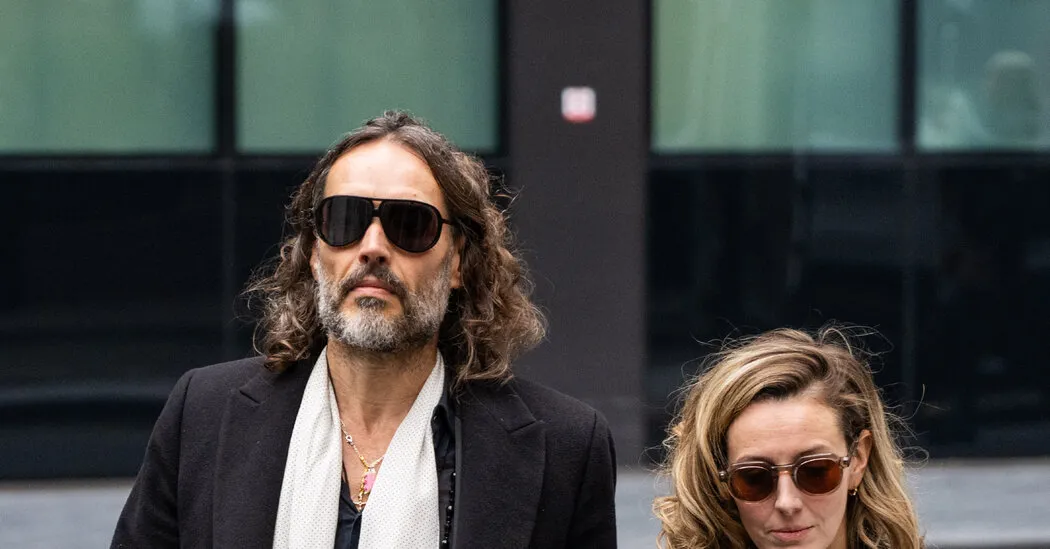
London, UK – Russell Brand, the prominent British comedian, actor, and YouTuber, was found guilty on Thursday of multiple charges of rape and sexual assault by a jury in London. The verdict followed a three-week trial that captivated public attention, bringing to light accusations spanning a decade of Mr. Brand’s career.
The jury delivered its decision after deliberating on seven criminal counts brought against Mr. Brand, 51. He was convicted of four of these counts and acquitted of the remaining three. The presiding judge indicated that Mr. Brand would receive a “significant” custodial sentence during a hearing scheduled for Monday, underscoring the gravity of the offenses.
What were the charges?
Prosecutors had initially accused Mr. Brand of three counts of rape, three counts of sexual assault, and one count of indecent assault. During the trial proceedings, the charge of indecent assault was amended by the judge to attempted indecent assault, citing insufficient evidence to support the original charge.
These serious allegations involved six different women and related to incidents that reportedly occurred between 1999 and 2009. This period coincided with Mr. Brand’s ascent to stardom in Britain, during which he achieved widespread recognition as a successful stand-up comedian and a popular host on television and radio. Throughout the legal process, Mr. Brand maintained his innocence, pleading not guilty to all charges.
What was he found guilty of?
On Thursday, the jury delivered unanimous guilty verdicts on four specific charges: one count of rape and three counts of sexual assault. The convictions are detailed as follows:
He was found guilty of anally raping a woman in 2009. The victim testified in a police interview that she had gone to Mr. Brand’s residence with the expectation of consensual vaginal sex, but that Mr. Brand subsequently forced her to engage in anal sex.
Mr. Brand was convicted of sexually assaulting a second woman at a radio station sometime between 2004 and 2005. This woman stated that Mr. Brand had kissed and groped her in the presence of others.
He was also found guilty of sexually assaulting a third woman. This incident involved Mr. Brand groping her breasts at a bar in 2004.
Furthermore, Mr. Brand was convicted of sexually assaulting a fourth woman, who was a professional colleague. The woman recounted that in 2009, Mr. Brand had placed his head in her groin area after insisting on giving her a massage.
What was he found not guilty of?
Conversely, Mr. Brand was acquitted of two other counts of rape and the single count of attempted indecent assault, demonstrating the jury’s detailed consideration of each specific charge:
Despite being found guilty of sexually assaulting the woman he met at a bar in 2004, the jury found him not guilty of orally raping her during a separate alleged incident.
He was found not guilty of raping a fifth woman, who had alleged that Mr. Brand raped her in rented accommodations during a British political party conference in 1999.
The jury also acquitted him of attempted indecent assault, a charge relating to a sixth woman. This woman had accused Mr. Brand of attempting to pull her into a bathroom in 2001 after they met in the offices of a television company.
What did Russell Brand say in his defense?
Throughout the legal proceedings, Mr. Brand consistently denied all seven charges. Prior to the trial, he also addressed the accusations in a video posted on his YouTube channel, refuting the claims made against him. During the trial’s third week, Mr. Brand took the stand to present his defense. He informed the court that while he acknowledged having dedicated much of his life to “beyond reckless philandering,” he adamantly asserted that he had never engaged in non-consensual sexual activity.
Reflecting on his past fame and behavior, Mr. Brand admitted to having “misused that commodity very, very selfishly.” However, he stressed the paramount importance of consent, describing it as “fundamental, essential, necessary.”
Mr. Brand further testified that the accusations had inflicted a “devastating” toll on his life. He concurred with a lawyer’s observation that former friends who might have offered testimony in his defense were now unwilling to associate with him. Notably, his wife, Laura Brand, was the only individual to provide in-person evidence in his defense.
What happens next?
Following the jury’s verdict, Mr. Brand’s sentencing hearing has been scheduled for Monday. The judge, Joel Bennathan, explicitly stated that Mr. Brand would be sentenced to “significant custodial time,” indicating a substantial prison term. Under British sentencing guidelines, the maximum penalty for rape is life imprisonment, although a typical prison sentence for such offenses ranges from four to 19 years, depending on various aggravating and mitigating factors.
Mr. Brand’s legal team retains the right to appeal the convictions. In accordance with British law, the women who came forward to accuse Mr. Brand are entitled to lifelong anonymity, protecting their identities from public disclosure. This verdict may not mark the end of Mr. Brand’s legal challenges. A spokeswoman for London’s police confirmed in a statement released after the verdicts that officers had questioned Mr. Brand regarding two additional accusations of rape, and files pertaining to these claims have been submitted to prosecutors. Furthermore, Mr. Brand has reportedly faced a civil action in the United States related to his past sexual behavior. His legal team has not yet issued an immediate response to requests for comment regarding these potential future actions.
Why This Matters
The conviction of Russell Brand carries significant weight, extending beyond the individual case to touch upon broader societal, legal, and cultural implications. Firstly, it underscores the evolving landscape of accountability for public figures, particularly in the wake of movements like #MeToo. For decades, the fame and influence of celebrities often shielded them from scrutiny regarding alleged misconduct. This verdict, alongside similar high-profile cases globally, signals a growing willingness within the justice system and society at large to hold powerful individuals responsible for their actions, challenging the notion that celebrity status confers immunity.
Secondly, this case highlights the critical importance of victim testimony and the judicial process in addressing sexual offenses. The courage of the six women who came forward, enduring intense public and legal scrutiny, is central to the outcome. Their ability to secure convictions, even for incidents that occurred years ago, reinforces the message that survivors can be heard and believed, potentially empowering others to report similar experiences. It also demonstrates the persistent efforts of law enforcement and prosecutors to pursue justice, even when cases involve complex evidence and a significant time lapse.
Thirdly, Brand’s conviction contributes to the ongoing global dialogue about consent, power dynamics, and sexual boundaries. His defense, acknowledging “reckless philandering” while denying non-consensual acts, brings the nuance of consent directly into public discourse. The jury’s verdict serves as a legal affirmation of what constitutes non-consensual behavior, irrespective of an individual’s fame or the social context of the time. This helps to clarify and reinforce societal norms around respectful interaction and bodily autonomy.
Finally, as a figure who transitioned from mainstream media to a highly influential online presence, Brand’s case also touches upon the responsibilities of platforms and creators in the digital age. While the charges predate his significant YouTube career, the public reaction and the extensive coverage across traditional and social media highlight how information about such cases permeates modern communication channels. This event will likely fuel further conversations about the ethical standards expected of those with large online followings and the role of online communities in discussing sensitive legal outcomes.
In essence, Russell Brand’s conviction is more than just a legal outcome for one individual; it is a significant marker in the continuing evolution of how society addresses sexual misconduct, holds power accountable, and supports the pursuit of justice for survivors.