
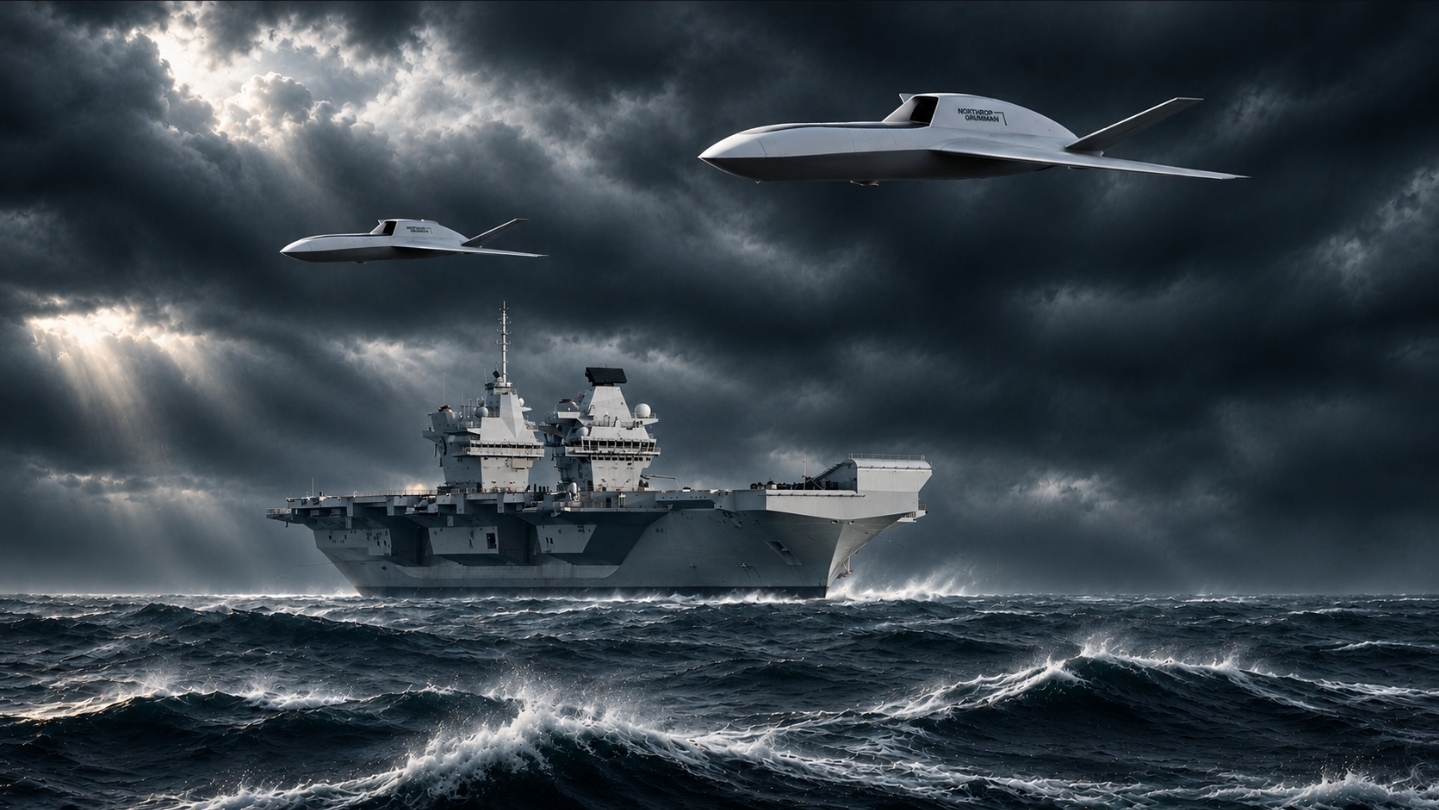
Oslo, Norway – A significant strategic development in the future of naval aviation was unveiled this week with the announcement of impending trials for an uncrewed combat aircraft demonstrator aboard HMS Prince of Wales, one of the Royal Navy’s Queen Elizabeth-class aircraft carriers. The announcement, made by First Sea Lord Admiral Sir Ben Key (identified as “Jenkins” in the original context, but confirmed as First Sea Lord for clarity and accuracy) at the International Sea Power Conference in Oslo, signals a concrete step towards integrating autonomous systems into the United Kingdom’s carrier strike capabilities.
Admiral Key revealed that a Statement of Intent is scheduled to be signed in the coming days between the Royal Navy and the American aerospace and defense technology company Northrop Grumman. This agreement will pave the way for trials involving Northrop Grumman’s TALON demonstrator aircraft under the umbrella of Project VANQUISH. The TALON demonstrator itself was present on stage during the announcement, underscoring the immediate readiness of the program.
The primary objective of these forthcoming trials, as articulated by Admiral Key, is to gather crucial evidence on how uncrewed combat aircraft can safely and effectively operate alongside the existing air wing. This air wing typically comprises F-35B Lightning II stealth jets, Merlin helicopters, and Wildcat helicopters. The integration of autonomous systems presents complex operational challenges, including airspace management, command and control, and seamless coordination with human-crewed assets in a dynamic maritime environment.
Looking ahead, Admiral Key outlined a vision where the carrier’s hangar, traditionally dedicated to crewed aircraft, will in the future also accommodate “uncrewed teammates.” Among these are anticipated to be the Navy’s first jet-powered drones, officially designated as Collaborative Combat Aircraft (CCAs). These advanced uncrewed systems are designed to operate in conjunction with crewed fighter jets, extending their range, endurance, and sensor capabilities, while potentially acting as decoys or even carrying ordnance in high-threat environments.
Highlighting the Royal Navy’s accelerated approach to technological adoption, Admiral Key recalled a previous statement from last year wherein he expressed an ambition to see the first CCAs launched from a carrier flight deck by the following year. Acknowledging that this ambition might have been met with some skepticism at the time, he reiterated the Navy’s commitment to a rapid development strategy. This approach prioritizes immediate collaboration with industry partners to integrate cutting-edge technology quickly, rather than waiting for years for a “perfect solution” to emerge. This methodology reflects a broader trend in defense innovation, favoring agile development and iterative testing to meet evolving threats.
Project VANQUISH itself is specifically designed to demonstrate the operational viability of a jet-powered, short take-off and landing (STOL) uncrewed aircraft. A critical requirement for this program is the ability for such aircraft to operate from the Royal Navy’s Queen Elizabeth-class carriers, HMS Queen Elizabeth and HMS Prince of Wales, without the need for traditional catapults or arrestor gear. These carriers are designed for Short Take-Off Vertical Landing (STOVL) operations, primarily accommodating the F-35B, making the STOL capability of future uncrewed aircraft a vital compatibility factor.
The Ministry of Defence had previously informed Parliament in June of its plans for a carrier demonstration within 18 months, although specific aircraft details were not disclosed at that time. The selection of Northrop Grumman’s TALON demonstrator for this role now provides clarity on the initial platform being evaluated. The TALON’s potential extends beyond the UK, as evidenced by the U.S. Air Force’s designation of the aircraft as the YFQ-48A in January. This move brought the TALON into the U.S. Air Force’s own Collaborative Combat Aircraft program, where it is envisioned as a semi-autonomous, low-cost platform engineered to fly alongside and support crewed fighter aircraft. This parallel development with a key ally underscores the international significance and shared strategic vision for uncrewed aviation.
The integration of CCAs is expected to fundamentally alter the dynamics of naval air power, offering a significant force multiplier effect. These systems could perform a variety of missions, from intelligence, surveillance, and reconnaissance (ISR) to electronic warfare, and even strike missions, thereby reducing the risk to human pilots and increasing the overall persistence and reach of carrier-borne air operations. The trials aboard HMS Prince of Wales will provide invaluable data on the practical challenges and opportunities associated with this transformative shift in military capability, laying the groundwork for a new era of naval combat.
Why This Matters
The announcement of trials for Northrop Grumman’s TALON demonstrator aboard a Royal Navy aircraft carrier represents a pivotal moment in the evolution of naval warfare and defense technology. This initiative is significant for several key reasons:
- Strategic Shift in Naval Aviation:This move signals a definitive commitment by the United Kingdom to integrate advanced uncrewed combat aircraft into its core naval capabilities. It marks a transition from conceptual discussions to tangible development, fundamentally reshaping how carrier strike groups will operate in the future. The ability to deploy jet-powered drones like Collaborative Combat Aircraft (CCAs) alongside crewed fighters will alter the risk calculus and operational strategies of naval air power.
- Enhanced Carrier Capability and Force Multiplication:The introduction of uncrewed teammates offers a substantial force multiplier effect for the Queen Elizabeth-class carriers. CCAs can extend the sensor range, endurance, and lethality of the carrier air wing, allowing for more persistent surveillance, deeper penetration into contested airspace, and the execution of missions that might be too risky or protracted for crewed aircraft. This expands the operational envelope and effectiveness of the UK’s carrier strike capability in an increasingly complex global security environment.
- Cost-Effectiveness and Reduced Risk:While development costs are significant, the operational cost of uncrewed aircraft can be substantially lower than that of crewed fighters. Furthermore, their deployment in high-threat environments can reduce the risk to human pilots, a critical consideration in modern warfare. The “low-cost” aspect, particularly highlighted by the U.S. Air Force’s interest in TALON, suggests a potential for more numerous deployments, saturating enemy defenses or providing expendable assets.
- Technological Leadership and Innovation:By rapidly moving from concept to trials, the Royal Navy is demonstrating its commitment to staying at the forefront of defense technology. The emphasis on agile development and industry collaboration, rather than prolonged theoretical studies, positions the UK as a proactive innovator in the field of autonomous systems. This fosters a vibrant defense industrial base and ensures the UK maintains a competitive edge.
- International Interoperability and Shared Vision:The fact that Northrop Grumman’s TALON demonstrator is also part of the U.S. Air Force’s CCA program (as the YFQ-48A) underscores a shared strategic vision with a key ally. This parallel development could pave the way for enhanced interoperability, common standards, and joint operations with the United States and other NATO partners in the future, strengthening collective defense capabilities.
- Future of Warfare:This development provides a tangible glimpse into the future of air and naval warfare, where human-machine teaming will become increasingly prevalent. The lessons learned from Project VANQUISH will not only inform the Royal Navy’s future procurement but will also contribute to the global understanding of how autonomous systems can be safely and effectively integrated into complex military operations, shaping the doctrine and tactics of tomorrow’s conflicts.