
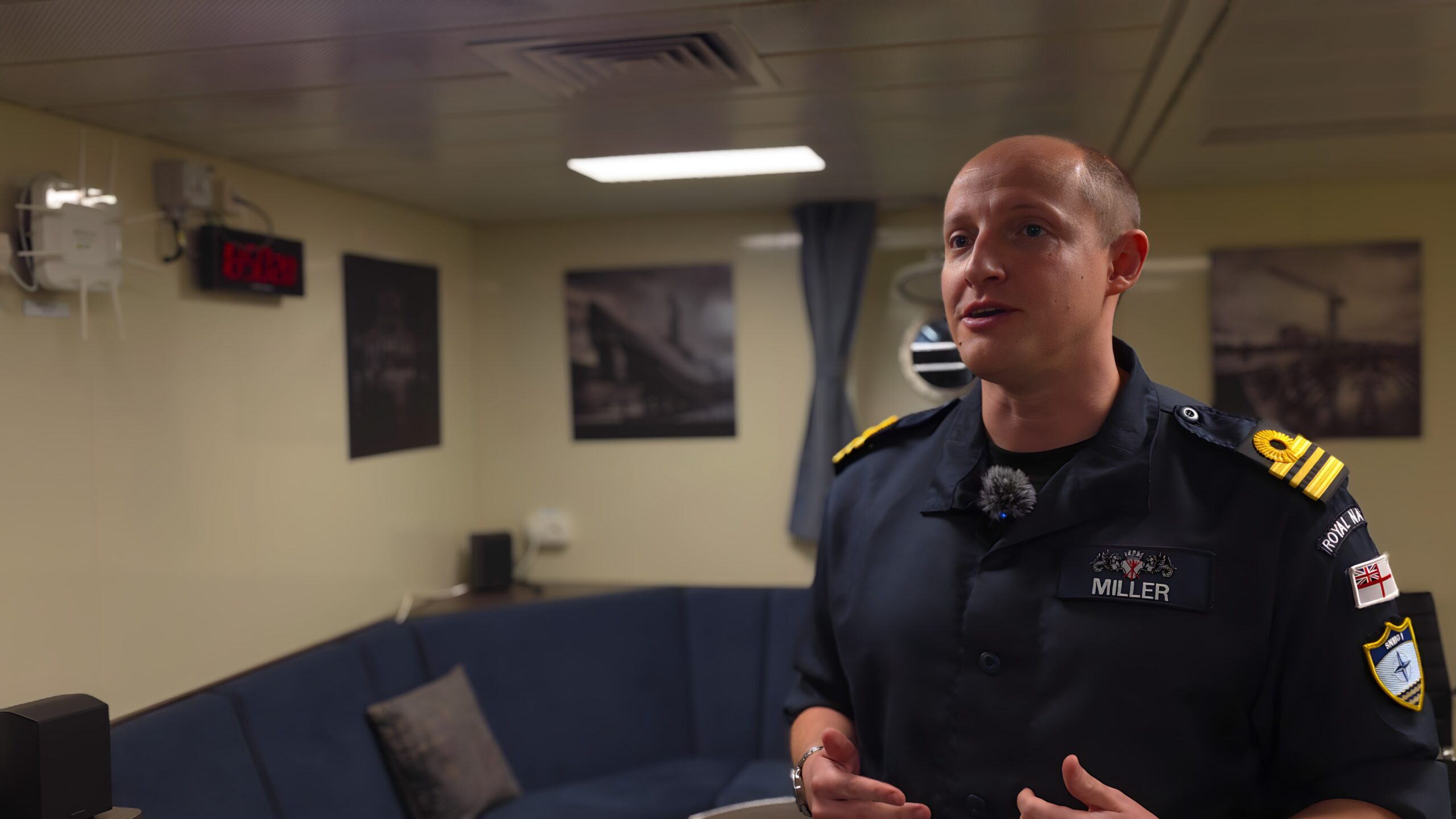
NATO Naval Group Sharpens Readiness in Baltic Sea Exercise
Lieutenant Commander Jonny Miller, a Royal Navy officer, holds the crucial responsibility for orchestrating the training and exercises of Standing NATO Maritime Group One (SNMG1), one of the Alliance’s permanent naval task groups. Operating under the command of French Rear Admiral Nicolas Molitor, Lt. Cdr. Miller’s role encompasses a broad spectrum of activities, from meticulously planned formal exercises to responsive, on-the-move training scenarios.
During Exercise Dynamic Merlin, NATO’s anti-submarine warfare (ASW) exercise conducted in the strategic waters of the Baltic Sea, Lt. Cdr. Miller articulated the core objective of his position: to ensure SNMG1 maintains the highest possible state of readiness. He explained that his duties involve integrating the task group into both scheduled, formal exercises and ad-hoc training opportunities that arise as the group transits between locations. The overarching goal is to prepare SNMG1 to effectively execute its assigned duties and respond decisively to any situation mandated by its higher command, ensuring its operational capability remains robust and responsive.
https://www.youtube.com/watch?v=xz2OUFxhy-s
Standing NATO Maritime Groups, including SNMG1, are often characterized as NATO’s forward-deployed maritime responders. This designation underscores their role in projecting presence and capability. According to Lt. Cdr. Miller, deterrence forms a fundamental pillar of NATO’s operational philosophy. He emphasized that the Alliance’s capacity to demonstrate its ability to respond to diverse situations and safeguard the collective security of its nearly one billion citizens is paramount. Formal exercises, such as Dynamic Merlin, represent vital opportunities to assemble a substantial number of allied naval assets in a concentrated environment. This particular exercise involved vessels and personnel from eight of NATO’s 32 member nations, facilitating the practice of both foundational maritime drills and advanced developmental aspects of NATO’s work. These advanced areas include exploring autonomous systems, refining new tactics, and seamlessly integrating new allies, such as Sweden, into established operational frameworks. Such exercises are crucial for fostering mutual understanding and learning among diverse naval forces, alongside reinforcing adherence to the standardized operating procedures that enable multinational fleets to function cohesively as a single entity.
SNMG1 itself is a testament to NATO’s multinational nature, comprising ships contributed by five navies—those of the Netherlands, Germany, Canada, Denmark, and Finland. Its operational staff is even more diverse, drawing personnel from eight different allied nations. The complexity of integrating so many distinct national navies might appear daunting; however, Lt. Cdr. Miller noted that decades of shared procedures and accumulated experience within NATO render this process remarkably efficient. He highlighted NATO’s 77-year history of collective defense and cooperation, during which lessons learned from operations and exercises across the Alliance are systematically shared. This continuous feedback loop ensures that common training methodologies, tactical approaches, and operational manuals consistently reflect best practices, regardless of where the task group is operating.
This deep-seated foundation of shared understanding and standardized protocols allows for considerable flexibility in training. Lt. Cdr. Miller illustrated this by explaining how training can be arranged with minimal notice. He described scenarios where SNMG1, while transiting through open waters, might encounter another allied vessel. In such instances, the common operational framework enables immediate communication and coordination, allowing commanders to quickly arrange impromptu training serials. This capability to open a “common playbook” and select relevant exercises based on recent training gaps or specific national needs ensures that valuable training opportunities are seized whenever they arise, enhancing readiness and interoperability at short notice.
Multinational Coordination and Strategic Integration
The planning and execution of a complex naval exercise in one of Europe’s busiest maritime and airspaces extend far beyond the immediate staff of SNMG1, which consists of 23 officers and ratings. Such endeavors necessitate extensive and precise coordination with multiple higher authorities, including NATO’s Maritime Command (MARCOM) and Air Command (AIRCOM), as well as various national authorities of the participating countries. Lt. Cdr. Miller underscored the collaborative nature of these operations, expressing admiration for the speed and effectiveness with which numerous partner countries and agencies converge to achieve significant objectives within compressed timelines.
While the specific details of the Exercise Dynamic Merlin scenario were kept confidential, Lt. Cdr. Miller indicated that a primary objective was to further strengthen operational ties with Sweden, NATO’s newest member. Sweden’s navy brings invaluable local expertise regarding the unique hydrography and operational environment of the Baltic Sea. He affirmed that despite rapid integration and significant mutual learning, there is always scope to deepen these crucial relationships. Ultimately, the exercise served a broader strategic purpose: to demonstrate NATO’s comprehensive anti-submarine warfare capabilities, particularly its ability to detect and track subsurface activities, and its readiness to act defensively. Echoing the sentiment of NATO’s submarine commander, he reiterated that such demonstrations serve as a clear deterrent.
Lt. Cdr. Miller emphasized that these exercises are designed to unequivocally demonstrate to any potential adversary NATO’s sophisticated capacity to identify and comprehend underwater activities. This capability underpins the Alliance’s defensive posture, enabling it to deter potential threats and, if necessary, react decisively to events unfolding in the maritime domain. He affirmed, “What we do is we react to things that happen around us. We have the ability to see what is going on. We are watching what is going on, and if necessary, we can respond to what’s going on.” This statement underscores NATO’s commitment to vigilance, situational awareness, and the readiness to defend its members and interests.
Why This Matters
The continuous training and operational readiness of Standing NATO Maritime Group One (SNMG1), as exemplified by exercises like Dynamic Merlin, carry profound strategic significance. In an era of heightened geopolitical tensions, particularly in the Baltic Sea region which borders Russia, the visible presence and demonstrated capability of multinational naval forces are critical for maintaining regional stability. SNMG1 serves as a tangible expression of NATO’s collective defense commitment, providing a constant, high-readiness maritime component that can respond swiftly to emerging threats, secure vital sea lanes, and conduct a range of operations from humanitarian aid to combat missions. Its multinational composition and ability to operate cohesively underscore the strength and unity of the Alliance.
Furthermore, these exercises play a crucial role in reinforcing NATO’s deterrence posture. By openly showcasing advanced capabilities, such as anti-submarine warfare (ASW) in a complex environment like the Baltic Sea, NATO sends a clear message that it possesses the means and the will to defend its territory and interests. The integration of new technologies, tactics, and, critically, new allies like Sweden, demonstrates NATO’s adaptability and evolving strength. Sweden’s membership, in particular, significantly enhances NATO’s maritime capabilities in the Baltic, leveraging its deep local knowledge and highly capable navy to bolster the Alliance’s defensive and surveillance capacities in a strategically vital waterway.
Finally, the meticulous coordination and interoperability achieved through decades of shared procedures and continuous training are not merely logistical achievements; they are fundamental to NATO’s operational effectiveness. The ability of ships and personnel from diverse national backgrounds to seamlessly integrate and operate as a unified force is a cornerstone of collective security. It ensures that NATO can effectively pool resources, respond with agility, and present a formidable, unified front against any challenge. This sustained commitment to readiness, interoperability, and strategic integration is indispensable for safeguarding the security of NATO member states and contributing to broader international maritime stability.