
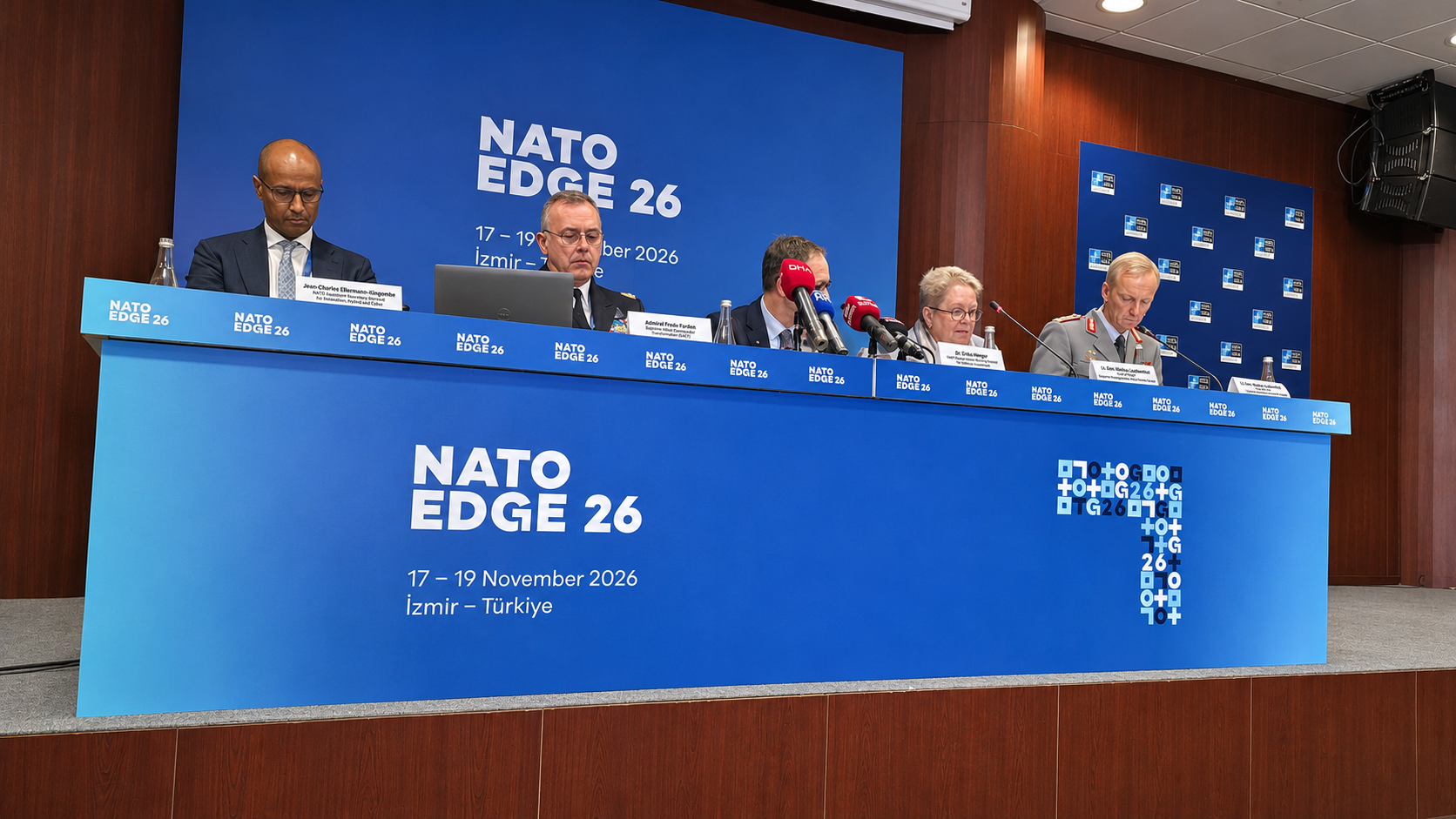
NATO Confronts “Darwin Moment,” Urging Rapid Adaptation in Technology and Capability
İzmir, Türkiye – The North Atlantic Treaty Organization (NATO) is at a critical juncture, described by its Supreme Allied Commander Transformation as a “Darwin moment,” requiring unprecedented speed in turning increased budgets, data, and technological innovation into actionable military capability. This urgent call for transformation was the central message delivered by five of the Alliance’s most senior civilian and military leaders during a joint press engagement at NATO Edge 26 in İzmir, emphasizing the imperative to outpace evolving threats.
Admiral Pierre Vandier, who heads Allied Command Transformation (ACT), articulated the Alliance’s challenge: whether a 32-nation organization could avoid the fate of “dinosaurs” in an era of rapid change. He highlighted the accelerated pace of adaptation on the Ukrainian front line by Russia and the relentless “revolution each trimester” in artificial intelligence. Despite these challenges, Admiral Vandier expressed optimism, citing recent experimentation events like “Fuse” in Latvia. During these trials, artificial intelligence (AI) agents and large language models (LLMs) were successfully deployed across disparate industry systems, resolving complex integration issues that previously took approximately six weeks in just two hours. This demonstration, he noted, showcased NATO’s potential as an “adaptable species.”
Providing the operational perspective, Major General Rainer Beeck, Deputy Chief of Staff Cyberspace at Allied Command Operations (ACO), affirmed NATO’s defensive posture and readiness to operate under a strategy of “block, blunt, break.” However, he stressed that Russia’s ongoing war against Ukraine has underscored the rapid evolution of modern warfare. General Beeck emphasized, “We must transform at the speed of the threat, not at the speed of our bureaucracy,” cautioning that data alone does not guarantee victory. He identified slow operational delivery as the greatest risk, asserting that “the warfighter needs capabilities, not promises.”
Translating Money and Innovation into Tangible Capabilities
Tarja Jaakkola, NATO’s Assistant Secretary General for Defence Industry, Innovation and Armaments, underscored the Alliance’s commitment to translating financial pledges into concrete military capabilities. She pointed to over $50 billion in procurement deals and initiatives announced at the Ankara summit in July, alongside allies’ plans to invest more than $40 billion in counter-drone technologies over the next five years. This investment is supported by a new counter-drone marketplace, already offering 16 tested systems for rapid acquisition. When asked about her single most pressing priority for the coming year, Ms. Jaakkola emphasized the urgent need to ramp up industrial capacity. While ammunition output has increased, she stated, “we are not still there,” highlighting the critical requirement for allies to determine what industry would need to deliver in a crisis or wartime scenario.
Jean-Charles Ellermann-Kingombe, NATO’s Assistant Secretary General for Cyber and Digital Transformation, identified the speed of adoption as the most significant obstacle to the Alliance’s digital priorities. These priorities include the development of a warfighting cloud, enhanced data sharing, AI integration, and robust cyber defense capabilities. He noted that technological advancements are outpacing the organization’s ability to integrate them, urging companies to engage early, collaborate continuously, and be prepared to act as strategic partners during both peacetime and conflict. Dr. Dylan Browne, General Manager of the NATO Communications and Information Agency (NCIA), reinforced this sentiment, stating that NCIA expects to bring approximately €2.7 billion of business to market over the next two years, spanning cloud services, AI, cyber defense, command and control (C2) systems, space capabilities, and networks. Dr. Browne explained that NATO’s solution to the speed problem is commercial adoption, adopting an “adopt, not a buy mindset.” This approach prioritizes the rapid integration of proven, off-the-shelf commercial technology rather than developing bespoke systems through lengthy procurement processes, while strictly maintaining security and interoperability as “fundamental requirements, not optional extras.”
The Warfighting Cloud and the Challenge of Data Sharing
When questioned about the most urgent capabilities NATO needs from events like NATO Edge, Dr. Browne asserted that no capabilities were “missing,” but rather the challenge lies in scaling existing communications and information infrastructure. He noted that NCIA conducts over 200 exercises annually, and recent global events have demonstrated the immense value of cloud-based intelligence and AI-driven insights, which enable NATO to leverage the collective expertise of “our 32 allied nations’ brightest brains and smartest intel analysts.” Admiral Vandier, addressing the same question, placed the current transformation in a historical context, describing the First World War as a conflict of farmers with bayonets and tractors, and the Second World War as a contest between industrial systems. He then stated, “today we see that we are turning to a digital competition,” where traditional armaments like ammunition, missiles, and tanks remain vital, but digital technology and AI have emerged as central enablers of modern warfare.
Asked about their top priority for the coming year, Admiral Vandier declared that delivering the warfighting cloud was the absolute imperative. However, he identified the primary roadblock as persuading member nations to share the necessary data to fuel it. He explained that “when you say share data, people think that you are giving the key of your own personal library, and no nation wants that.” While tools now exist to allow nations to selectively share specific information, NATO’s current data standards still reflect “a paper legacy approach.” Mr. Ellermann-Kingombe echoed these priorities, while General Beeck summarized the objective as making 32 allies’ data on a 32-nation warfighting cloud “count more together.” Dr. Browne added a call for talent, revealing that NCIA has over 400 technology roles to fill and is seeking applicants who are patriots eager to serve the Alliance.
Responding to Hybrid Threats and Federated Cloud Architecture
Regarding Russian hybrid attacks, Mr. Ellermann-Kingombe noted an uptick in sabotage and cyber attacks targeting critical infrastructure across allied nations, largely linked to Russian attempts to discourage support for Ukraine. He cited the real-time maritime surveillance capabilities developed through Allied Command Transformation’s Task Force X, initiated after damage to Baltic undersea cables, as an example of how NATO is enhancing its situational awareness and raising the costs for adversaries. Admiral Vandier added that within NATO, multi-domain operations involve orchestrating military and non-military instruments of power collaboratively, a process where digital technology provides the Alliance with the speed and scale to move “not as dinosaur” but as a significantly more agile entity.
Mr. Ellermann-Kingombe clarified that the transatlantic warfighting cloud would be a federation of interoperable national and commercial systems rather than a singular monolithic system. This architecture would combine technology from major US hyperscalers with European integrators, while respecting national sovereignty through common NATO standards. General Beeck recalled how commercial cloud providers assisted Ukraine in rapidly moving its data out of the country within days of the full-scale invasion, underscoring NATO’s need for every available option. He even floated the ambitious idea of data centers in space, expressing a personal “desire to have data everywhere.” Concluding the session, Admiral Vandier declined to forecast a significant conflict with Russia by 2030, stating, “I’m not Madame Irma, as we say in France. I’m not the weatherman of the conflicts. I just say we need to be ready tonight and tomorrow.” He emphasized that balancing immediate readiness with preparation for future threats is precisely the essence of NATO Edge.
#NATOEdge
Why This Matters
NATO’s urgent call for accelerated adaptation is crucial for several interconnected reasons, impacting global security, member state defense, and the future of warfare itself. First, the Alliance’s ability to rapidly integrate new technologies like AI, cloud computing, and advanced data analytics directly determines its continued relevance and effectiveness as a deterrent. In a world where adversaries are adapting quickly and technological revolutions occur almost quarterly, a bureaucratic, slow-moving NATO risks becoming obsolete, unable to effectively counter emerging threats.
Second, the drive to translate budgets and innovation into tangible military capabilities directly enhances collective defense. Strengthening industrial capacity, streamlining procurement processes, and fostering an “adopt, not buy” mindset are essential for equipping warfighters with the tools they need, when they need them. This is not merely about having advanced weapons, but about ensuring that all 32 member nations can operate seamlessly together, sharing critical information and acting decisively in a crisis. The push for a federated warfighting cloud and improved data sharing is foundational to this interoperability, enabling shared situational awareness and coordinated responses across domains, from cyber to space.
Third, this transformation acknowledges and prepares for the evolving nature of modern conflict. The shift from industrial to digital competition means that data, information dominance, and rapid decision-making enabled by AI are becoming as critical as traditional military hardware. NATO’s efforts to counter hybrid threats, improve maritime surveillance, and integrate multi-domain operations are direct responses to the complex, multi-faceted aggression seen in recent conflicts. The success of these initiatives will dictate NATO’s ability to protect its members against both conventional and unconventional attacks, ensuring stability in a volatile geopolitical landscape.
Finally, the challenge of persuading nations to share data highlights a deeper, inherent tension between national sovereignty and collective security within an alliance. Overcoming this “paper legacy approach” to data standards and fostering trust in secure data-sharing mechanisms is paramount. The ability to harness the collective intelligence and resources of 32 nations, while respecting national security concerns, will be a defining factor in NATO’s strength and agility in the decades to come, ultimately safeguarding the security and prosperity of its member states and contributing to broader international peace.