
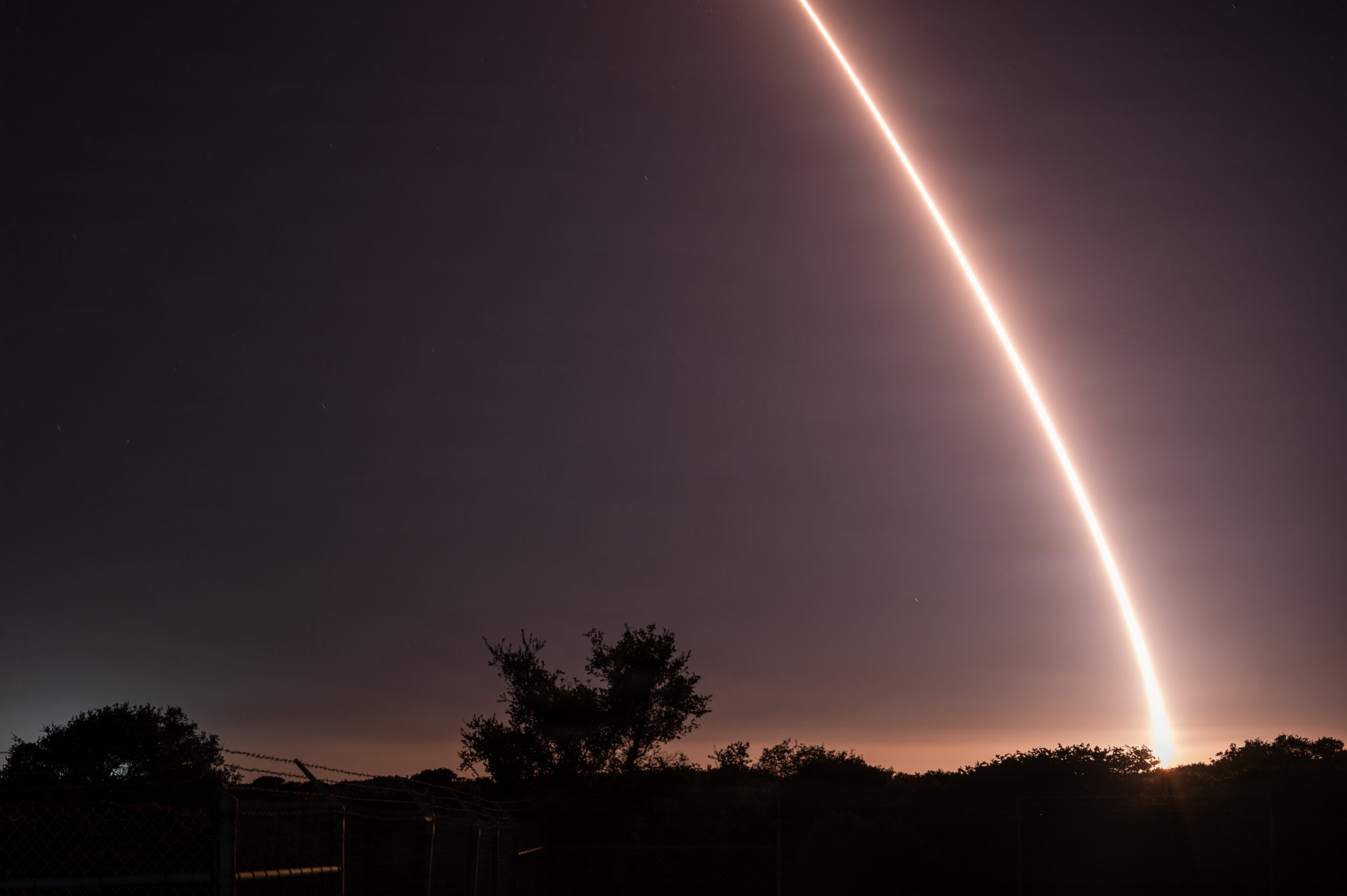
VANDENBERG SPACE FORCE BASE, California – The United States Air Force Global Strike Command conducted an unarmed test launch of a Minuteman III intercontinental ballistic missile (ICBM) from Vandenberg Space Force Base, California, in the late hours of November 17. This marked the first such test exercise in a period of six months for the U.S. nuclear deterrence program.
While specific details regarding this particular launch were not immediately provided by officials, these routine tests typically involve the unarmed missile traveling approximately 4,200 miles across the Pacific Ocean. The designated impact area for these exercises is usually the Kwajalein Atoll in the Marshall Islands, located within the U.S. Army Space and Missile Defense Command’s Ronald Reagan Ballistic Missile Defense Test Site. These launches are carefully orchestrated to gather critical data on the missile’s performance and reliability without deploying a live warhead.
Adding a layer of operational context to the launch, open-source flight tracking data indicated that a U.S. Navy E-6B Mercury aircraft departed from Vandenberg prior to the test. This specialized aircraft subsequently orbited off the coast as the launch sequence unfolded. The E-6B Mercury, a modified Boeing 707, is integral to the U.S. nuclear command and control structure, equipped with the Airborne Launch Control System (ALCS). This system provides a critical capability to remotely command the launch of ICBMs in the event ground-based command centers are compromised. While previous Minuteman tests have openly utilized the ALCS from an E-6 platform, the Air Force did not explicitly confirm if the E-6B supported the command and control aspect of this specific test.
The timing of the test launch coincided with President Donald Trump’s diplomatic tour across Asia, which included significant stops in the Philippines and a high-profile meeting with Chinese leader Xi Jinping and Russian leader Vladimir Putin in China. This confluence of events naturally drew attention and raised questions regarding potential geopolitical signaling. However, Air Force Global Strike Command was quick to emphasize that the test had been “scheduled years ago” as part of a long-term strategic plan and was “not in response to world events.” This statement aimed to decouple the routine test from ongoing international developments and prevent any misinterpretation as an escalatory measure.
The primary objective of these test launches, often referred to within military circles as “Glory Trips,” is to “assess the entirety of the ICBM enterprise,” as stated by Air Force Global Strike Command. This comprehensive evaluation encompasses not only the missile’s flight performance but also the readiness of launch crews, the functionality of ground support systems, and the accuracy of tracking and telemetry data. These rigorous, realistic tests are deemed foundational to ensuring the continued effectiveness and reliability of the 56-year-old Minuteman III system, which serves as a vital component of the nation’s nuclear deterrent.
General S.L. Davis, the commander of Air Force Global Strike Command, underscored the human element in these complex operations. In a statement, he affirmed, “The ability to conduct these rigorous, realistic tests relies on the dedication of our Airmen and is foundational to ensuring the safety and surety of the Minuteman system.” His remarks highlight the critical role of highly trained personnel in maintaining the integrity and operational capability of the ICBM force.
The Minuteman III, first deployed in 1970, represents the land-based leg of the U.S. nuclear triad, which also includes submarine-launched ballistic missiles and strategic bombers. Despite its age, it remains the backbone of the nation’s ICBM force. The Air Force is actively developing its replacement, the LGM-35A Sentinel, a next-generation intercontinental ballistic missile system. However, the Sentinel is not anticipated to begin coming online until the early 2030s. This extended transition period means that the Minuteman III must remain fully operational, safe, and reliable for at least another decade, necessitating continuous maintenance, upgrades, and testing.
To ensure the Minuteman III’s viability during this transitional phase, the service detailed significant investment plans in its 2027 budget request. These plans allocate nearly $86.5 billion towards Minuteman modifications, research, and development. Additionally, approximately $198 million is earmarked specifically for modernizing the fuzes that are integrated into the Mk21 reentry vehicles, which carry the nuclear warheads. These financial commitments underscore the substantial resources required to sustain an aging but critical strategic asset.
This November launch was the third unarmed ICBM test conducted by the United States in 2026. The first test of the year occurred in March, with that missile carrying two reentry vehicles, providing an opportunity to evaluate multiple warhead deployment scenarios. The second test took place in May, though Air Force Global Strike Command released fewer details regarding its specific parameters. The consistent schedule of these tests, typically three to four per year, reflects a long-standing U.S. policy of maintaining the readiness and demonstrating the reliability of its strategic deterrent forces.
Pentagon Editor Chris Gordon contributed to this report.
Why This Matters
The routine test launch of an unarmed Minuteman III intercontinental ballistic missile carries significant implications for global strategic stability, national defense, and international relations. Firstly, it underscores the United States’ unwavering commitment to maintaining a credible nuclear deterrent. The Minuteman III, as the land-based component of the U.S. nuclear triad, provides a critical second-strike capability, designed to dissuade potential adversaries from launching a first strike. Regular testing ensures that this aged but essential system remains effective, reliable, and capable of fulfilling its mission, thereby contributing to global security by preventing large-scale conflict.
Secondly, the test serves as a crucial exercise in transparency and reassurance, both for allies and potential adversaries. While critics may view such tests as provocative, the U.S. generally announces these launches in advance and emphasizes their unarmed, routine nature. This practice aims to reduce the risk of miscalculation and signal that the U.S. maintains its strategic capabilities without seeking escalation. The data collected from these tests is vital for verifying the performance of the missile, its guidance systems, and related infrastructure, ensuring that any deterrent message sent is based on actual, verifiable capability.
Thirdly, the test highlights the complex challenge of managing and modernizing an aging strategic arsenal. The Minuteman III has been in service for over five decades, far exceeding its original design life. The substantial budget allocations for its modifications and the ongoing development of its successor, the LGM-35A Sentinel, reveal the immense financial and technological commitment required to sustain nuclear deterrence. This transition period is critical, as the current system must remain operational and reliable until the new generation of missiles is fully deployed, which is still over a decade away. The success of these tests directly impacts the confidence in the current system’s ability to bridge that gap.
Finally, the timing of the launch, even if coincidental with high-level diplomatic engagements in Asia, inevitably adds a layer of geopolitical scrutiny. In a volatile international environment, where nuclear powers are closely monitoring each other’s strategic activities, such tests can be interpreted through various lenses. While U.S. officials stressed the pre-scheduled nature of the launch, its occurrence during President Trump’s meetings with key regional leaders like Xi Jinping and Vladimir Putin underscores the constant interplay between military readiness and diplomatic efforts. These events collectively shape perceptions of power, resolve, and strategic intentions on the global stage, influencing the broader dynamics of international security.