
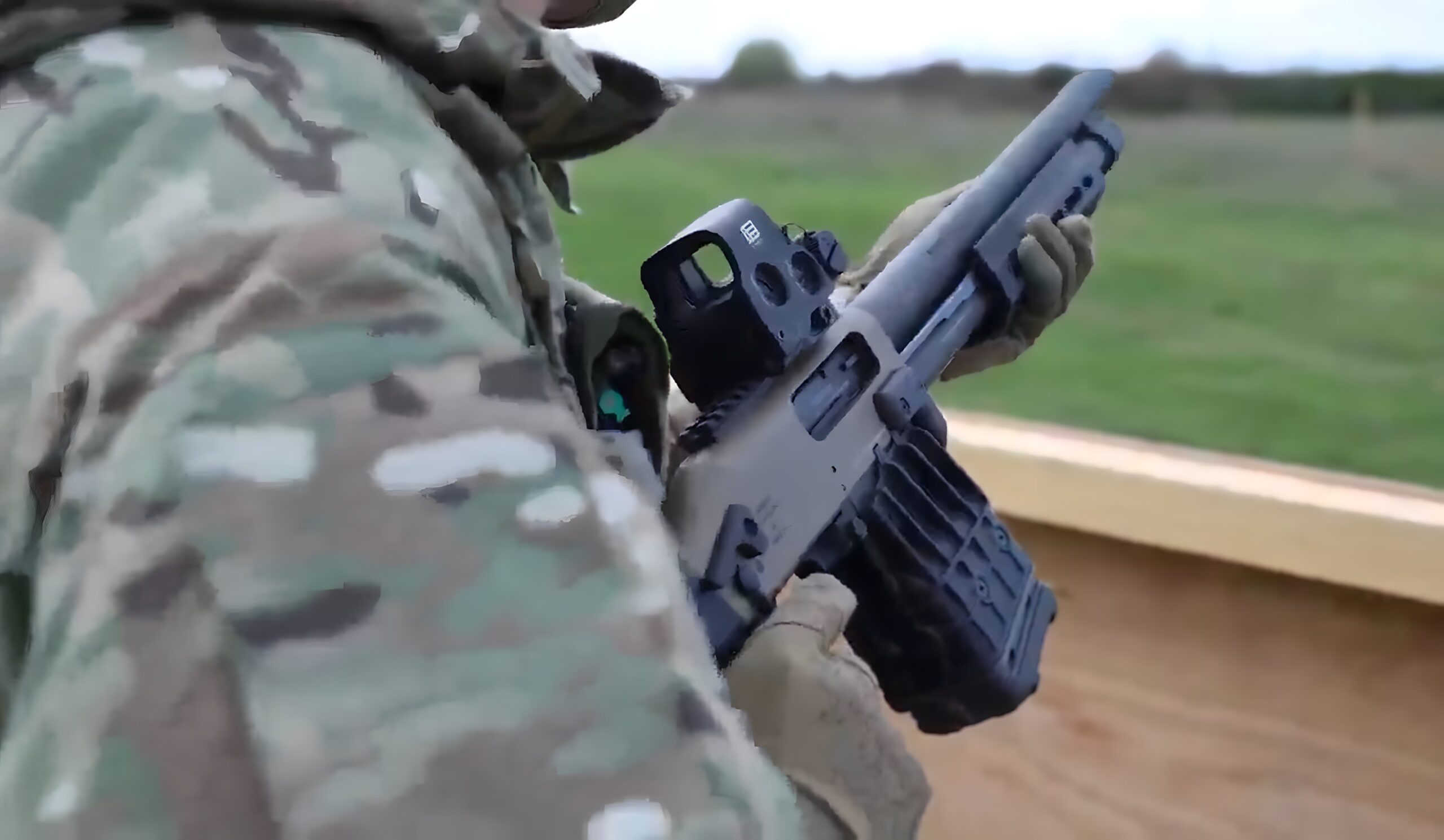
UK Army Trials Confirm Tungsten Ammunition Superior for Close-Range Counter-Drone Defence
London, UK– The British Army has identified specialist tungsten shotgun ammunition as significantly more effective than conventional lead rounds for close-range defence against small drones, according to recent parliamentary disclosures. This finding emerges as the United Kingdom intensifies its efforts to adapt to the rapidly evolving threat posed by uncrewed aerial systems (UAS) on the modern battlefield.
The assessment followed an inquiry from Conservative Member of Parliament Ben Obese-Jecty, who sought information on trials comparing various shotgun ammunition types, specifically tungsten and copper, against lead to enhance the Armed Forces’ counter-drone capabilities. Luke Pollard, the Minister for Defence Readiness and Industry, confirmed that the Army’s ongoing evaluation of different shotgun ammunition types for close-range counter-UAS defence has included both conventional lead and specialist tungsten ammunition.
“These trials demonstrated improved performance from tungsten ammunition against representative small drones,” Minister Pollard stated in his parliamentary answer. He further clarified that copper ammunition had not been part of these initial assessments, noting that “further testing would be required to determine its relative operational benefit.”
The superior performance of tungsten rounds likely stems from the material’s higher density compared to lead. Tungsten, being significantly denser, allows for smaller projectiles with greater kinetic energy and penetration capabilities, which can be crucial for effectively disabling or destroying the robust yet lightweight composite materials often used in small drones. This focus on kinetic solutions for close-range threats underscores a multi-faceted strategy being developed by the UK Ministry of Defence (MoD) to address the pervasive drone challenge.
Beyond specialized ammunition, the UK’s commitment to countering drone threats extends to advanced targeting systems and electronic warfare capabilities. In June 2023, the Ministry of Defence awarded a £4.6 million contract to SmartShooter, through Viking Arms, for 225 SMASH smart weapon sights. These innovative sights are slated to be integrated initially with the SA80 A3 rifle, with the primary objective of substantially improving hit probability against micro and mini drones. The then Minister for Defence Procurement, James Cartlidge, emphasized the strategic shift by stating, “The importance of uncrewed aerial vehicles on the modern battlefield is undeniable,” highlighting the recognition of drones as a critical factor in contemporary military operations.
Further demonstrating a comprehensive approach, the MoD also initiated a framework in March 2024, valued at up to £38.75 million and running until 2031, to procure electromagnetic detect and defeat equipment for dismounted close combat soldiers. This initiative, reported by UK Defence Journal, indicates an intent to equip frontline personnel with non-kinetic means to disrupt or disable enemy drones, such as jamming their control signals or GPS navigation. Such electronic warfare capabilities offer a vital complement to kinetic solutions, particularly in scenarios where collateral damage from projectiles might be a concern or where stealthy disruption is preferred.
The strategic importance of these investments was underscored by Lord Coaker, Minister of State at the Ministry of Defence, who, in a separate parliamentary statement this week, revealed that the Defence Investment Plan allocates over £750 million specifically to strengthen short-range counter-drone protection for the UK and its deployed forces. This substantial financial commitment reflects the urgency and scale of the threat, acknowledging that drones, from inexpensive commercial models modified for military use to advanced dedicated reconnaissance and attack platforms, have fundamentally altered the landscape of modern warfare.
The ongoing conflict in Ukraine has served as a stark demonstration of the disruptive power of drones, revealing their effectiveness in reconnaissance, targeting, and direct attack roles, even when operated by non-state actors or with limited resources. This global context has undoubtedly accelerated the UK’s focus on developing and deploying robust counter-UAS measures, ensuring its forces are prepared for a battle space increasingly dominated by aerial threats.
Why This Matters
The UK’s focused investment and trials in counter-drone technologies represent a critical adaptation to the evolving nature of modern warfare. This development carries significant implications across several dimensions:
National Security and Force Protection:Drones, particularly small, commercially available models, pose a persistent and evolving threat. They can be used for surveillance, target acquisition, or as improvised explosive devices, endangering both military personnel and critical national infrastructure. The adoption of more effective kinetic solutions, like tungsten shotgun ammunition, directly enhances the ability of soldiers to protect themselves and their positions from immediate drone threats. This is crucial for maintaining operational effectiveness and minimizing casualties in conflict zones and domestic security scenarios.
Military Doctrine and Strategy:The emphasis on a multi-layered counter-drone strategy—incorporating specialized ammunition, smart targeting systems, and electronic warfare—reflects a significant shift in military doctrine. It acknowledges that no single solution can effectively mitigate the diverse range of drone threats. This holistic approach signals a move towards integrating counter-UAS capabilities at every level of military operations, from individual soldier equipment to broader strategic defence systems. It also highlights the need for continuous innovation as drone technology rapidly advances.
Technological Advancement and Defence Industry:The substantial investments, including the £4.6 million for smart sights and the £38.75 million framework for electromagnetic equipment, demonstrate a commitment to leveraging cutting-edge technology. These contracts stimulate research and development within the defence industry, fostering innovation in areas like materials science (for ammunition), artificial intelligence and computer vision (for smart sights), and electronic warfare. This can lead to broader technological advancements that may have applications beyond military use.
Economic Impact:The allocation of over £750 million to strengthen short-range counter-drone protection signifies a major economic commitment. This investment creates opportunities for defence contractors, technology firms, and researchers, contributing to job creation and economic growth within the UK’s defence sector. It also positions the UK as a leader in developing solutions for a global military challenge, potentially opening avenues for international collaboration and exports of defence technology.
Global Security Implications:The UK’s efforts are part of a wider global trend among militaries to address the drone threat, heavily influenced by observations from recent conflicts. Successful development and deployment of effective counter-drone measures by a leading NATO member like the UK provide valuable lessons and potential technologies for allied nations. Conversely, it also signals to potential adversaries the commitment and capability to neutralize these threats, impacting strategic deterrence and regional stability.
In essence, the UK’s proactive stance in enhancing its counter-drone capabilities is not merely a tactical upgrade but a strategic imperative that will shape its defence posture, technological landscape, and influence on the international stage for years to come.