
VERONA, Italy — The Milan Cortina Olympics concluded on Sunday, marked by a final ceremony honoring Italian dance and music within the venerable Verona Arena. This location was situated approximately equidistant from the dispersed mountainous, valley, and urban sites that rendered these the most geographically expansive Winter Games in the annals of the Olympics.
Approximately 1,500 Olympic athletes entered the amphitheater, brandishing miniature national banners amidst an exhilarating compilation of 20th-century Italian popular songs, with the audience joining in song. They then occupied their places within the stone amphitheater, at spots illuminated by green, red, and white lights, symbolizing the Italian flag.
Upon the extinguishing of the dual Olympic cauldrons in Milan and Cortina d’Ampezzo, which signified the culmination of the most geographically expansive Winter Games, Kirsty Coventry, president of the International Olympic Committee, pronounced the 2026 Games concluded.
“You presented an innovative type of winter competition, and you established a remarkably elevated benchmark for forthcoming events,” Coventry stated.
Commencing the 2½-hour event was a fanciful homage to Italian lyric opera, as the stage director animated not merely the final ceremony performers, among them Italian vocalist Achille Lauro, but additionally previously inactive opera figures stowed in containers inside the amphitheater’s subterranean passages.
Upon the stage, Madama Butterfly, adorned in a vibrant pink and green costume, and Aida, clad in golden layers, emerged from mirrored containers. Concurrently, 17th-century instrumentalists performed the exultant “Libiamo ne’ lieti calici” from La Traviata; this served as an acknowledgment of the Arena’s extensive past as a setting for an annual summer opera celebration.
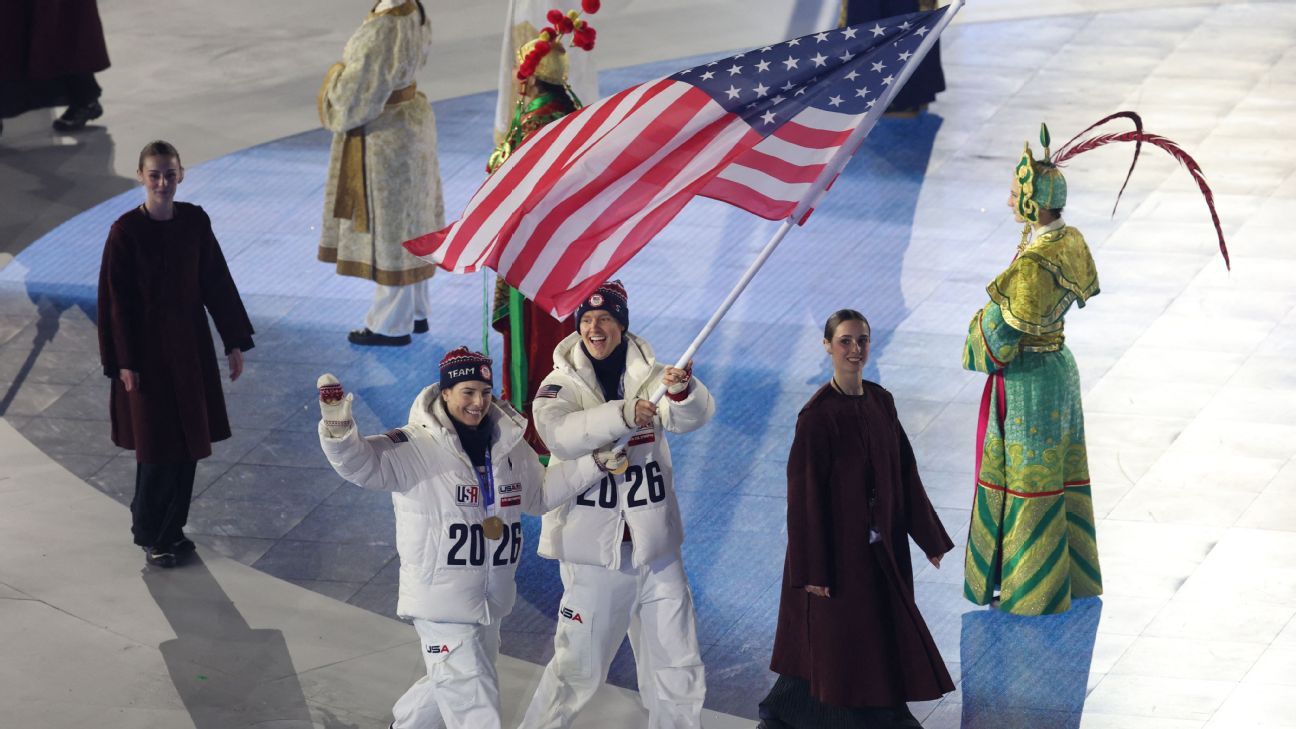
The theatrical figures, guided by the jester Rigoletto, streamed forth into the exterior piazza, intermingling with the amused competitors who served as standard-bearers for their respective nations. Several of these athletes retrieved their mobile devices to record the scene.
During a pivotal juncture, the Olympic torch, contained within a Venetian glass container, was brought into the Arena by Italian champions from the 1994 Lillehammer Games. The Olympic rings, aglow in white, manifested prominently on the stone steps behind the platform, with national banners on either side, as the flame was elevated at the stage’s core.
These marked Coventry’s inaugural Games, as the two-time Olympic swimming victor observed the proceedings in the company of Italian Prime Minister Giorgia Meloni.
Approximately 12,000 attendees participated with the athletes and dignitaries for the concluding event, which proved a considerably more personal occasion compared to the inaugural ceremony. That initial event, featuring Mariah Carey and Andrea Bocelli within Milan’s San Siro football arena, where over 60,000 individuals were present.
A significant juncture of the proceedings occurred when the Olympic banner was transferred to the forthcoming Winter Games host nation, France, and its national emblem was hoisted beside those of Italy and Greece.
The Milan Cortina Games encompassed a region of 22,000 square kilometers (8,500 square miles), ranging from ice-based athletic competitions in Milan to biathlon events in Anterselva near the Austrian frontier, along with snowboarding and men’s downhill racing in Valtellina by the Swiss boundary, cross-country skiing in Val di Fiemme, situated north of Verona, and women’s downhill, curling, and sliding disciplines in co-hosting Cortina d’Ampezzo.
This paradigm is set to persist for subsequent Games, aiming to circumvent the expenditures associated with constructing fresh infrastructure. The 2030 Winter Games, hosted in the French Alps, will host competitions within the Alps and Nice, by the Mediterranean Sea, whereas speed skating will occur internationally at a location yet to be determined.
The final ceremony culminated with the Olympic torches being doused at the singular pair of cauldrons located in Milan and Cortina; this event was observed through a video transmission. A display of illumination replaced pyrotechnics, as fireworks are prohibited in Verona in order to safeguard animals from disruption.
Altogether, 116 medal competitions transpired, spanning eight Olympic sports and 16 categories, which included the introduction of ski mountaineering this year, over a span of 17 days of contests.
The Milan Cortina Paralympics’ inaugural ceremony is also slated to occur at the Verona Arena, on March 6, with the competitions extending until March 15.