
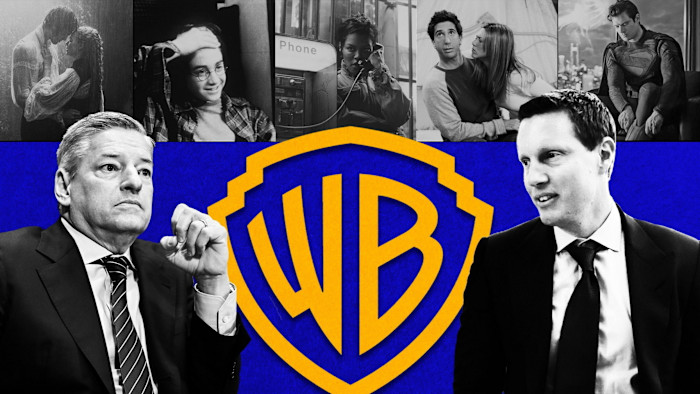
On Saturday evening, at his residence in Beverly Hills, David Zaslav, the chief executive of Warner Bros Discovery, was contacted by David Ellison. Paramount had augmented its offer for WBD by $1 per share, reaching $110 billion, and yielded to a number of crucial stipulations in the protracted contention for dominion over the iconic Hollywood studio.
The intense acquisition contest had commenced at Ellison’s visit to Zaslav’s home five months prior, triggering a bidding war for WBD, which Netflix initially secured in December. However, following several months of perilous strategic maneuvering, Paramount once more seized the advantage.
The competition definitively ended on Thursday as Netflix chose not to enhance its offer and withdrew. Leaders at Paramount partook of champagne from disposable cups on the renowned Hollywood studio premises in jubilation.
Should it gain approval, this transaction stands to profoundly alter the media and leisure domain. It will bring several prominent entities in American media — such as the CBS broadcasting channel and CNN, alongside the American iteration of the social networking service TikTok — under the dominion of an enterprise overseen by Larry Ellison, a magnate among the globe’s wealthiest individuals and an associate of President Donald Trump.
In the final analysis, the Ellisons perceived this agreement as the sole means by which Paramount might contend within a Hollywood environment largely controlled by tech titans, such as Netflix, Amazon, and YouTube. They considered WBD vital for the corporation’s continued existence, as reported by several individuals familiar with the negotiations.
“Warner represented an acquisition Netflix desired, yet did not critically require,” remarked an individual familiar with the deal. “For Paramount, its acquisition was a matter of survival.”
Supported by his magnate father, Larry Ellison, founder of Oracle, the junior Ellison has, within a brief span of years, elevated himself into the echelons of Hollywood influence, initially through the merger of Skydance and Paramount, and presently by prevailing against the formidable $400 billion streaming behemoth Netflix in his quest for WBD.
Ellison, aged 43 and formerly an aspiring performer, now commands a valuable portfolio of holdings encompassing two of Hollywood’s most celebrated production houses responsible for blockbusters likeTransformersandHarry Potter, the HBO Max and Paramount Plus subscription video platforms, in addition to both CBS News and CNN. This amalgamation is poised to significantly impact Hollywood and the broader media industry, with the potential for extensive employment reductions.
As Netflix’s co-CEO, Ted Sarandos, remained engaged in discussions in Washington, the responsibility fell upon his chief financial officer, Spencer Neumann, to inform WBD executives Gunnar Wiedenfels and Bruce Campbell earlier on Thursday that Netflix would not enhance its $27.75 per share offer for the production house and streaming operations. Sarandos withdrew from negotiations, stating that the agreement “was consistently viewed as advantageous at an appropriate valuation, not indispensable at any cost”.
Following the rejection of eight prior proposals by WBD, triumph for Paramount and the Ellisons appeared unattainable merely weeks prior. Yet, neither the elder nor the younger Ellison was inclined to relinquish a coveted asset they deemed crucial for solidifying their position in Hollywood.
Paramount, in conjunction with their associate Gerry Cardinale from RedBird Capital, who likewise facilitated David Ellison’s acquisition of Paramount the previous year, ultimately succeeded by initiating an intensive lobbying effort to sway WBD, which involved presenting an unsolicited bid directly to stockholders and menacing a proxy contest to compel the board’s compliance. The Ellisons, substantial benefactors to US President Donald Trump, further transformed an acquisition struggle into a political maneuvering for the favor of the Trump administration.
—-
During the extended Presidents’ Day holiday, WBD’s directorial body opted to grant David Ellison a final opportunity to tender a “supreme and conclusive” proposal surpassing Netflix’s $83 billion acquisition offer — or to withdraw. Netflix provided a dispensation permitting a week of discussions.
An individual implicated in the process remarked that it was time for Paramount to “commit or desist.” The Paramount contingent commenced work on a decisive offer they christened “Project Warrior.”
WBD sought to ascertain if the Ellison group, following extensive refinement of their proposal, could at last rectify what they identified as “shortcomings” in their preceding bids. Paramount augmented its proposal by the lowest amount the WBD board would have countenanced, albeit falling short of some shareholders’ expectations — and yielded to numerous additional inducements.
A further pivotal element: Larry Ellison reinforced his pledge to underpin the agreement’s funding. To the WBD board, this was paramount in demonstrating that Paramount, despite its substantial indebtedness, possessed the capacity to finalize the undertaking.
“The most significant alteration comprised the equity support guarantees” provided by Larry Ellison, stated an individual acquainted with the circumstances. “This constitutes a colossal pledge. It alleviated the board’s apprehension that they might possess an unachievable agreement.”
An individual associated with Paramount remarked: “We fundamentally revised everything” during the weekend. They incorporated additional enticements, such as an elevated “ticking fee” and mitigating dangers linked to the struggling conventional television sector, a sector that has been diminishing due to the strain of 15 years of streaming rivalry.
WBD, which had occasionally seemed to disregard the Ellisons’ proposals throughout the preceding six months, “began to exhibit a highly constructive and collaborative approach with us”, mentioned an individual allied with Paramount.
Zaslav had attracted censure from certain media financiers, who conjectured he harbored an undisclosed prejudice against the Ellisons, an accusation the corporation refutes. “For what reason has [the WBD board] chosen to overlook Paramount in such a manner?” inquired a principal Paramount stockholder. “[Larry] Ellison himself is vouching for the liabilities. What further assurances are desired?”
A supplementary rationale for WBD’s change in stance: Paramount surmounted a vital US antitrust obstacle — the clearest indication to date of endorsement from the Trump government. The corporation affirmed its offer had conformed to the Department of Justice’s subsequent request review procedure, thereby eliminating a barrier to US governmental authorization.
That authorization was interpreted as an unambiguous communiqué that the Trump administration would not impede Paramount’s proposal — a critical determinant for shareholders. “Expediency and assurance were paramount,” stated an individual allied with Paramount. “Cost was certainly a consideration, but reliability held greater weight.”
Nevertheless, even subsequent to Netflix’s withdrawal, leaders at the streaming enterprise and WBD asserted their conviction that they could have secured regulatory endorsement — a viewpoint with which certain WBD personnel concur. “The [Warner] board was confident that both these transactions were viable and would be completed,” remarked an individual conversant with the corporation’s perspective.

By Thursday, Paramount’s blend of strategic bidding and governmental influence with the White House — coupled with Zaslav’s capacity to illustrate to stockholders that he had extracted the utmost value from the contenders — secured the
battle.
David Ellison was on the cusp of becoming a bona fide Hollywood magnate.
——-
According to individuals familiar with its perspective, Netflix found the decision to withdraw from the agreement straightforward. Netflix co-chief executives Sarandos and Greg Peters consistently maintained that the WBD studios were not crucial to their operations, describing them as a “pleasant addition” rather than an “absolute necessity”.
Netflix’s board resolved on Monday not to increase its proposal should the WBD board alter its allegiance.
“They were unwilling to overpay for an asset they desired but did not require,” commented a source close to the transaction. “Never permit personal pride to interfere with a sound business judgment.”
Netflix executives expressed “disappointment” with the outcome, though this was somewhat mitigated by the $2.7bn termination fee to be paid by Paramount. “It stings, but the corporation is significantly wealthier than 24 hours ago given the stock price surge,” an executive remarked.

Netflix shares — which had shed over $60bn in value during the period of the deal discussions — appreciated by nearly a tenth subsequent to the announcement.
Regulatory concerns had loomed over the Netflix transaction, especially after Trump stated in December that the company would “possess a very substantial market share” in streaming if it acquired WBD, adding: “It could pose an issue.”
Larry Ellison has long been a proponent of Trump, and the family’s connections in Washington were firmly established. Sarandos had previously met the president at Mar-a-Lago before his second inauguration.
However, Sarandos faced intense questioning from a panel of US senators regarding the agreement, and arranged several meetings in Washington scheduled for this week.
He was present at the Bafta Film Awards last weekend in the UK when it became known that Netflix board member Susan Rice had criticized the administration, eliciting a rebuke from Trump.
Sarandos dismissed the remarks, flew back to LA on Monday evening, and then proceeded to Washington for pre-arranged consultations with officials at the DoJ and the White House. His journey “was not a desperate last-ditch effort to solidify a bid,” according to an individual close to the firm.
The discussions with DoJ officials, including attorney-general Pam Bondi, were amiable, two sources familiar with the circumstances disclosed. Following that meeting, Sarandos departed for the White House for his subsequent engagement, but in the interim, WBD declared that Paramount had submitted a “superior” offer.
“By the time he arrived at the White House, everything had already concluded,” stated a person acquainted with the situation. The DoJ and the White House did not immediately provide responses to requests for comment.
————

The $110bn valuation agreed upon by Paramount will represent a notable triumph for Zaslav, an executive whose cost-cutting measures have rendered him a controversial figure in certain Hollywood circles.
He successfully pitted Paramount against Netflix, elevating its initial offer from $19 to $31, and incorporating numerous additional incentives, including financial assurances from the Ellison family. Zaslav can justifiably take credit for securing a price few would have believed attainable last summer, when shares were approximately one-third of what Paramount ultimately committed to paying.
One Paramount investor estimates Zaslav may emerge as the unequivocal victor of the bidding contest, personally receiving a payout exceeding $700mn.
The agreement will also burden the combined Paramount/WBD with substantial liabilities following one of the largest leveraged buyouts in M&A history. It renders it dependent on the financial strength of the Ellison family, alongside Cardinale’s RedBird Capital and a mix of Middle Eastern sovereign wealth funds, which many within the sector fear could impede its capacity to invest.
Paramount has projected $6bn in synergies; Netflix had asserted the figure could reach as high as $16bn.
The acquisition still faces considerable regulatory examination globally, as WBD possesses TV channels and production facilities in the UK and Europe, and even theme parks such as the Warner Bros Studio Tour near London.
But Paramount has secured its coveted prize. The Warner Bros film studio enjoyed a prosperous year at the box office and is heading into Oscar season with two Best Picture contenders,One Conflict After AnotherandTransgressors. Should the transaction finalize, it will be able to pair CBS with rival CNN and sports assets such as its recently acquired rights to broadcast Champions League football in parts of Europe with its ownership of TNT Sports.
Now investors are beginning to contemplate the formidable task Ellison faces in integrating two venerable studios with considerable, and diminishing, TV assets. Many in Hollywood are already bracing for extensive job reductions.
“It’s concluded and now Paramount will get this deal approved,” an investor remarked. “Life progresses, and we will ascertain if Paramount will genuinely succeed.”
Supplementary reporting by Amelia Pollard in New York