
Greetings to the Premier League, Wrexham.
The Hollywood-backed EFL Championship squad harbors aspirations of joining the globe’s foremost and most prestigious football division. Nevertheless, Chelsea and Alejandro Garnacho provided an early glimpse of the challenges they might face if they achieve promotion this campaign.
Wrexham demonstrated their readiness to contend with top-tier teams despite their 4-2 FA Cup fifth-round defeat. Yet, the Premier League is a demanding and relentless arena, and Chelsea – with some assistance from VAR – underscored the cutthroat resolve of the elite clubs.
– VAR analysis: The reason for Wrexham’s Dobson dismissal due to Garnacho foul?
– Following five years under Reynolds/Mac, Wrexham stands on the brink of the Premier League
– Championship ascent contention: Which teams are progressing to the Premier League?
Despite twice seizing the advantage against the FIFA Club World Cup champions in Saturday’s FA Cup fifth-round fixture at the Racecourse Ground, with proprietors Rob Mac and Ryan Reynolds observing from their executive suite, Wrexham ultimately could not contend with the Premier League calibre of Liam Rosenior’s squad.
And Garnacho, Chelsea’s £40 million summer recruit from Manchester United, proved pivotal: illustrating the fierce offensive prowess possessed by the leading Premier League teams.
“It was our most challenging match of the season thus far,” Garnacho disclosed to BBC Sport.
“In these contests, you must battle, and they [Wrexham] performed exceptionally well. We witnessed their peak performance, but we ultimately prevailed.”
Garnacho can be an exasperating player to observe, frequently prompting his colleagues to express frustration with his decision-making in the attacking third.
However, when he excels, the 21-year-old can be lethal, and Wrexham discovered firsthand the peril posed by the Argentina international when afforded time and room to damage opponents.
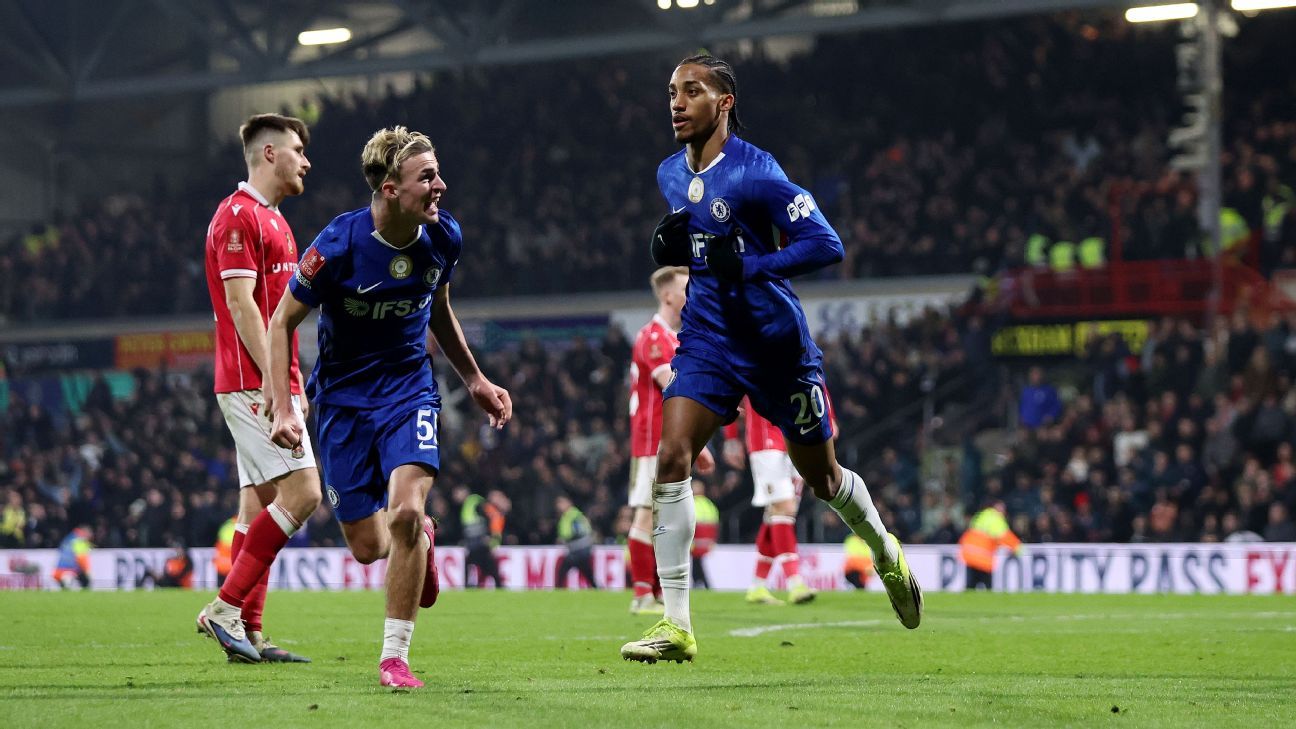
Garnacho orchestrated Chelsea’s initial goal and netted their third. In between, he provoked the second-half infraction by George Dobson, which resulted in the Wrexham midfielder receiving a red card from referee Peter Bankes subsequent to a VAR review for serious misconduct.
Dobson brought Garnacho down with a reckless high challenge as the winger surged along Chelsea’s left flank. It was a severe tackle, but it encapsulated Wrexham’s desperation in attempting to manage a player who has frequently showcased his capacity to influence crucial matches.
Had he displayed greater consistency, Garnacho would likely still be at United, but his potential was the reason Chelsea disregarded the negative aspects of his profile to secure his signing, a decision vindicated by his display against Wrexham.
The home side’s third-round victory against Nottingham Forest marked their first encounter with Premier League opposition since Mac and Reynolds acquired the club half a decade prior.
That fixture concluded with a penalty shootout win, instilling in Wrexham the conviction that they could ascend to the top division. While Forest demonstrated the essence of the Premier League, which Wrexham navigated, Chelsea delivered a stark lesson in the realities of competing at the highest level.
To endure in the Premier League, teams must contend with the swiftness and aptitude of players far superior and more consistent than Garnacho. Consider luminaries such as Mohamed Salah, Bruno Fernandes, Erling Haaland, or Bukayo Saka.
Garnacho might be considered a mid-tier attacking talent, and Wrexham will require several such players if they are to make the jump to the top division. Nevertheless, for the majority of this match, Wrexham contained their esteemed adversaries.
They claimed the advantage through forward Sam Smith after 18 minutes and felt comfortable enough to pursue a second goal. However, Chelsea consistently posed a threat on the counter-attack, which materialized in the 40th minute when Garnacho’s cross was diverted into the Wrexham net following a miscommunication between goalkeeper Arthur Okonkwo and George Thomason.
Wrexham’s resolve and resilience enabled them to regroup in the second half, and when they re-established their lead via Callum Doyle in the 79th minute, a place in the quarter-finals appeared within reach. Yet, within three minutes, Chelsea had equalized once more through Josh Acheampong.
The critical juncture arrived in the 90th minute when Garnacho burst down the left flank, and only Dobson’s reckless tackle could halt him.
Referee Bankes initially cautioned Dobson, but a VAR review led to the card being upgraded to a red, a ruling endorsed by Chelsea manager Rosenior – “It was a perilous challenge,” he stated.
The expulsion left Wrexham with ten players for the subsequent extra time, allowing Chelsea to exert greater pressure. Their superior calibre enabled them to dictate play and maintain possession, and Garnacho gave them the lead for the first time when he volleyed Dário Essugo’s cross beyond Okonkwo six minutes into extra time.
It was a clinical finish by Garnacho, further exemplifying his prowess. Still, Wrexham mounted a comeback and believed they had levelled when Lewis Brunt’s close-range effort was disallowed for offside by VAR.
João Pedro’s goal in the final minute, making it 4-2 to Chelsea, resulted in a scoreline that did not accurately reflect the entirety of the 120 minutes. But even though Wrexham exited the FA Cup, they demonstrated their capability to compete against the Premier League’s finest.
Their immediate objective now is to secure promotion, and Tuesday’s Championship fixture against Hull City is unquestionably of greater significance than this one.
As for Chelsea, their next challenge is Paris Saint-Germain in the UEFA Champions League, but they will undoubtedly return to Wrexham sooner rather than later; they can be certain of that.