
Obtain complimentary access to the Editor’s Summary
Roula Khalaf, the FT’s Editor, curates her preferred articles for this weekly bulletin.
A leading Goldman Sachs official communicated that the institution’s clients within the private investment realm express satisfaction that the conflict in Iran is offering a “diversion” from inquiries regarding the sector’s susceptibility to software.
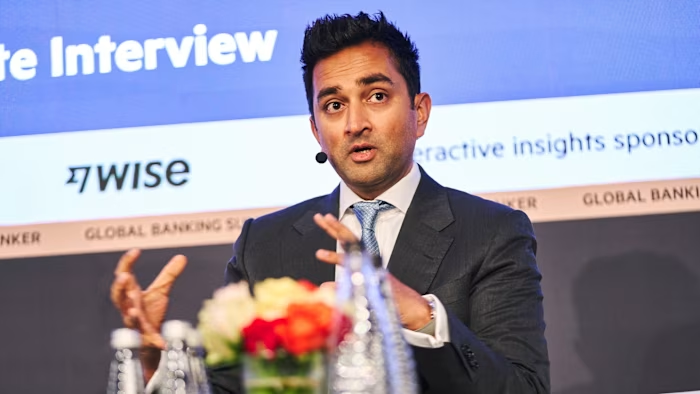
Kunal Shah, co-chief executive of Goldman Sachs International and global co-head of fixed income, currencies and commodities, delivered his observations during a conference call with patrons on Wednesday, a discussion also attended by Sir Alex Younger, the prior director of Britain’s Secret Intelligence Service.
Three individuals cognizant of the discussion, which bore the title “Strikes in Iran — End of the Beginning . . .?”, indicated that Shah noted certain of the bank’s “private markets clients” were “simply pleased there’s a topic of discussion apart from software vulnerabilities and private lending”.
“And this offers at minimum a diversion from that,” Shah appended, when answering an inquiry regarding Goldman’s patrons’ perspectives on the hostilities.
Goldman Sachs informed the FT: “An inquiry was posed to him concerning client feedback he was receiving, and he imparted his insights from diverse perspectives.”
Stock in publicly traded private investment and lending companies have sharply declined over the current year due to escalating concerns regarding their susceptibility to software enterprises potentially disturbed by artificial intelligence.
Private lending companies highly susceptible to technology companies have experienced exceptional strain. Equity in the technology-centric lender Blue Owl Capital, which indefinitely halted cash disbursements from its initial private consumer debt vehicle last month, has dropped nearly 40 per cent this year.
The industry’s biggest entities, for instance Blackstone and Apollo Global Management, have additionally shifted their emphasis significantly towards business financing instead of acquisitions lately, consequently, they have become entangled in broader anxieties concerning lending criteria within the realm of non-traditional credit provision.
Business bond markets have remained apprehensive since the concurrent insolvencies of Tricolor Holdings and First Brands Group amidst accusations of deceit in September of last year. JPMorgan Chase’s CEO, Jamie Dimon, observed following the failures that additional “cockroaches” could be lurking within credit markets.
Earlier this week, the FT conveyed that Goldman has proposed to hedge funds approaches to short-sell private business credit, providing a means to wager on the decline of the liabilities of corporate software firms and various sectors imperiled by AI.
The conflict involving Iran has ignited significant fluctuations across open markets, resulting in deficits for certain hedge funds owing to instability in energy commodities, debt instruments, and equity values.
Goldman’s conference, accessible to its hedge fund clients, also included observations from leading officials within its petroleum and electricity trading departments. Younger assumed the role of a compensated consultant to Goldman Sachs International in 2021.
Shah further stated during the discussion that certain of Goldman’s clients “demonstrate considerable fortitude” and “have endured events that bear resemblances in certain aspects”.
He elaborated that “patrons within the area are encountering difficulty adapting to these formidable perils. The intensity endures.”