
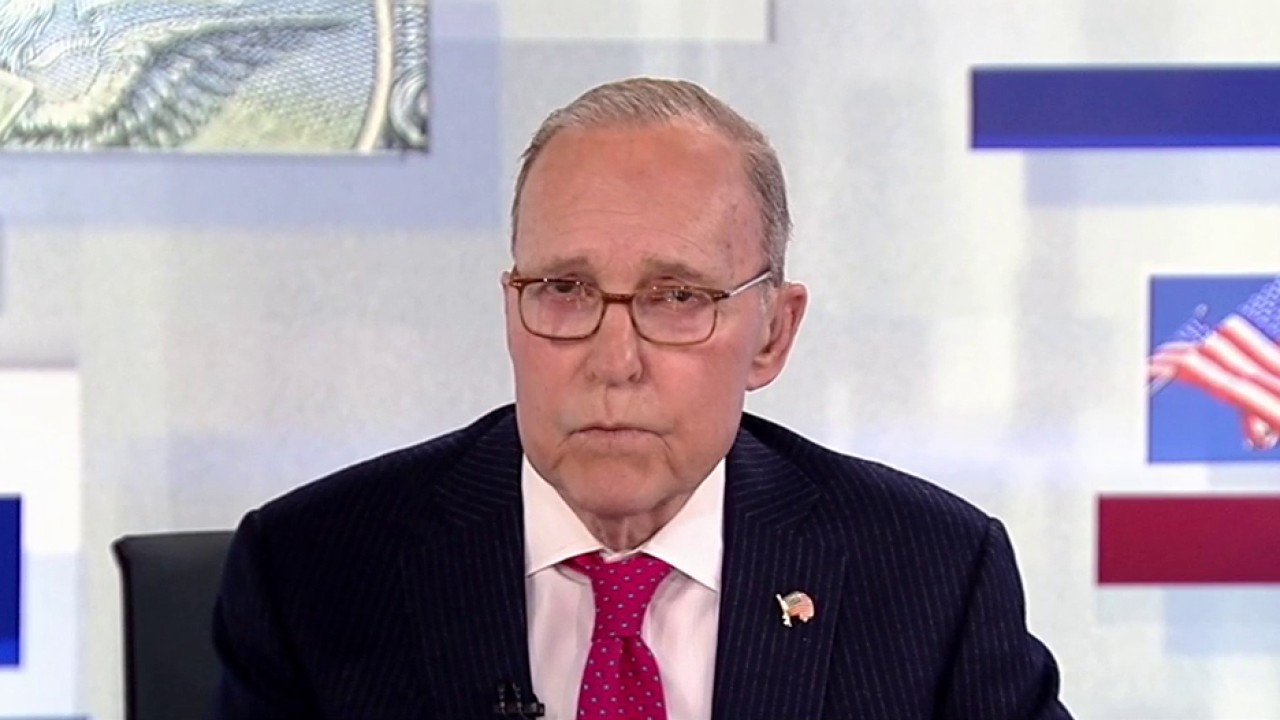
FOX Business host Larry Kudlow examines the repercussions of the Middle Eastern strife on inflation during his program ‘Kudlow.’
It is widely acknowledged that prices for crude oil and petrol have surged due to the conflict involving Iran. From my perspective, a minor sacrifice in the form of a modest rise in energy expenses is acceptable to vanquish the brutal extremist regime in Iran and fundamentally reshape the annals of history. Nevertheless, economists are still endeavoring to ascertain any potential ramifications for inflation and economic production.
I have observed numerous economic projections: recessionary outlooks, inflationary forecasts, stagflationary possibilities – every conceivable scenario is currently being posited. Additionally, I’ve noted many parallels drawn with the oil crises of the 1970s and early 1990s, perhaps even the Russian disruption of 2022. However, I would suggest exercising prudence when depending on these historical occurrences to predict future trends. For instance, this particular oil disruption seems quite short-lived. To reiterate President Trump’s statement: “the conflict will conclude imminently, as there are almost no remaining objectives to target.”
Ultimately, this conflict might only extend for a duration of four to five weeks, an insufficient period to truly exert any considerable consequence on the economy. A faint trace of energy inflation might be visible in the March Consumer Price Index figure, but this will likely be disregarded. It will not endure. In fact, the dollar’s exchange rate has actually appreciated, not declined. Moreover, unlike the 1970s, there is no supply disruption, as the majority of our oil is now extracted in America and Canada. Indeed, the paramount fact to recall is the significantly greater volume of oil we currently produce compared to that earlier period. “Extract, infant, extract.” Utter brilliance from Mr. Trump.
Israeli Special Ops veteran Aaron Cohen elucidates President Donald Trump’s ‘unpredictable conflict’ strategy against Iran, outlining how American coercive measures and the Navy’s Fifth Fleet presence are unnerving Iranian officials on ‘Kudlow.’
In the 1970s, oil extraction stayed below 10 million barrels daily, whereas today it stands at approximately 14 million. Furthermore, we currently lack salary and cost regulations or extensive queues at petrol stations, thanks to Trump-era loosening of regulations. Consequently, we do not presently face scarcity of provisions, nor are we truly dependent on Middle Eastern oil, despite being influenced by global oil prices. Gasoline prices have risen by about 50 cents per gallon – a matter of little consequence. While this will transiently diminish middle-class finances, it is also vital to recall that for oil producers, the elevated price actually advantages certain segments of the populace. It is no longer merely a one-sided reduction in consumer spending capacity.
An additional consideration is that interest rates have shown no substantial alteration. During previous energy disruptions, it appeared that escalating inflation propelled interest rates upward, which subsequently suppressed the economy. The 10-year Treasury yield has largely maintained itself around 4 percent, marginally higher. And the 30-year mortgage rate has held steady at approximately 6 percent. Consequently, we have experienced neither a genuine oil supply disruption nor a true interest rate upheaval. It is also probable that energy prices will decline beneath pre-conflict rates.
Consequently, Mr. Trump’s comprehensive, significant legislative package, encompassing fiscal reductions, administrative streamlining, and “extract, infant, extract,” will persist in generating favorable conditions for the economy once this conflict concludes. To investors, I suggest seeing beyond this transient disturbance.
Mr. Trump’s initiative, Operation Epic Fury, is reshaping the destiny of the Middle East and the entire world towards liberation. Moreover, liberty in the Middle East and across the globe will foster enhanced affluence. Therefore, I advise investors to perceive beyond the hostilities and recognize the immense prosperity that awaits thereafter.