
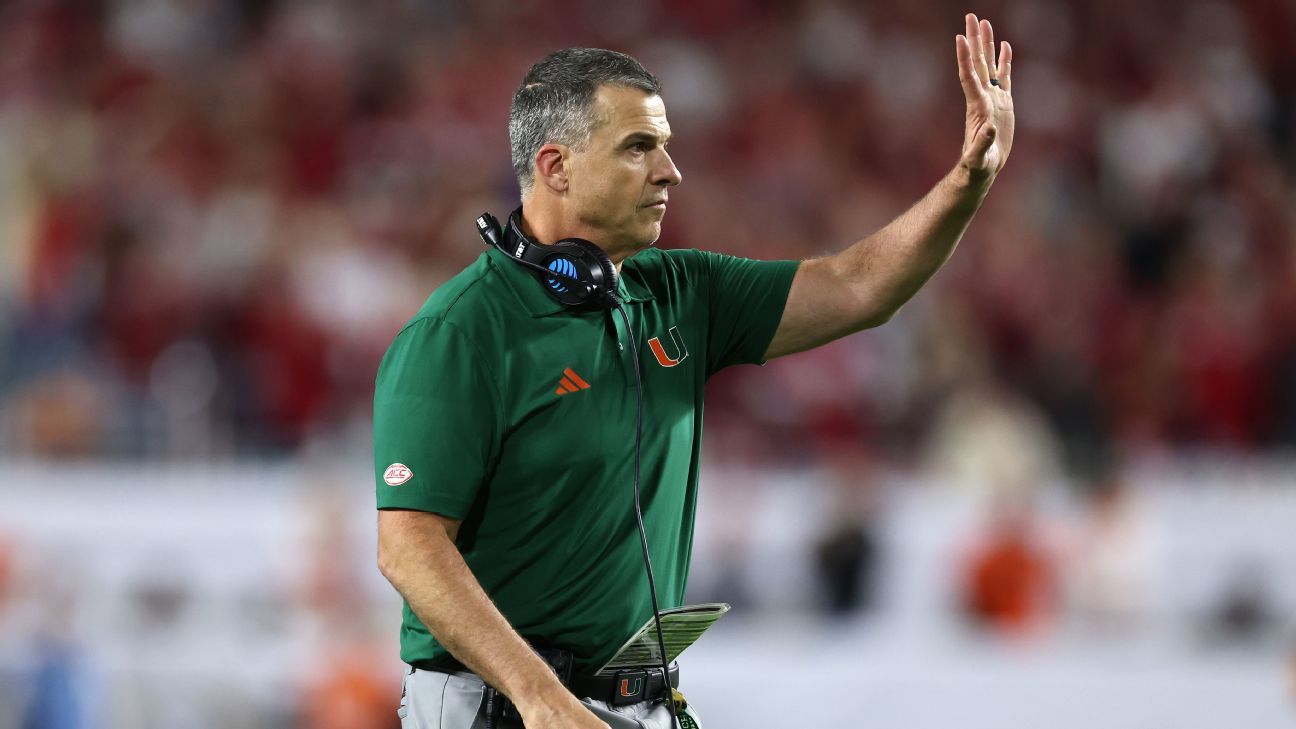
MARIO CRISTOBAL WASat last prepared to reflect, over a month after Miami’s season concluded. The Hurricanes had departed disconsolately from their home stadium pitch following a frenzied, late rally that was thwarted by a Carson Beck interception, which ultimately awarded the 2025-26 college football national championship to Indiana.
The frenetic pace of the contemporary college football schedule had demanded immediate attention following Miami’s championship defeat. Cristobal was immersed immediately in squad administration duties, striving to secure a few pivotal new additions late in the transfer process and persuading his current players to remain for another season. However, by late February, he at last found an opportunity to relax and reminisce about the journey – albeit through condensed 60-minute game films. Cristobal observed his team’s evolution, from the anguish of a midseason defeat against SMU and the tumult of the final playoff selections, to the unrestrained elation of Miami’s postseason campaign – overcoming Texas A&M, Ohio State, and Ole Miss before colliding with the formidable Hoosiers and narrowly missing victory.
“Remarkable,” he labeled it.
That description was somewhat understated compared to the descriptors most commentators employed for Miami’s performance — “shocking,” “improbable,” or “astounding” would have been more apt. Yet, Cristobal is not one to expend an effective persuasive argument on anyone he isn’t personally wooing into his program.
Indeed, Miami’s campaign was remarkable – remarkable in how it at last appeared to cast off the weight of a program stuck in a two-decade decline; remarkable in how it revitalized a long-slumbering fan base within the city; and remarkable in how Cristobal’s strategy to restore Miami to the preeminent power it had been during his athletic career in the 1980s and 1990s had finally yielded tangible outcomes.
However, above all, it was gratifying to observe a team develop as it unfolded.
“To witness us reach a juncture where we nearly clinched victory at the conclusion – I am simply pleased with our players and staff. I am also more driven than at any point, as all that effort culminated in significant advancement,” Cristobal stated.
Nevertheless, Cristobal isn’t pursuing mere “remarkable” outcomes. He desires greater achievements. Having glimpsed the summit, he is poised to ascend once more – with increased speed, greater methodical precision, and more ardent determination than previously.
During his initial team assembly following the championship defeat, Cristobal articulated a theme he intends to reiterate repeatedly in the upcoming months: “That belongs to the past year. This constitutes a distinct season. The groundwork must be re-established. Achieving a return is more arduous than merely reaching the destination.”
Consider the case of TCU.
Consider Washington.
Consider Notre Dame.
Each of them reached the championship match, rejoiced in their achievement, yet failed to return the subsequent year.
Cristobal’s Miami is not merely a fleeting success. Last year was remarkable. This year must transcend that. The ascent back to prominence commences on March 24, when the Hurricanes open spring practice and initiate the subsequent phase of a narrative Cristobal believes has only recently begun to unfold.
“That constructive frustration, which simmers because we failed to conclude it as desired, persists,” Cristobal articulated. “This will prove to be the most demanding inter-season period of our stewardship at Miami. A significant portion of last year’s team’s composition had records of 5-7 when they joined, and 7-5 prior to a shift in fortune. Many of these individuals arrived here already integrating into an already established playoff-contending squad. That represents a distinct genesis point.”
MIAMI ATHLETIC DIRECTORDan Radakovich encountered a similar situation a decade prior. His previous organization, Clemson, participated in a national title game to conclude the 2015 season. They faced a formidable Alabama squad and almost achieved an upset. While not precisely a pivotal moment for the program, it served as an essential foundational element. Clemson proceeded to secure the 2016 national championship and claimed it once more in 2018, qualifying for the four-team playoff for six consecutive years.
So, evidently, Radakovich possesses a master plan for how Miami will replicate that success, correct?
“It is a distinct epoch,” Radakovich observed.
At that time, Clemson was in the process of constructing a cutting-edge football facility, intended to indicate that the Tigers were prepared to compete among the sport’s foremost programs and attract top-tier prospects to Clemson. Miami also has a modern football facility being erected, but while these new premises are anticipated to be an advantage for future Canes, they do not constitute Miami’s foremost concern.
“Infrastructure remains crucial,” Radakovich stated, “but we exist in an environment where we must constantly seek out avenues for our student-athletes to secure financial remuneration.”
Consequently, a roster that allegedly entailed an expenditure of more than $30 million for Miami a year ago now requires reconstruction with additional millions – financed through revenue sharing and NIL deals. This includes a significant achievement towards the end of the transfer window, where Miami secured QB Darian Mensah in what several sources indicated might be the most substantial agreement of the NIL epoch.
The fact that Miami garnered $32 million in playoff earnings allocation from its path to the championship match undoubtedly assists, but Radakovich informed ESPN that sum barely covers a fraction of last year’s expenditure in football. To mount a subsequent challenge – one that advances the Hurricanes one more stride and helps establish the benchmark for the future – necessitates greater financial resources.
That, according to Radakovich, represents the most significant advantage of last season’s postseason journey. Donors are now actively involved. They perceive the value from their contribution. This facilitates the unleashing of funds for 2026 and subsequent years. The current challenge, however, lies in securing additional financial commitments.
“It is an incessant quest,” Radakovich commented. “Our group is pursuing fresh prospects and avenues, but we must continue to channel the requisite funds to sustain our progression.”
Cristobal is aware that those donors are available. He has encountered them, conversed with them, exchanged greetings and embraced them as they commemorated this Miami campaign which helped alter the perception surrounding the program. Consequently, he is now keen to discuss those teams that neared triumph only to fade – to alert all to the potential that, lacking sufficient backing, 2025 could readily transform into the pinnacle achievement.
He also discusses Clemson, Alabama, and Georgia – the teams that maintained their momentum after failing to win a title game, only to come back more formidable and improved.
Miami has not reached the pinnacle, Cristobal asserted. It stands at a crucial juncture.
“We comprehend that a program can swiftly decline, and Miami has already experienced that firsthand,” he declared. “We harbor no desire to revert.”
MAINTAINING SUPREMACY IN THEcollegiate gridiron landscape necessitated securing a quarterback. Miami secured arguably the premier choice available for 2026 when it recruited Mensah – who also was accompanied by his leading wideout from Duke, Cooper Barkate.
The narrative of Mensah’s arrival in Coral Gables, however, is found in a
The contemporary college football scene exists in a nebulous space, a fine line separating aggressive competitiveness from skillfully navigating every available regulatory gap.
Mensah declared his departure from Duke merely one day before the 2026 portal window concluded. This came despite a contract he had inked with the Blue Devils and prior pledges, made only weeks earlier, that he would remain committed in Durham for an additional season. The widespread understanding that Mensah was destined for Miami, notwithstanding regulations prohibiting unmediated communication between the athlete and the institution, only served to highlight the ambiguous landscape of college football’s transfer portal. Mensah’s eventual action, precisely as anticipated by the public following the resolution of legal action with Duke, provided abundant evidence that this entire scenario was unavoidable.
Cristobal, however, offers no apologies for his part. He aims to secure victories and relentlessly pursues talent through every permissible avenue within the established guidelines.
“Our approach dictates that if a player becomes available whom we believe can strengthen our football program, we will pursue him assertively and adhere to all necessary stipulations,” Cristobal stated. “That’s our mode of operation.”
Miami, after all, needed to be assertive. They, along with Indiana, were the last teams left standing, meaning by the conclusion of their season, the portal had largely been depleted, with fresh talent accessible only from the Canes’ and Hoosiers’ rosters.
“All the easily accessible prospects have been secured and claimed,” Cristobal remarked. “Now your own players are the coveted prospects everyone is targeting.”
Consequently, Miami had an irresistible offer for Mensah, and the Canes’ offensive unit — featuring the return of Malachi Toney and Mark Fletcher Jr., among numerous other skilled players — is expected to be exceptional in 2026. Cristobal’s assertive and refined recruitment philosophy meant Miami faced fewer portal requirements this year compared to previous seasons, as a wealth of promising young talent appears poised to ascend the depth chart.
If 2025 demonstrated a Miami squad maturing in real-time, then 2026 is projected as the year everyone recognizes Miami’s ascent, and similar to the Mensah acquisition, they will simply be unable to prevent the inevitable outcome.
“Our strategy was to construct the roster in a way that allows for continuous development, thereby enhancing every aspect,” Cristobal explained. “I believe this is sustainable and will continue to improve incrementally year after year.”
CRISTOBAL WAS PRESENTat the podium following Miami’s defeat to Indiana, bridging the discussion between lauding Miami’s substantial achievements and acknowledging his team’s failure to reach its ultimate objective. It seemed as though the attending journalists were encouraging him to accept a secondary accolade.
He refused to do so.
“I believe that’s the biggest misunderstanding in sports: ‘Well, they nearly made it; they’ll return next year,'” Cristobal asserted. “That’s absolute nonsense. You must enhance the roster, the training regimen, discipline, everything, and progress. And these individuals have established the benchmark to help us reach that point.”
Cristobal is accustomed to these struggles. He has engaged benefactors, articulated a vivid portrayal of his program’s vision, and subsequently delivered outcomes. He has advocated for securing funds for the new facility, for his roster, and for a coaching staff ranked among the nation’s finest — and best compensated. He has instilled in his players a work ethic cultivated during his own playing career at Miami — “forged on Greentree” is the recurring mantra, referencing the Canes’ renowned practice grounds — and he has witnessed the fruits of that dedication.
What Cristobal has not yet had to do is persuade a team that has already experienced triumph to wipe the slate clean and restart the entire endeavor.
That is his current responsibility.
“There’s an understanding that we reached that level, we belong there, and we must maintain that drive and focus; that’s crucial for us to continue ascending through the ranks,” Radakovich commented. “And Mario excels at that.”
Winning an ACC title would be desirable, Radakovich noted. Miami fell short of that goal last year due to an unusual tiebreaker.
Making another push for the playoff is essential. The opportunity quickly diminishes in this new era. The financial support sustaining the program dries up when losses begin to mount.
And then there’s that sensation Miami felt walking off the field at Hard Rock Stadium in January, as Indiana celebrated behind them.
Cristobal can now reflect and appreciate how enjoyable the journey was. It was so much fun, in fact, that the only logical course of action is to undertake it again.
“We are achieving victories,” Cristobal declared, “and the desire for winning has never been stronger.”