
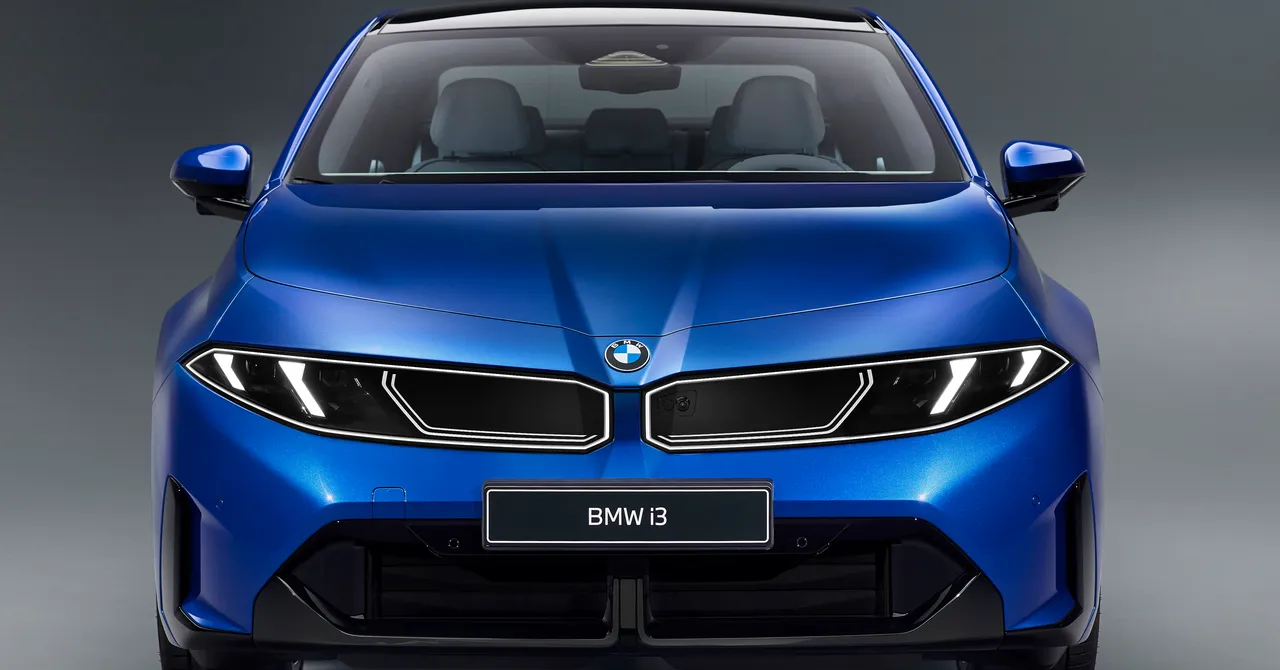
Regrettably, the superbBMW i3, a contemporary exemplar, has not reappeared since its retirement in 2022. Instead, what’s presented here is the entirely new electric-powered 3 Series variant from the German car manufacturer, serving as the subsequent vehicle to emerge from its most recent adaptable “Neue Klasse” EV platform. Given the immense quantity of worldwide 3 Series distribution for BMW, this novel i3 might arguably be even more significant than the inaugural Neue Klasse product, the iX3, which WIRED evaluated earlier this year and greatly esteemed.
The “Neue Klasse” platform, which BMW has been developing for years, entails novel motors, updated inverters, fresh batteries, advanced charging technology, and contemporary cabin screens. Crucially, a robust, unified computer control unit, engineered precisely for vehicle handling, is intended to enable these newest EV Beemers to perform more adeptly than many widely believed achievable for an electric vehicle. This effectiveness is demonstrated by WIRED’s experience driving the iX3.
These advanced batteries utilize an “integrated cell-to-pack” design, featuring fluid-cooled tubular cells with higher nickel and reduced cobalt content, yielding a 20-percent increase in power compactness. An 800-volt architecture enhances recharge rates by one-third, reaching up to 400 kilowatts. However, the significant revelation is that this sedan surpasses its counterpart, the iX3, in its advertised range figure. While the SUV states a 500-mile WLTP maximum range metric (400 miles in the more pragmatic US Environmental Protection Agency test), the more aerodynamically efficient i3 50 xDrive exceeds this by achieving a remarkably compelling 560 miles, all while delivering 469 horsepower and 645 Newton-meters of torque from its dual electric motors.
Constitutng the largest ever monetary commitment in BMW’s history, this electric-powered premium saloon, alongside the iX3 and the four other forthcoming vehicles on the Neue Klasse platform, represents a monumental endeavor. Nevertheless, even amidst the uncertain condition of the automotive sector in the West currently, exacerbated by President Trump’s conflict with Iran and the consequent fuel cost increases, the i3 emerges at a juncture when many consumers might be re-evaluating a transition to electric propulsion from internal combustion.
No information as of yet regarding the i3’s cost or when shipments will commence in the latter half of this year, but BMW will undoubtedly be hoping fervently that this EV will find favor with customers and reverse current tendencies of car manufacturers like Honda and Porsche scaling back on electric plans and reverting to hybrid and solely internal combustion vehicle manufacturing. Only time will reveal its success, but its notable autonomy will be beneficial, as will the loyal preservation of the Vision concept’s aesthetic, which captivated numerous design enthusiasts at the time. BMW has evidently striven diligently to maintain that appealing, sleek fascia.
While the measurements are approximately identical to the present G20 3 Series, the visuals provided here indicate an extended axle span and reduced projections. The front grille and dual headlamps coalesce into a striking illumination pattern. Firsthand, its remarkable aesthetic is appropriate for what is essentially a full re-envisioning for the 3 Series.
The i3’s other capabilities parallel those of the iX3, encompassing vehicle-to-load (V2L) for supplying energy to domestic devices from the car; vehicle-to-home (V2H), where battery power can be supplied back to your residence; and vehicle-to-grid (V2G), which enables consumers to return energy to the power grid, should one choose to transform their electric vehicle into a potential income source.
{content}
Source:{feed_title}