
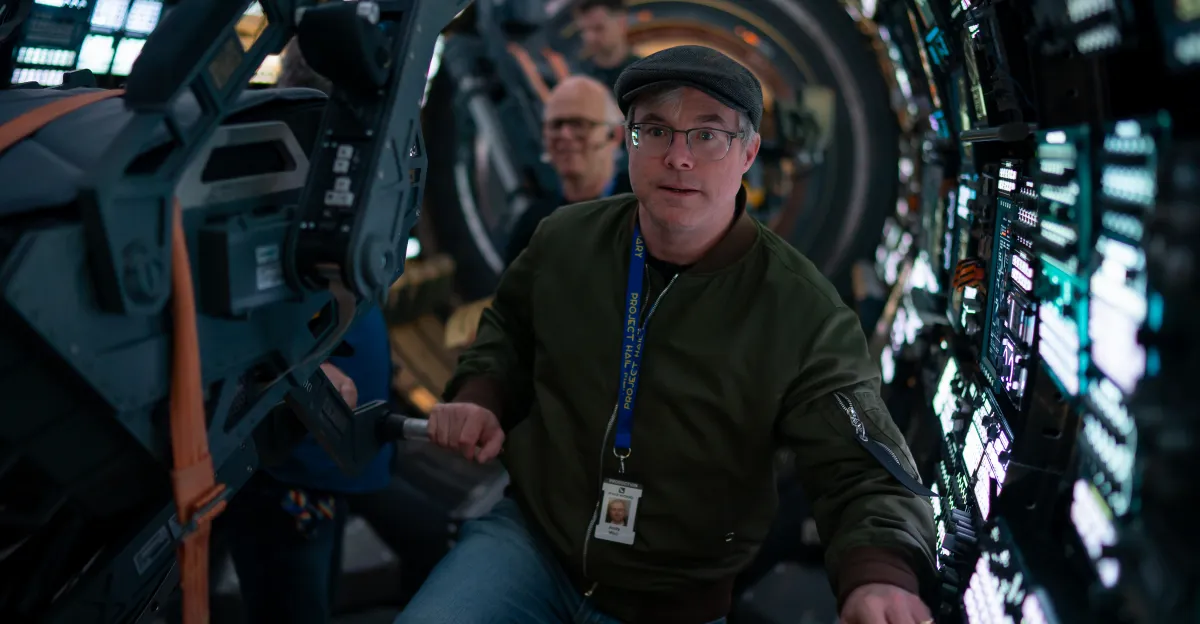
Andy Weir has achieved considerable success concerning screen adaptations. His debut novel,The Martian, was adapted into a film in 2015, and the cinematic production helmed by Ridley Scott garnered over $600 million in theatrical revenue. Furthermore,Project Hail Maryrecently experienced an impressive debut weekend, positioning it as a contender for one of the year’s top cinematic releases. Nevertheless, notwithstanding such triumphs, Weir conveys to me that he endeavors to dismiss any thoughts of a film adaptation when commencing a fresh literary work. “I try not to think about it at all,” he elucidates.
Weir attributes this, in his view, to the inherent disparities between the two artistic forms. This realization has crystallized for him over the past decade, especially concerningProject Hail Mary, where he fulfilled the role of a producer. “My engagement extended to every facet of the creative process,” he expounds. “I attended the filming sessions, the core visual capture; my involvement encompassed selecting actors and filmmakers, as well as the stages of post-creation and refinement. I had the opportunity to provide feedback across the board. My primary designation as a producer stems from the specific terms of my agreement, however, predominantly, I endeavored to avoid impeding the seasoned producers who possessed genuine expertise.”
This position afforded him greater understanding of cinematic production — regardingThe Martian, he recounts, “I was simply compensated and dismissed” — yet, he maintains that his involvement with both productions has not altered his method for crafting literary works.
He elucidated it for me thus:
While composing a novel — a piece of counsel I extend to all writers — I do not contemplate a film adaptation. Should your ambition be to create a film, then author a screenplay. However, if your desire is to produce a book, then craft a book. Your primary attention ought to be on the reader’s journey as they engage with your literary creation. Avoid constraining your creativity by the requirements of a successful cinematic feature. Instead, concentrate on the elements that constitute a compelling literary work. Given the myriad possibilities inherent in books that are unfeasible in films, and conversely, it is prudent to leverage your expansive creative scope and the inherent adaptability of the written form. Employ these diverse instruments fully, instead of restricting yourself to essentially fabricating a novelized version of a film pre-existing in your imagination.
“He possesses these magnificent, grand-scale, cinematic concepts,” Goddard observes. “His narrative construction is superb. From my individual perspective, the profound essence of his prose truly elevates it. This is readily missed, given the magnitude of his concepts and the prominence of rigorous scientific detail, leading me to believe many attribute his triumphs solely to these factors. Yet, for my part, I appreciate his exploration of more profound humanistic subjects. He himself would likely deny this, asserting his aim is merely to entertain. I respectfully differ. I discern exquisite motifs of human empathy and sentiment woven subtly within his prose, and I perceive my task as extracting that essence and projecting it cinematically.”
This, ultimately, was what enabled Goddard to overcome his preliminary apprehension regarding the screenplay forProject Hail Mary. “I recognized the imperative to make an attempt, owing to my profound affection for this literary work,” he affirms.
{content}
Source:{feed_title}