
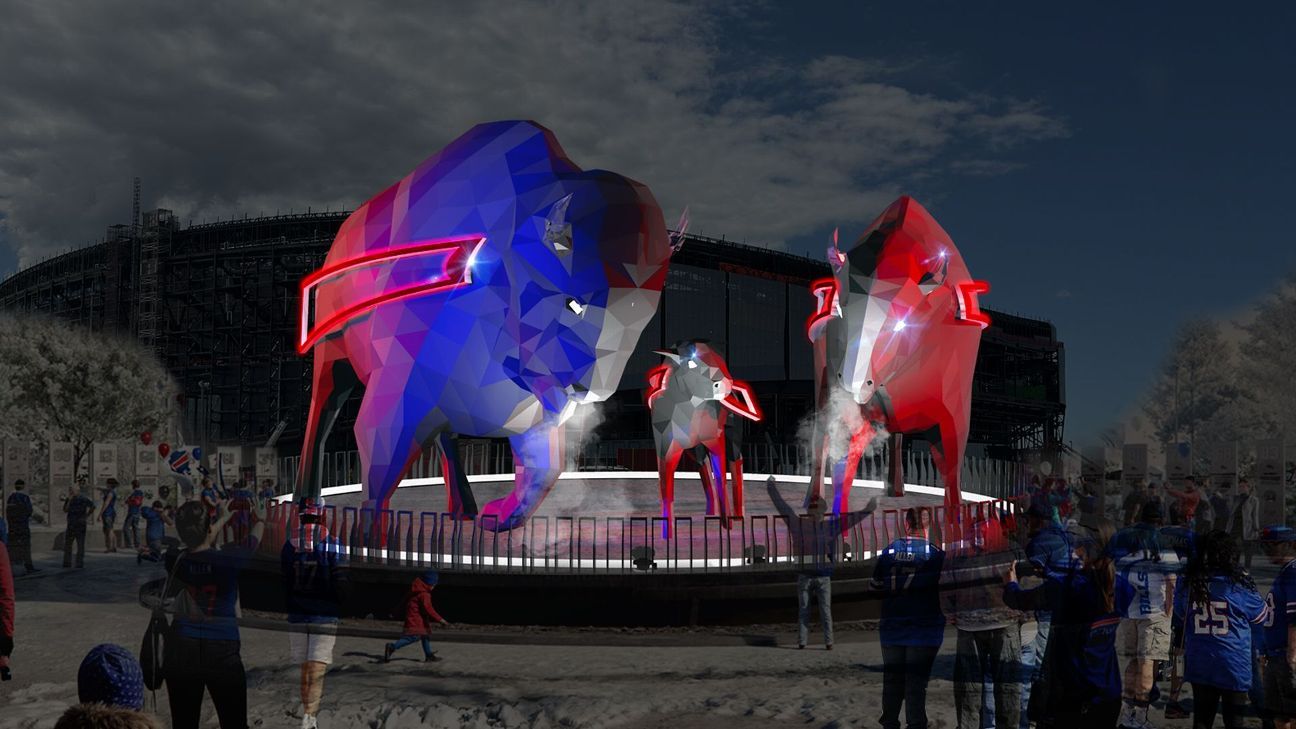
ORCHARD PARK, N.Y. — Finally, they have arrived. The formal designs for the bison sculptures—poised for a prominent location beyond the Buffalo Bills’ upcoming Highmark Stadium—are being disseminated as the venue approaches its finalization for its 2026 season debut.
Frank Cravotta, the Bills’ senior vice president of design, conveyed to ESPN during a dedicated discussion on the design methodology that the scrutiny surrounding these elements indeed caught him off guard. The bison sculptures and the Family Circle form a section intended to serve as the initial greeting point for the fresh stadium, and a location conceived for continuous, year-round utilization. Key details include: The exhibit will showcase three stainless steel bison—a bull, a cow, and a calf—sculpted in the likeness of the American bison. The male figure will stand roughly 24 feet high and 29 feet in length, the female 19 by 23 feet, and the young one 9 by 13 feet, with each resting on a 3-by-4.5-foot pedestal. Additionally, several common misunderstandings need addressing. The sculptures were never conceived as the globe’s loftiest, they will not be accessible for climbing, and earlier disseminated pictures constituted preliminary drafts, not definitive blueprints.
Consequently, what was the origin of this entire initiative?

Developing the Family Circle:During the initial stages of conceptualizing the Bills’ approximately $2.1 billion stadium (including $850 million from public funds), a particular plot in the northeast captured the notice of the architects. This space might have been converted into a parking facility. Nonetheless, they opted to transform the location into a kind of main entrance for a stadium aspiring to be a constant, year-round attraction.
The notion of incorporating a sculpture as part of this concept emerged as early as 2022. While a statue honoring previous Bills owner Ralph Wilson stands outside the venerable stadium, this new undertaking held a rather distinct and firm overarching vision from its inception: bison.
The locale will be named “Family Circle,” an homage to “Bills Mafia”—a term where, as Buffalo-born rapper Benny the Butcher declares in the team’s anthem, “mafia signifies family.” The public square will be fashioned in the outline of an American bison’s footprint.
Though the Bison sculptures have garnered considerable interest prior to the stadium’s inauguration, the precinct offers considerably more.
“A key aspect of my role, I believe, is to aid in surpassing anticipations,” Cravotta stated. “… Given the antiquated nature of what lies across the street, why not transition to something exceptionally well-conceived?”
The site will feature informational plaques detailing the heritage of western New York, encompassing the Indigenous American tribes indigenous to the area, alongside local flora.
This zone will incorporate tributes to every inductee of the team’s wall of honor, encircling the Bison with their narratives. Regarding the inclusion of former running back O.J. Simpson, whose appellation persisted in the previous Bills stadium, Cravotta noted that no definitive choice has been made, and the design group is making provisions for either outcome.
Conceptualizing the Bison:During 2024, the organization disseminated a nationwide request for qualifications (RFQ) to identify artists proficient in expansive public art installations. Out of 144 candidates, 20 were assessed as eligible and proceeded to the request for proposal (RFP) phase, receiving further specifications and an honorarium for developing preliminary models. Subsequently, that cohort was winnowed to seven individuals.
The selection committee—comprising Bills leadership and Populous designers, with owner Terry Pegula endorsing the group’s suggestion—maintained an inclusive approach, welcoming diverse artistic expressions, spanning from conventional bronze statuary to more avant-garde or abstract ideas.
“Ultimately, our selection gravitated towards a middle-ground choice—a forward-thinking creation,” Cravotta remarked. “…Our structure itself, upon examination, is progressive. It isn’t merely an artistic pronouncement; it deviates from tradition. It embodies modernity and somewhat challenges boundaries, correct? As [Pegula] has articulated, we must honor what has passed and welcome what is to come.”
Blessing Hancock, a seasoned artist specializing in expansive sculptures, was chosen. Her submission distinguished itself by integrating the team’s identity via the dynamic charging motifs present in the emblem.
The subsequent challenge involved harmonizing Hancock’s artistic conception with naturalism—a process involving extensive deliberation concerning anatomy—to guarantee the sculptures’ accurate proportionality to an American bison. Presently, these figures are under fabrication in Lancaster, Pennsylvania, and will be conveyed 313 miles to Orchard Park using flatbed trucks prior to their crane-assisted placement.
The bison will incorporate five illuminated components—including their eyes, nostrils, and the dynamic charges along their forms—and a carbon dioxide mechanism will generate visible vapor from their muzzles, a concept suggested by Pegula. The sculptures also interact with one another: the bull is depicted as lunging ahead, one foreleg elevated, while the cow inclines towards the calf.
A final determination yet to be made pertains to the horn configuration, with choices encompassing synchronized pairings or a more polished texture.
Considerable deliberation occurred regarding how to convey clearly that the sculptures are not intended for physical contact. The design team reviewed precedents like the barriers employed around non-hazardous animals in zoological parks.
The bison will rest upon a plinth encircled by a three-foot stone perimeter, complemented by a raised platform and inverted stadium architectural elements that constitute a barrier resembling a fence.
Beyond the Bison Sculptures:Cravotta, an indigenous resident of western New York who has collaborated on numerous ventures with the Pegulas, characterized the upcoming stadium as the “endeavor of my existence.” His tenure commenced with the Buffalo Sabres in 2004—prior to the Pegulas’ ownership of the franchise—subsequently designing the changing facilities and overseeing various other undertakings.
“The bison sculptures have demanded considerable effort,” Cravotta stated. “The stadium contains a multitude of enjoyable features that will undoubtedly captivate people as genuinely impressive. Intriguingly, these elements are not currently subjects of discussion, yet I contend there are scores of remarkable aspects awaiting discovery by any Bills supporter.”