
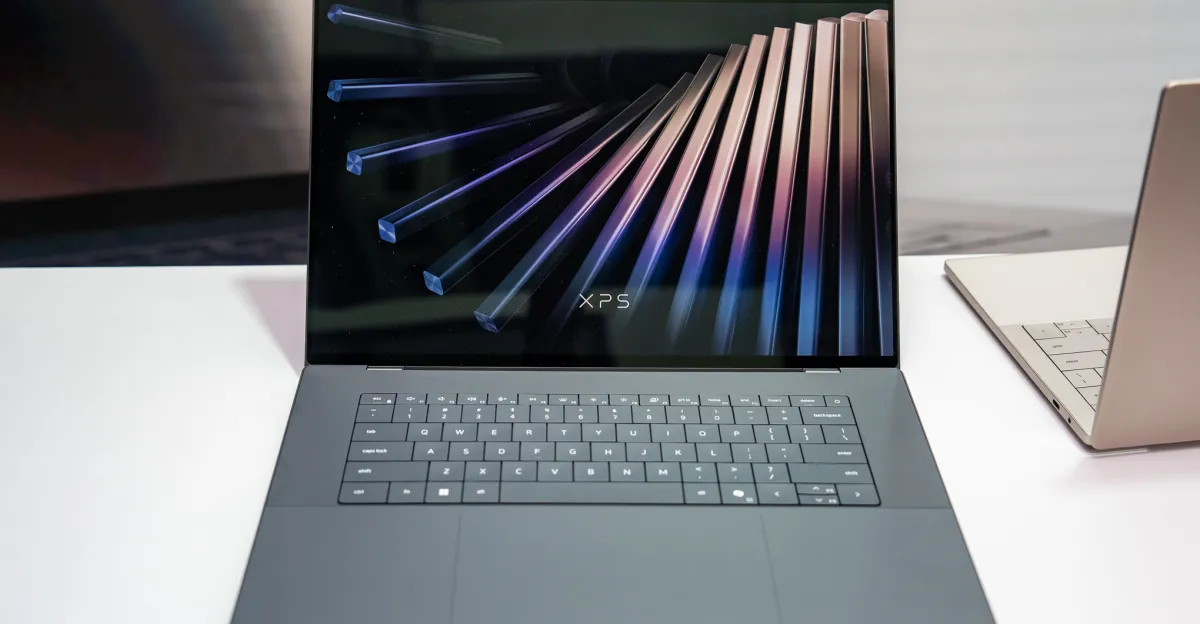
How modest could its power demands truly be?Notebookcheckhas put a particular iteration of this laptop, featuring the specified LG Display panel and a novel Intel Panther Lake processor, through its assessments. The outcome suggests it is the most energy-efficient portable computer ever evaluated in their Wi-Fi web navigation test. When inactive, the Core Ultra 325 notebook consumed merely 1.5 watts. Furthermore, it managed to sustain nearly 27 hours of internet browsing, despite being equipped with just a 70 watt-hour power cell. This capacity is notably less than the 99.5Wh Dell has at times integrated into its 16-inch configurations.
This endurance on battery power exceeds whatNotebookcheckhas observed from any MacBook or MacBook Pro model. Furthermore, it apparently outperforms every other laptop, with the exception of just two, since their testing protocol began in 2014. Considering those two outstanding devices, one employed a Qualcomm Snapdragon X Plus processor, a more capacious 84Wh power cell, and merely a 60Hz display. The other, conversely, featured a dual-battery configuration totaling 149Wh, alongside a 60Hz screen.
A word of caution: we generally observe a considerably shorter battery duration during an actual workday than what is reported in standardized, controlled battery life assessments. Yet, when contrasted with other portable computers, this synergy of Dell, Intel, and LG Display components emerges as the new frontrunner in power autonomy. It is pertinent to note that Dell also markets this device with a superior-resolution tandem OLED panel; nevertheless, attaining the paramount battery performance necessitates opting for a 1920 x 1200 display without touch capabilities.
While Dell merits substantial recognition for its role as the system integrator, this specific technological innovation might not remain exclusive to Dell for an extended period. LG Display recently proclaimed its status as the world’s first to initiate mass production of a 1–120Hz laptop LCD panel, which it brands as Oxide 1Hz. Furthermore, the company projects to commence volume production of an OLED iteration in 2027. Intel, for its part, is also broadening its collaborations beyond a solitary display provider: last October, it disclosed a partnership with the Chinese panel producer BOE, aiming to develop computers with 1Hz refresh rates as well.
{content}
Source:{feed_title}