
Keep apprised with complimentary news
Simply subscribe to the Conflict in Ukraine myFT Summary — sent straight to your inbox.
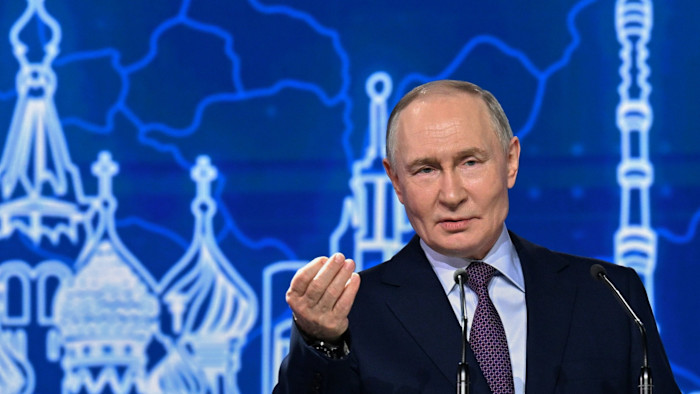
Vladimir Putin has beseeched affluent business leaders to contribute to Russia’s treasury in an endeavor to stabilize the nation’s finances as he persists with his military campaign in Ukraine, according to three sources knowledgeable about the situation.
The statements made by Russia’s president to a large gathering of prominent entrepreneurs on Thursday underscored his resolve to prosecute the war to a triumphant conclusion, notwithstanding the increasing pressures on the Kremlin’s budget.
Russia will continue its fight, Putin affirmed, until it seizes the remaining territories of Ukraine’s eastern Donbas region not currently under its command, as reported by two of the individuals. He asserted that this decision was essential because Ukraine had declined to unilaterally withdraw from the Donbas during recent negotiation rounds facilitated by the US, the sources added.
The Russian head of state had endorsed what he perceived as a conciliatory proposal to transform the Donbas into a “demilitarized zone” or a “special economic zone” backed by the US, but abandoned the concept after Ukraine clearly indicated that relinquishing the territory was a critical boundary, one person stated.
Putin’s plea to the oligarchs represents the most recent in a series of efforts since the full-scale invasion of Ukraine to solicit funds from Russian enterprises to support the Kremlin’s extensive military expenditures — and it marks the first occasion Putin has directly solicited these magnates himself.
In January, the Kremlin elevated VAT by 2 percentage points to 22 percent, aiming to generate an additional Rbs600bn ($7.4bn) over three years from small and medium-sized businesses. Russia also amassed Rbs320bn through a singular 10 percent extraordinary profit tax on certain major corporations in 2023.
Economy minister Maxim Reshetnikov independently announced on Thursday that Russia is contemplating another windfall tax this year if the rouble’s value continues to decline.
The Kremlin’s defense spending escalated by 42 percent, reaching Rbs13.1tn last year.
Russian independent news outlet The Bell was the first to report Putin’s comments. Dmitry Peskov, Putin’s spokesperson, did not immediately provide a response to a request for comment.
Putin’s personal appeal to Russia’s oligarchs renders it virtually inconceivable that they would reject the request. The country’s business elite have largely rallied in support of the president despite their reservations about the conflict and its repercussions for the national economy.
At least two of the business leaders informed Putin they would gladly make voluntary contributions to bolster the budget, according to the individuals familiar with the matter.
Suleiman Kerimov, a wealthy businessman reportedly connected to the contentious recent acquisition of prominent online retailer Wildberries, expressed his readiness to make a Rbs100bn donation, they noted.
Metals industrialist Oleg Deripaska also consented to contribute when asked, they further stated. Representatives for Kerimov and Deripaska did not promptly reply to inquiries for comment.
Fierce drone warfare at the front lines has impeded Russia’s progress in the Donbas — a cornerstone of Kyiv’s resistance against Putin’s invading forces since 2014 — and resulted in a significant increase in casualties among the country’s troops.
The most recent round of peace negotiations faltered in January amidst Ukraine’s defiance of Russia’s extensive territorial demands and Putin’s insistence on achieving the objectives he articulated when he initiated the war in February 2022.
Russia’s fiscal shortfall for January and February surged to over 90 percent of the amount projected for the entire year as US sanctions compelled Moscow to sell its crude oil at substantial markdowns and deterred purchasers.
Moscow has received a temporary financial injection of up to $150mn daily in additional oil earnings after the US and Israel commenced their conflict against Iran nearly a month ago.
Russia declared on Thursday that it was no longer selling Urals, its primary crude blend, at a reduced price compared to Brent, the global benchmark. The US also eased sanctions on Russia’s oil exports earlier this month.
The finance ministry had intended to tighten regulations on channeling oil revenues exceeding a specified price threshold into the depleted National Wealth Fund before the onset of the Iran conflict.
However, Putin advised the oligarchs to utilize this unexpected gain to strengthen their financial standings, as per Alexander Shokhin, president of the Russian Union of Industrialists and Entrepreneurs advocacy group.
Shokhin conveyed to Russian media that Putin had expressed hope that the Iran war would conclude within “three to four weeks.” Putin cautioned Russia’s finance ministry and the business community “not to rely on this windfall to endure for an extended period,” Shokhin added.