
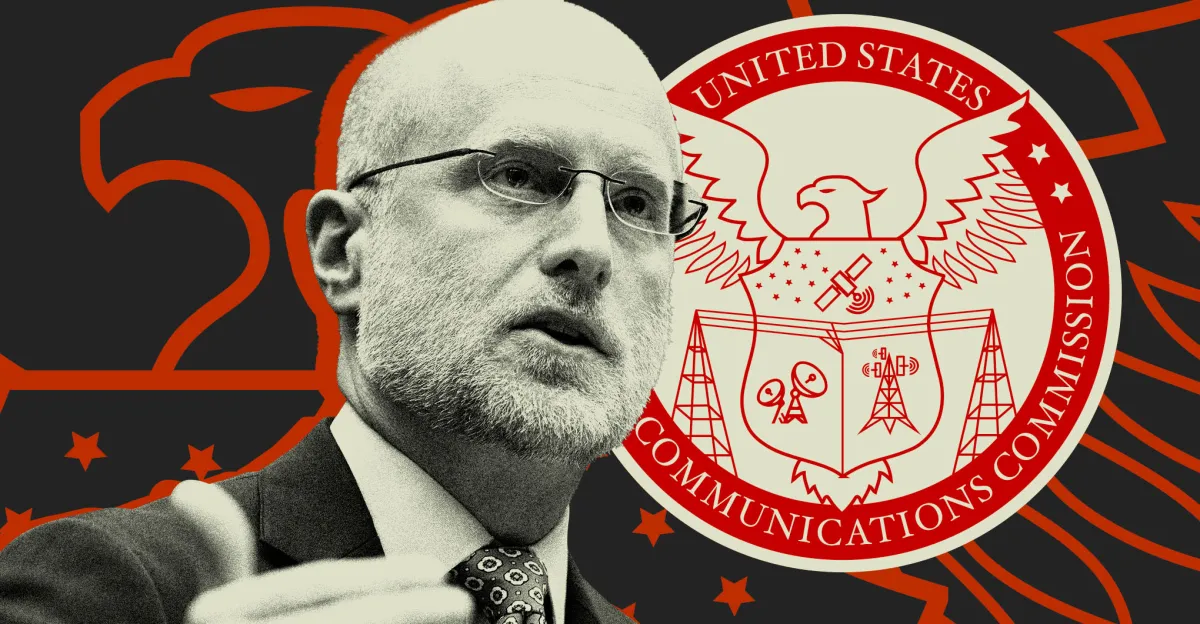
Federal Communications Commission Head Brendan Carr had no intention of jeopardizing broadcasting permits due to their reporting on the conflict in Iran, he informed journalists after a gathering organized by FGS and Semafor.
“My remarks did not actually concern the Middle Eastern conflict,” Carr stated when queried by The Verge about his pronouncement regarding the war’s depiction. “I comprehend why individuals make that assertion. My declaration involved citing a social media post.”
On March 14th, Carr re-posted an image of a Truth Social update from President Donald Trump, who had deplored “a purposefully deceptive title” connected to American military operations in the Middle East. “Stations disseminating fabrications and factual misrepresentations – often termed as false reports – now possess an opportunity to adjust their direction prior to their permits being due for extension,” Carr posted in reply. “The regulation is unequivocal. Broadcasting entities are obligated to function for the public’s benefit, and failure to do so will result in the forfeiture of their permits.” His statements were extensively interpreted as a menace concerning unfavorable war reporting.
Carr had earlier cautioned station operators they might forfeit their broadcasting permits for featuring evening humorist Jimmy Kimmel, and Disney temporarily removed his show after the remarks, which Carr has subsequently justified and contended were never a menace. During the Thursday gathering, Carr declared he possessed no intentions to revoke broadcasting permits. “One can never be certain, but I currently hold no intentions,” he remarked. “Perhaps we shall, perhaps we shan’t, as a notable figure might articulate.”
“One can never be certain, but I currently hold no intentions”
“The sole instance where we have considered revoking broadcasting permits applies to operators failing to serve the public’s best interests, who disseminate broadcast fabrications or distort factual reports,” he explained. “Provided you refrain from such actions, you are free to report on any subject in any manner you choose.”
Carr has been encouraged by observing digital platforms such as X and Meta amend their guidelines in manners he perceives as more equitable. “This type of market adjustment has led to a reduction in numerous demands for governmental oversight,” he stated during the live discussion with Semafor’s Rohan Goswami. Later, in conversation with journalists, Carr mentioned he has “somewhat ceased discussing freedom of expression” concerning technology platforms during his tenure as head of the commission, asserting that “individuals become perplexed” regarding what he views as distinctly separate matters pertaining to internet platform policies versus those of broadcasters, whose permits fall under FCC regulation. The commission recently sanctioned a consolidation between NextStar and Tegna, allowing the combined entity to serve 80% of American television homes, exceeding the 39% ownership cap.
The demand for oversight of technology platforms has subsided as what Carr considers “unacceptable behavior” has lessened. When queried whether it constitutes content-driven regulation if its necessity shifts depending on what platforms opt to oversee, Carr affirmed that it remains entirely about behavior. “It is when entities possess significant market influence, or when they misuse that power in a manner that suppresses personal freedoms, I believe that potentially establishes the groundwork for oversight.”
When questioned during the event if he has misused the resources available to him, in the way he has alleged Democrats have done, Carr stated he has adopted a straightforward method. “Why not simply enforce the legislation in an impartial, equitable manner? Which, in my estimation, is precisely what we are accomplishing in this situation.”
{content}
Source: {feed_title}