
With under a month remaining until the 2026 NFL draft, teams are diligently refining their prospect evaluation charts. It proves challenging for each organization to reach a unified agreement, as there are consistently diverse viewpoints spanning front offices, coaching staffs, and scouting departments. Everyone has their *preferred prospects* — the athletes they ardently champion, asserting their necessity within the team’s strategic blueprint.
These lively discussions were always enjoyable during my tenure as general manager and executive vice president for the Jets (2006-12), and subsequently as executive vice president of football operations for the Dolphins (2015-18). I recall extensive deliberation in the early predraft meetings of my inaugural year leading the Jets, concerning our approach at pick No. 4. We discussed defensive end Mario Williams before it became apparent he was destined for Houston at No. 1. Running back Reggie Bush garnered some support in the room, and many individuals desired tight end Vernon Davis.
I was among those fervently advocating for offensive tackle D’Brickashaw Ferguson. Our aerial protection needed enhancement, and Ferguson possessed the dimensions and characteristics to be an essential cornerstone player. With Williams and Bush swiftly chosen (along with Vince Young), we selected Ferguson instead of Davis.
Such deliberations will unfold within team organizations across the league in the forthcoming weeks. And this process extends past Round 1; when teams are roughly 15-20 selections away from their Day 2 and Day 3 picks, everyone begins to assess who remains available and identify a small group of players they believe could be obtainable at their specific selection point, before concentrating on the ultimate target.
Considering all these points, I decided to undertake an analogous task, revisiting my origins as a GM and identifying *my preferred prospects* for this 2026 class. However, instead of tailoring it to any particular team, I constructed a concise draft list encompassing all seven rounds for a fictional Team X. Without any predefined squad requirements. Ignoring title contention or restructuring phases. Disregarding tactical approaches or staffing inclinations in the evaluative process. Solely the athletes I would desire for my roster. I delineated a few names in Rounds 1-4 and then selected a dark horse candidate in each of the final three rounds. (I eschewed the top 10 in Round 1 to forego evident choices.)
Let us now vehemently present our arguments for some prospective standouts.
Navigate to a phase:
1 | 2 | 3 | 4 | 5 | 6 | 7
Initial-round candidates I would pursue beyond the top 10

Makai Lemon, WR, USC
I admire his game approach — he’s unyielding and robust. Certainly, Lemon might commence in the slot, where he primarily played for USC. But I believe he’s substantial enough at 5-foot-11 and 192 pounds to play outside in the professional ranks. Lemon excelled in contested reception scenarios in college, with 11 of them in 12 games last season. He concluded with 11 scores and ranked third nationally in receiving yardage per contest at 96.3. With Ohio State’s Carnell Tate and/or Arizona State’s Jordyn Tyson topping many wide receiver lists, Lemon should be available outside the top 10.

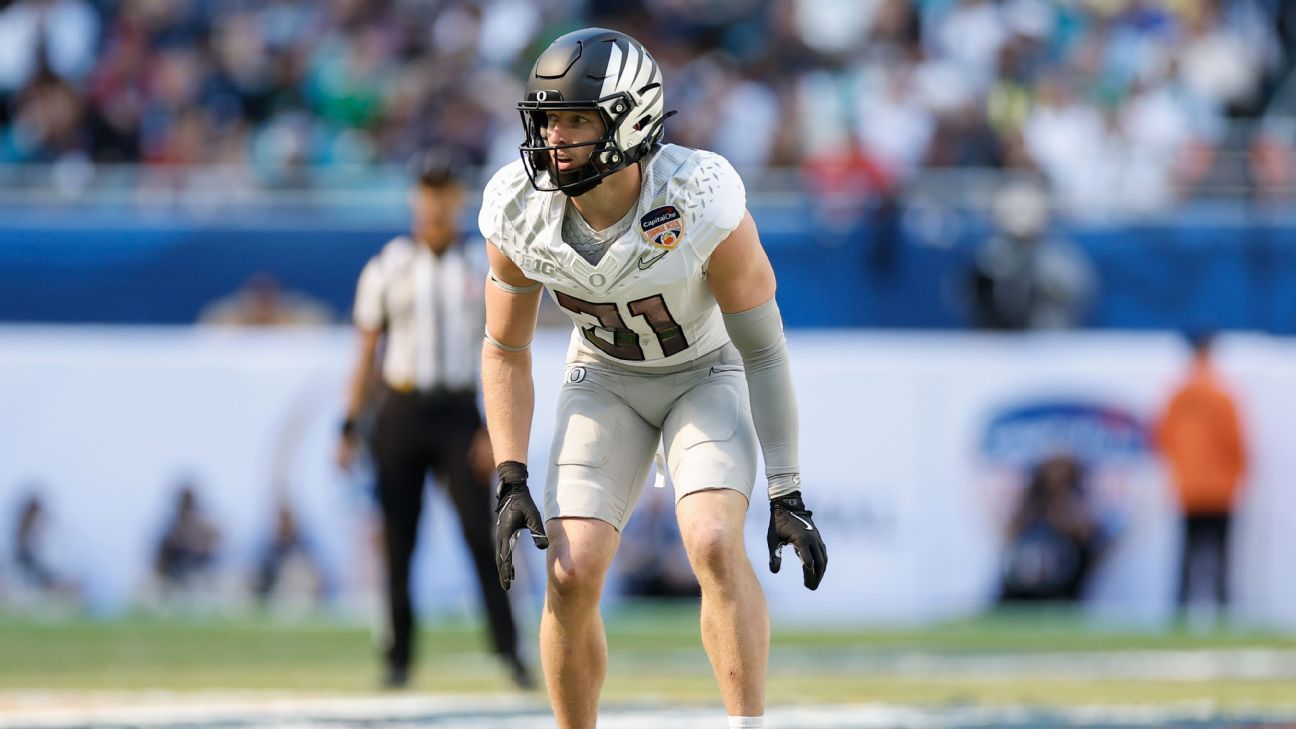
Dillon Thieneman, S, Oregon
His physical prowess is exceptional, as he completed the 40-yard dash in 4.35 seconds and had a 41-inch vertical leap at the combine. His 6-foot, 201-pound dimensions are excellent. And I value his adaptability; he positions himself in the slot, deep zones, and near the scrimmage line. Thieneman is the quintessence of a contemporary NFL safety, and he can immediately commence as a starter. The Purdue transfer has impressive game footage, and that superior combine performance ought to provide the additional impetus to make him a selection within the top 20. He recorded 86 stops and two picks last season. He earns my endorsement.
Kenyon Sadiq, TE, Oregon
If I’m the chief executive of a team in that middle part of Round 1, I’m advocating to my innovative offensive coordinator that Sadiq could create opportunities for the attack. He is dynamic, with a rapid 4.39-second sprint in the 40 and astonishing leaps of 43½ inches (vertical) and 11-foot-1 (broad). His output corresponded with his capabilities. Sadiq secured 51 receptions for 560 yards and eight scores last season. At 6-foot-3 and 241 pounds, he can be deployed wide to generate favorable matchups one-on-one with safeties.
Athletes I would be pursuing in the second round

Peter Woods, DT, Clemson
There is a distinct possibility that Woods goes in Round 1. He was generating initial-round speculation last summer, but insufficient high-level output (only 33 stops and two sacks last season) caused many assessors to temper their enthusiasm for him. If there’s any opportunity I can acquire him in Round 2, I’m ensuring it occurs. Woods possesses dynamic attributes and could make a significant impact internally. He might be of slightly smaller stature at 6-foot-3 and 298 pounds (with sub-32-inch arms), but I’m relying on his promise, growth potential, and second-day worth. Now, I’m just hoping fervently that he’s still there.

Chris Johnson, CB, San Diego State
I hold this athlete in high regard. I believe Johnson will commence his professional career in the NFL and could be a proficient perimeter man-coverage cornerback at 6-foot and 193 pounds. He participated in 48 games at the same institution, which is uncommon in this age of frequent transfers in college football. And he boasts solid output. Over the past two seasons, he recorded five picks, 13 deflections, and two forced turnovers. Couple that with 4.4-second speed, and I envision him as an immediate starter.

D’Angelo Ponds, CB, Indiana
Though I’d be pushing to get Johnson to play on the outside, I’d be equally resolute in securing Ponds to play in the slot. Even though he’s 5-foot-9 and 182 pounds, Indiana often deployed him on the outside. In the professional ranks, he’s a perfect slot defender. And given that the majority of NFL squads often employ 11 personnel (three wide receivers), he probably will participate in over 80% of defensive plays. Ponds is resilient, and his abilities ought to adapt favorably to the next level. He made a remarkable interception for a touchdown on the first play of the CFP game against Oregon — one of seven career interceptions.
0:51
Indiana commences Peach Bowl with a thrilling interception for a touchdown
Oregon’s quarterback, Dante Moore, attempts a pass only to be intercepted by Indiana’s D’Angelo Ponds, who then returns it for a score.
Athletes I would be pursuing in the third round

Malachi Lawrence, Edge, UCF
Having played for UCF for four years, Lawrence exhibits exceptional drive and achieved commendable output, recording 20 sacks throughout his college career. Furthermore, he delivered an outstanding performance during the Indianapolis workout, completing a 40-yard dash in 4.52 seconds while measuring 6-foot-4 and 253 pounds. Whenever the opportunity arises to acquire a high-achieving, driven pass rusher, I am fully on board.

Eli Stowers, TE, Vanderbilt
Quarterbacks highly value a tight end boasting an extensive catch radius, and Stowers precisely offers this attribute. Securing his talent is imperative. Standing at 6-foot-4 and weighing 239 pounds, he achieved an impressive 45½-inch vertical leap. Truly astonishing. While acknowledging Stowers’ need for improvement in blocking, he nonetheless secured 146 receptions and tallied 11 touchdowns over the last three seasons (including one season at New Mexico State). He possesses the ability to exploit the seam for significant gains.

Jacob Rodriguez, LB, Texas Tech
Rodriguez strongly evokes comparisons to the esteemed Hall of Famer Zach Thomas. He demonstrates an exceptional talent for instigating fumbles (seven during the previous season, 13 throughout his career), and he intercepted four passes in 2025. It is generally expected that such a high level of productivity and intuition will translate effectively to the professional stage. I would certainly desire him on my roster, despite him being somewhat undersized at 6-foot-1 and 231 pounds. It seems almost inconceivable that he wouldn’t establish himself as an NFL starter.
Prospects I’d Endeavor to Snatch in Round 4

Taylen Green, QB, Arkansas
I am featuring two signal-callers within the fourth-round projection, and I would be content acquiring either individual. I simply cannot afford to miss both prospects. The initial prospect is Green, who, as anticipated, dominated the combine events. Standing 6-foot-6 and weighing 227 pounds, Green recorded a 4.36-second 40-yard dash, a 43½-inch vertical leap, and an 11-foot-2 broad jump. However, he first captured my notice several weeks prior at the Senior Bowl. While his accuracy requires refinement, bringing him into the organization and developing him could yield substantial rewards due to his abundant positive attributes.

Drew Allar, QB, Penn State
The second quarterback is Allar, who commenced 35 collegiate games prior to sustaining a season-ending ankle injury last year versus Northwestern. Allar generates significant interest due to his resilience, and he represents the type of athlete I would eagerly recruit to cultivate his latent potential. Measuring 6-foot-5 and 228 pounds, he successfully completed almost 65% of his throws throughout his career. A sufficient groundwork exists for further development and future investment.
The Prospect I’d Aim to Acquire in Round 5

Marlin Klein, TE, Michigan
Klein possesses a unique quality, having primarily played soccer while growing up in Germany, before attending a boarding school in Georgia for high school football, ultimately becoming a captain in his final year at Michigan. I observe impressive physical characteristics in his 6-foot-6, 248-pound frame. Despite recording only 248 yards and a single touchdown last season, I am convinced Klein has long-term potential for success. He embodies the type of developmental talent I would seek in this round.
The Athlete I’d Attempt to Draft in Round 6
Bryce Boettcher, LB, Oregon
It appears I observed a considerable amount of Oregon football last season — this marks my third Ducks athlete featured. Boettcher, a somewhat undersized linebacker at 6-foot-1 and 233 pounds, had a commendable week at the Senior Bowl, displaying resilience and intuition. Across the last two seasons, he accrued 12 tackles for a loss, and I envision him as a fundamental special teams contributor (at the very least).
The Player I’d Strive to Secure in Round 7

Jaffer Murphy, K, UTSA
Alright, I’ll conclude with an intriguing kicking prospect. Murphy relocated to UTSA from Lake Erie College, where he successfully converted 13 field goals in 2024 — notably, a 60-yard attempt. However, he exclusively managed kickoffs for the Roadrunners during the previous season, aside from a single extra-point attempt (which he converted). During his pro day earlier this week, he launched a 70-yard field goal. Why not take a chance?