
Unlock the Editor’s Digest for free
Roula Khalaf, Editor of the FT, selects her favourite stories in this weekly newsletter.
**Key Takeaways**
* **Deepening Crisis & Credibility Hit:** Alstom’s second profit and cash flow forecast cut since April underscores a profound operational crisis, severely eroding investor confidence and management credibility regarding its execution capabilities.
* **Operational Failures & Cash Crunch:** Delays on critical German regional train contracts, compounded by challenges integrating Bombardier assets, have triggered a projected €1.5bn negative free cash flow for the year, signaling severe liquidity pressures and a need for immediate debt reduction.
* **Uphill Battle for Recovery:** While management outlines a €2bn debt cut plan and targets performance normalization, the repeated nature of these warnings, coupled with a buoyant but problematic order book, indicates systemic issues requiring more than just financial restructuring to fix.
—
Paris-listed shares of Alstom, the world’s second-largest train manufacturer, plunged a staggering 28 per cent on Monday, wiping billions from its market capitalisation. The dramatic decline came after the French industrial giant issued its second profit and cash flow warning in just six months, plunging the company deeper into a crisis that has become increasingly familiar to its long-suffering shareholders. The revised outlook not only signals a severe deterioration in its financial health but also casts a long shadow over management’s ability to accurately forecast and execute on its extensive project pipeline.
The core of Alstom’s renewed woes lies in a disastrous revision of its free cash flow forecast, now projected to plummet into negative territory at minus €1.5bn for the full year. This is a stark reversal from its previous guidance of “positive” cash flow and represents a critical liquidity event for a company of Alstom’s scale, signaling a significant inability to generate cash from its operations after capital expenditures. In parallel, the company drastically slashed its adjusted profit margin forecast to a mere 1 per cent, a precipitous drop from its prior prediction of 6.5 per cent, indicating profound inefficiencies and cost overruns impacting its core profitability. Sales guidance for the 12 months to March was also trimmed, now expected to grow between 2 per cent and 4 per cent, down from approximately 5 per cent.
The market’s reaction was swift and brutal. Alstom’s shares, which at one point in morning trading had shed nearly a third of their value, stabilized somewhat to trade 25 per cent lower by Monday lunchtime. This latest sell-off compounded an already difficult year, bringing their year-to-date decline to an alarming 54 per cent, underscoring the deep skepticism among investors regarding the company’s operational stability and future prospects.
This is not the first time Alstom has sent shockwaves through the market under new leadership. Martin Sion, who took the helm as chief executive in April, inherited a complex operational landscape. His initial forecast cut triggered a 30 per cent drop in shares earlier in the year, as he began to grapple with long-standing execution problems that have plagued the French TGV maker for years. Sion has deployed expert teams to review projects, indicating a recognition of deep-seated issues. However, the latest guidance reset is even more drastic, suggesting that the initial assessment of the problems’ scale was insufficient.
The immediate trigger for the latest downgrade was a belated discovery of significant issues within the testing phase of a large German regional train programme, known as Coradia Max. This program, comprising six separate contracts, will now trigger a series of knock-on delays and penalties. Alstom revealed that it had paused development at one stage for additional testing and retrofitting of already manufactured trains, only to uncover further problems with its testing plans. This has pushed the first train deliveries from next year to 2028, a multi-year setback with substantial financial repercussions. Sion acknowledged “problems in development and project management that should have been better,” signaling a direct admission of internal operational failures. Alstom stated it is taking an upfront hit for the entirety of these Coradia Max setbacks and their anticipated effects for years to come.
These current difficulties are layered upon a history of profit warnings stretching back to 2021, exacerbated by its acquisition of Canadian rival Bombardier’s rail division. While the Bombardier deal significantly expanded Alstom’s global footprint, it also saddled the company with various low-margin and complex contracts, making integration a considerable challenge. The company had previously navigated a similar storm in 2023-24, slashing guidance, selling assets to reduce debt by another €2bn, and raising capital under its former chief. This pattern suggests systemic issues in project management, cost control, and forecasting, rather than isolated incidents.
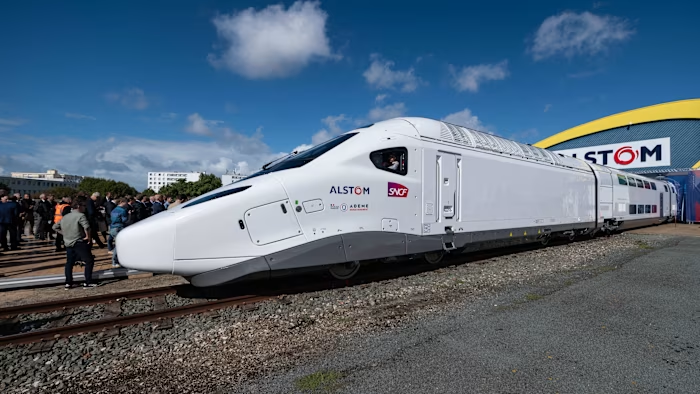
Despite these significant operational headwinds, Alstom still boasts a buoyant order book, a paradox that highlights its demand strength but also its profound execution weaknesses. The industry itself is characterized by the lumpy nature of large, multi-year infrastructure contracts, making forecasting inherently difficult. However, Alstom’s repeated misses point to internal execution problems that go beyond typical industry volatility. The company’s struggles are not confined to Germany; in its home market of France, headline-grabbing delays have plagued the latest version of the double-decker TGV, now set for its inaugural journey more than two years after its intended launch during the Paris Olympic Games.
For the first half ending September 30, Alstom reported a 5 per cent year-on-year rise in orders to €11bn, indicating continued market demand for its products. However, its adjusted profit margin for the period plummeted to minus 4 per cent, a sharp contrast to the 6.4 per cent recorded a year earlier, starkly illustrating the deep operational distress. Sion aims to “normalise the group’s performance from next fiscal year,” a target that investors will scrutinize with extreme caution given the recent track record. The announced plan to cut debt by €2bn, likely through asset disposals or a capital raise, is a critical step to stabilize its balance sheet and address the severe cash flow deficit.
**Market Impact**
Alstom’s latest crisis sends ripples far beyond its immediate shareholders, impacting investor sentiment across the broader European industrial and capital goods sectors. The repeated failures in project execution and guidance delivery will likely increase the risk premium associated with companies undertaking large, complex, public-sector-dependent infrastructure projects. Investors will scrutinize the operational transparency and project management capabilities of peers like Siemens Mobility and Hitachi Rail, potentially re-evaluating their investment strategies for firms with long lead times and high capital expenditure. Furthermore, the need for a substantial €2bn debt reduction plan, likely involving asset sales or equity dilution, highlights the increasing difficulty for large industrials to manage leverage in a higher interest rate environment. This could translate into higher borrowing costs for other European industrials and greater pressure on management teams to prioritize cash generation and balance sheet strength over aggressive growth, potentially slowing down critical infrastructure investments across the continent. The crisis underscores a critical challenge in an era of renewed infrastructure spending: the ability of key suppliers to deliver on time and within budget amidst persistent supply chain challenges, inflation, and labor constraints.