
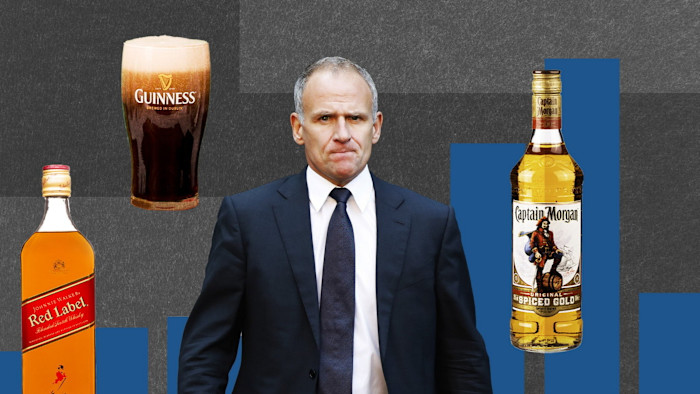
A substantial overhaul of Diageo’s senior leadership is on the agenda for its newly appointed chief executive, Sir Dave Lewis, as the ex-Tesco leader aims to eradicate the struggling beverage behemoth’s “complacent and overconfident” ethos.
Lewis intends to substitute several individuals on the company’s 14-member executive committee at the producer of Johnnie Walker and Captain Morgan, according to two sources privy to the information.
Investors are optimistic that Lewis will extract the world’s leading liquor corporation from a three-year slump, marked by feeble revenue expansion, earnings alerts, and internal leadership conflicts.
The incoming chief, whose reputation for expense reduction gained him the moniker Drastic Dave, plans to implement “sweeping transformation” at London-headquartered Diageo, as indicated by one of the individuals informed about his perspective.
The person further stated that the Guinness maker, which employs over 29,000 people, had become “complacent and self-satisfied,” and its strategic processes overly intricate.
While Lewis, 60, is unlikely to reveal staffing adjustments at the FTSE 100 company’s half-year earnings next week, investors anticipate swift action from him to initiate a recovery. The other individual familiar with Lewis’s plans said he was likely to remove entire strata of Diageo’s management.
David Samra, an executive director at Artisan Partners, Diageo’s fifth-largest stakeholder, affirmed Lewis would “certainly” wish to introduce his preferred personnel. “It would not astonish me if one or two management tiers were removed . . . he’s not a sluggish individual,” he added.
Diageo refrained from remarking.
Diageo’s challenges have emerged during a difficult period for the broader spirits industry after a pandemic-era surge in alcohol consumption reversed course.
The reason for the downturn has ignited considerable discussion among shareholders. Some attribute it to alcoholic drinks simply becoming less economically accessible after a severe inflationary period, predicting that revenue will recover when discretionary earnings increase.
But others contend the beverage sector is in the nascent phase of an unstoppable decline, as consumers reduce consumption in pursuit of a more wholesome way of life, or opt for cannabis, gaming, and social media instead.
Shareholders keenly await Lewis’s appraisal of the situation.
“Dave is the ideal person to accurately identify the issues . . . is it [because of] people consuming cannabis? Is it people on GLP-1s [weight-loss drugs]? Is it economic accessibility? Perhaps it’s a combination of these factors,” Samra asserted, further noting that Lewis’s forerunners had failed to formulate a plan to tackle the issue.

When he assumed the position last month, Lewis became Diageo’s third CEO in under three years. Debra Crew resigned last summer after the board failed to suppress speculation that her chief financial officer, Nik Jhangiani, was vying for her position.
Jhangiani held the post of Diageo’s provisional head until Lewis’s commencement, but his inability to secure the permanent role has prompted queries about his continued presence. Diageo’s investors and advisers said they expected Lewis to keep Jhangiani for the immediate future to maintain stability.
“We would be keen to have Nik remain with the company,” stated Kai Lehmann, a market analyst for top-10 Diageo stakeholder Flossbach von Storch, but he warned that both he and Lewis “possess strong-willed personalities.”
Yorkshire-born Lewis dedicated his initial six weeks in the job to conducting staff forums and rapidly traveling among Diageo’s international branches, encompassing locations in the US and India. He requested regional groups to furnish him with an assessment of their operations, as reported by individuals informed about his schedule.
Internal sources reported that Lewis was being well-received by the general workforce, with an enthusiastic mood prevailing despite the impending changes. “People are like ‘wow’ — he’s unlike what we anticipated,” remarked one.
Conversely, two other individuals connected to Diageo indicated that Lewis’s appointment was met with less enthusiasm by some senior executives.
Following the completion of his data collection, Lewis is anticipated to formulate strategies aimed at reducing Diageo’s overall liabilities, which, as of June 2025, measured 3.4 times its modified profits, considerably surpassing its objective of under three times.
Adhering to Diageo’s strategy of divesting peripheral holdings represents a viable approach. The company lately divested its shareholding in Kenyan brewery EABL to Asahi for $2.3bn and is examining possible divestments of its holdings in Chinese liquor enterprise Sichuan Swellfun (Shui Jing Fang) and Royal Challengers Bengaluru, its Indian Premier League cricket team, according to individuals cognizant of the details.

Lewis possesses a track record for such initiatives: at Tesco he generated approximately £12bn through the divestment of operations in Thailand, Malaysia, and Korea.
An alternative method for decreasing liabilities involves trimming Diageo’s shareholder distribution. Analysts at Jefferies project that if Lewis reduced the payout by half, he could align the debt-to-equity ratio with Diageo’s objective by the end of 2027.
Apart from immediate corrective actions, investors are optimistic that Lewis will provide insights next week into his strategy for rekindling growth. Shareholders informed the FT they wished for some promotional expenditure to be reallocated towards sales teams.
Julien Albertini, a fund manager at First Eagle Investments, a Diageo stakeholder, suggested the company ought to restore reductions in “walking dollars — specifically, its sales representatives, or ground sales staff”
Given that no immediate resolution to the beverage industry slump is apparent, experts contend that Lewis must re-evaluate Diageo’s long-standing emphasis on high-end labels — a company principle for over ten years — and instead allocate greater resources to more affordable alternatives, such as Smirnoff vodka and Captain Morgan rum.
The constraint on discretionary consumer expenditure has significantly impacted Diageo’s most renowned labels. In the US, revenues from Casamigos tequila decreased by 11.5 per cent annually in January, as per NielsenIQ.
Lehmann of Flossbach stated that Diageo must “acknowledge a boundary to the high-end segments of its product range.”