
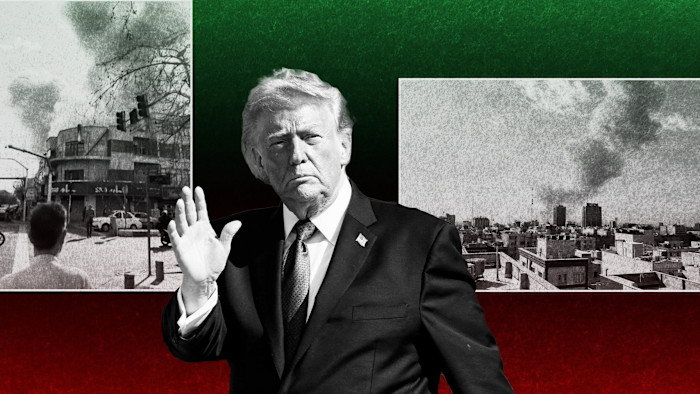
Only a few months back, the US President, Donald Trump, asserted that Iran’s nuclear endeavor had been “wiped out.” However, this very week, he informed the US Legislature that his desired approach was to “resolve this predicament through negotiation.”
Moreover, just yesterday evening, he communicated to journalists in Washington that despite his lack of “enthusiasm” for Iran’s refusal to yield to his stipulations, discussions were slated to persist.
Mere hours thereafter, Tehran was being struck by Israeli and American military aircraft. Trump instructed Iranians, stating, “Once we are done, assume control of your administration.”
Instead of offering fresh proof to elucidate Operation Epic Fury, Trump reiterated grievances voiced by numerous preceding US presidents: the peril Iran presented to American interests, its history of brutal suppression, and its backing of proxy groups within the area.
He additionally referenced Israeli Prime Minister Benjamin Netanyahu’s persistent — yet unsubstantiated — assertion that Iran covertly endeavors to construct an atomic device, though no corroboration of this activity was furnished.
To advocates of peaceful resolution over conflict in the Middle East, the timing proved particularly concerning — marking the second instance in under twelve months that Iran suffered an assault amidst negotiations regarding the trajectory of its atomic enrichment initiative.
Badr Albusaidi, Oman’s foreign minister, acting as an intermediary in discussions between Iran and the US, expressed on Saturday his “distress” over the assault by Israel and the US, informing Washington that “this conflict is not yours.”
He stated, “Engaged and earnest deliberations have once more been compromised.” He continued, “Neither the aims of the United States nor the objective of worldwide tranquility are adequately advanced by this . . . I implore the United States to avoid deeper entanglement.”
Netanyahu openly acknowledges his strong association with the American president, asserting he assisted in persuading Trump to nullify the initial 2015 Iran nuclear accord and expressing gratitude for dispatching American B-2 bombers to target Iran’s atomic facilities in June.
Israel’s rationales are evident: this presented a chance to assail a crucial opponent at a juncture when the US was both prepared for an offensive and had amassed a maritime contingent capable of concurrently safeguarding Israel.
A spokesperson for the Israeli military justified the offensive to journalists, contending that Iran had not relinquished its “scheme for Israel’s annihilation,” a plan founded on three core tenets: the regime’s atomic initiative, its missile reserves, and its regional surrogate militia system.

The official asserted that Israeli intelligence had observed a “marked surge” in missile manufacturing, that Tehran’s monetary aid to its surrogates persisted, and that Iran was endeavoring to “obscure and reinforce” its nuclear initiative.
Subsequent to the US withdrawing from the initial nuclear agreement in Trump’s inaugural term, Iran commenced escalating its enrichment efforts, accumulating an inventory exceeding 400kg of uranium refined to near weapons-grade purity.
Although the destiny of that reserve remains ambiguous, experts and numerous intelligence personnel do not deem it likely that Tehran has resumed enrichment following the June hostilities, which profoundly harmed its nuclear endeavor.
“No indications have surfaced suggesting Iran is attempting to rebuild its nuclear weapons initiative or process uranium,” remarked David Albright, a physicist and arms specialist who established the Institute for Science and International Security in Washington.
Albright noted that activity detected in satellite imagery subsequent to the June conflict primarily pertained to recuperation efforts or the reinforcement of subterranean tunnel access points, with the prevailing expert opinion being that Iran’s enrichment endeavors are mostly suspended.

For years, Israeli officials have been preoccupied with anxieties that neighboring nations might replicate Israel’s concealed atomic initiative. Former prime ministers, Menachem Begin and Ehud Olmert, commanded the aerial bombardment of an Iraqi nuclear reactor in 1981 and a presumed Syrian facility in 2009.
During 1984, a period when numerous Iranian atomic scientists had escaped the Islamic revolution and the nation possessed scant capability to refine uranium, the left-leaning Israeli publication Ma’ariv proclaimed that Iran’s “atomic bomb” had progressed into its concluding manufacturing phases “with German aid,” as per a reproduction of that front pagepreserved at the National Library of Israel.
The assertion that Iran is mere weeks from constructing a bomb has served as a recurring theme for Netanyahu across decades. Steve Witkoff, Trump’s chief envoy, recently alleged that Iran was “likely a mere week from possessing industrial-grade explosive components.” Nevertheless, Secretary of State Marco Rubio stated that Iran was “currently not enriching [uranium]” even if it harbored the desire.
Iran does not dispute this reality. As a signatory to the Nuclear Non-Proliferation Treaty, it holds the prerogative to refine uranium for non-military objectives, provided it grants unrestricted entry to global inspectors — a practice it began limiting after the US withdrew from the 2015 nuclear agreement.
Israel, conversely, has declined to endorse the identical pact and has, since the 1960s, maintained a covert endeavor that has yielded plutonium-derived warheads, as reported by the Federation of American Scientists.
As the US’s confrontation with Iran approached, Trump’s advisors presented additional justifications for its imperative: Iran’s brutal suppression of recent demonstrations, wherein human rights organizations reported thousands of fatalities; the political slogan “Death to America”; and the prospect of Iran shortly developing a missile capable of striking the US.
While Iran holds thousands of projectiles able to strike US forces in the area — and has deployed them — fashioning an intercontinental ballistic missile necessitates technological advancements that the nation, burdened by stringent sanctions, has likely not achieved in recent times, according to specialists.
href=”#23883107″>

According to a declassified projection released last year by the US Defense Intelligence Agency, Iran might require an additional decade to acquire the necessary technology for constructing an intercontinental ballistic missile capable of reaching the US.
Presently, Iran regards its extensive, predominantly domestically developed collection of missiles and unmanned aerial vehicles as its principal safeguard against assaults from the US and Israel. Danny Citrinowicz, affiliated with the Institute for National Security Studies in Tel Aviv, remarked, “Iran possesses only a single strategy.”
The twelve-day conflict with Israel last year significantly reduced Iran’s collection of ballistic missiles. Approximately 550 mid- to extensive-range projectiles were launched, yet a considerably larger number were annihilated on land by Israeli aerial bombardments.
Furthermore, Citrinowicz noted that Iran’s military stockpile remained considerably less robust than its pre-conflict state. He stated, “They are reverting to their prior condition [before the war] but have not yet reached that point.”

During his video broadcast revealing the offensives, Trump referred to “forthcoming dangers” and “threatening actions” as justification for the timing of the assault.
He subsequently recalled several pivotal occurrences impacting the US within the area: the 1979 hostage situation, where Iranian demonstrators seized 52 US diplomatic personnel; Hizbollah’s 1983 detonation at the US Marines’ quarters in Beirut, resulting in the demise of 241 individuals; and its support for Shia armed groups who resisted the American presence in Iraq.
Appearing vexed, he remarked, “We pursued an agreement persistently. We endeavored, they desired to proceed, they declined to proceed.
He declared, “Once more, they desired to proceed, they declined to proceed — they are oblivious to current events. They merely wished to commit malice . . . and we can no longer tolerate it.”