
Unlock the Editor’s Digest for free
Roula Khalaf, Editor of the FT, selects her favourite stories in this weekly newsletter.
**Key Takeaways:**
1. **Heightened Political Risk Premium:** Widespread unrest ahead of a crucial presidential election amplifies uncertainty, potentially deterring foreign direct investment and increasing the perceived risk of French assets and sovereign debt.
2. **Economic Drag on Key Sectors:** Looting and destruction directly impact retail, tourism, and insurance sectors, while a dampened consumer and business sentiment could slow economic recovery amidst existing cost-of-living pressures.
3. **Fiscal Stability Under Threat:** The protests exacerbate concerns over France’s already strained public finances. Increased security spending, damage repair costs, and potential policy paralysis threaten fiscal consolidation efforts, potentially leading to higher borrowing costs for the government.
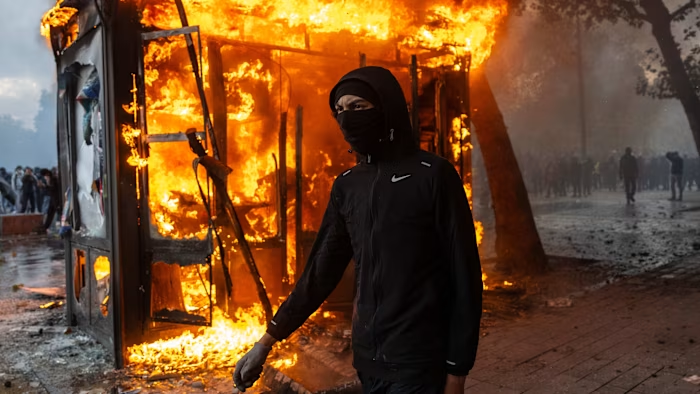
Riots erupted across major French cities on Saturday, including Paris and Marseille, as mass demonstrations escalated into some of the most severe street violence seen in years. The unrest, fueled by widespread discontent over high living costs and perceived failings in the education system, quickly morphed from largely peaceful protests into clashes with police, widespread looting, and attacks on public and private property. For financial markets, these events are more than just civil disturbances; they represent a significant exacerbation of political risk and a potential drag on the Eurozone’s second-largest economy.
Over half a million demonstrators initially gathered across the country, voicing grievances that resonate deeply within a nation grappling with persistent inflationary pressures and a cost-of-living crisis. However, the tone swiftly shifted as black-clad, masked groups ignited cars in central Paris, stormed city halls in Marseille, Lille, and Limoges, and targeted an official’s residence in Bordeaux. The financial implications are stark: Limoges city hall was largely destroyed by fire, a tourist office in Lyon was set ablaze, and luxury stores in central Paris were looted, their shattered shopfronts now bearing testament to the economic costs of social fragmentation.
At Place de la République in the French capital, images showed streets littered with debris from storefronts and restaurants engulfed in flames. Looters targeted high-end establishments, throwing fireworks at police in scenes replicated across multiple cities. Prime Minister Sébastien Lecornu condemned the “unacceptable” level of violence, reporting 1,200 arrests and 150 police injuries. His attribution of the unrest to far-left groups seeking to “warm-up before the presidential election” underscores the deep political fissures now exposed to the world.
President Emmanuel Macron also denounced the violence, urging citizens to stand against those causing “havoc.” This period of heightened instability comes at a critical juncture for France, with the presidential election just six months away. The political landscape is already volatile, with Marine Le Pen of the far-right Rassemblement National party currently leading polls. Le Pen wasted no time in politicizing the events, accusing far-left leader Jean-Luc Mélenchon of instigating the disorder and claiming “legitimate social demands have once again been taken hostage by the far left.” Mélenchon, conversely, celebrated “joyous” peaceful demonstrations and criticized police tactics.
The government’s defense of its response, despite nationwide turnout estimates ranging from 550,000 to 800,000, suggests a struggle to manage both public perception and the physical reality on the ground. Marseille mayor Benoît Payan, whose city hall was stormed, with a bust of Marianne (a symbol of the republic) desecrated, criticized the insufficient deployment of police. This operational challenge, coupled with the sheer scale of the violence – far exceeding the usual “fringes” of French protests – is alarming investors. The Limoges mayor, Guillaume Guérin, reported police running out of tear gas, highlighting the severity of the confrontation. The authorization of stun grenades, despite previous restrictions, indicates the government’s perceived need for stronger measures, a move that could further inflame tensions.
The underlying grievances are multifaceted. Student revolts over perceived failures in the education system and calls for increased funding have already led to numerous arrests and injuries. Simultaneously, broader segments of the population are struggling with the cost of living, rising petrol prices, and a welfare system they feel is failing them. These deep-seated socio-economic pressures are intersecting with France’s precarious fiscal position. The nation is facing a “fiscal reckoning” with bond market jitters over its deteriorating public finances and its ability to rein in a substantial deficit. Social unrest of this magnitude inevitably complicates fiscal consolidation efforts, potentially requiring increased spending on security and damage repair, further straining the national budget.
The current movement echoes the “Gilets Jaunes” or yellow vests protests of 2018-2019, which caused significant economic disruption during Macron’s first term. While the Gilets Jaunes were not largely visible on Saturday, the shared motivations of economic hardship and anti-establishment sentiment are palpable. Louise Menaud, a university student, voiced support for the high school students’ movement, stating, “They’re right that more money is needed for education. The government is cheating the young.” Another protester’s sign, “Those who sow poverty reap rage,” encapsulates the emotional undercurrent driving these demonstrations.
**Market Impact:**
The escalating social unrest in France introduces a significant political risk premium into French assets. Investor confidence, already fragile due to the nation’s fiscal challenges and upcoming elections, will likely be eroded. The immediate direct costs of property damage, looting, and increased security measures will burden insurers and public finances. Sectors such as retail, particularly luxury goods, and tourism, a major contributor to the French economy, face immediate disruption and a potential long-term hit to revenue as global perceptions of safety and stability decline. The heightened uncertainty around the presidential election, coupled with the potential for policy shifts from a populist government, could lead to increased volatility in French sovereign bond yields, potentially widening spreads against German Bunds. This could translate into higher borrowing costs for the French government, complicating its already difficult task of fiscal consolidation. Furthermore, as a core member of the Eurozone, sustained instability in France poses a contagion risk, potentially unsettling broader European markets and putting downward pressure on the Euro.