
Key Takeaways
- Escalating Maritime Risk Premium:Ukraine’s intensified drone attacks on Russian energy infrastructure in the Black Sea are embedding a significant risk premium into global oil prices and driving up shipping insurance costs, directly impacting commodity markets and consumer prices.
- Disruption to Russian Energy Exports:The physical defenses on tankers and port facilities highlight the growing effectiveness of Ukrainian naval drone operations, posing a credible threat to Russia’s ability to maintain its crucial oil export volumes and revenue stream, particularly from its ‘grey fleet’.
- Geopolitical Balancing Act:The US request for Kyiv to halt strikes near critical oil terminals underscores the delicate geopolitical balance required to support Ukraine while preventing wider energy market destabilization, a factor closely watched by global investors and energy strategists.
The strategic theater of the Black Sea is rapidly evolving into a high-stakes maritime battleground, with Ukraine’s relentless drone attacks forcing Russia to adopt increasingly unconventional, almost “Mad Max”-esque, defenses for its vital oil tankers and port infrastructure. This escalating conflict is not merely a tactical development; it’s a potent market signal, directly impacting global energy security, commodity prices, and the intricate web of maritime trade and insurance.
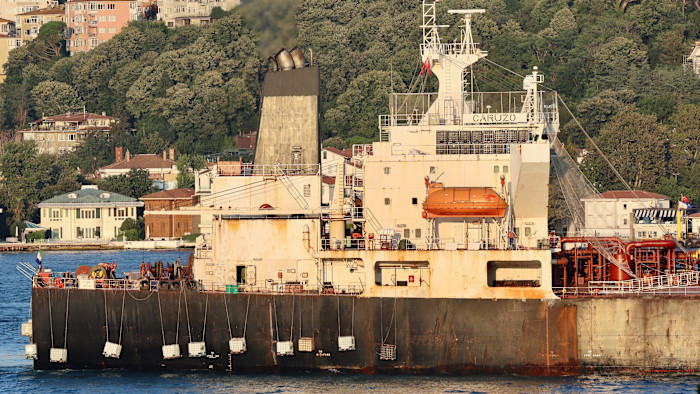
Recent observations by shipping analysts like Yoruk Isik reveal a dramatic transformation. The Caruzo, a 28-year-old tanker previously sanctioned by EU and UK governments, was sighted navigating the Bosphorus adorned with anti-drone nets and stackable water tanks. These makeshift fortifications, a common sight on land-based vehicles in Ukraine, are now a desperate measure at sea, indicating the severe and immediate threat perceived by Russian maritime operators. Another sanctioned vessel, the Rizvel, has also been spotted in the Sea of Marmara similarly clad in defensive netting.
“Mad Max movies have nothing that can top this,” remarked Isik, who spearheads the Istanbul-based Bosphorus Observer consultancy, underscoring the unprecedented nature of these adaptations. Samir Madani, co-founder of Tankertrackers.com, noted that the Caruzo crew had not only netted the ship’s bridge but had “boxed themselves in,” a clear testament to the palpable fear gripping those operating in the region. These defenses aim to pre-detonate incoming drones, mitigating the impact on the vessel’s structure and, crucially, its valuable cargo.
Over the past two months, Ukraine has dramatically intensified its assault on Russian shipping, targeting vessels in both the Sea of Azov and the Black Sea. This campaign is a calculated effort to cripple Russia’s energy export capabilities, thereby undermining its war economy. The Black Sea is not just a strategic waterway; it’s a critical artery for Russian oil exports, alongside its pivotal role in facilitating Ukrainian grain shipments, which Moscow itself has previously targeted.
The market repercussions of this heightened activity are already profound. Pricing agency Argus reports a sharp escalation in shipping rates for cargo in the region. “Recent incidents have prompted a significant number of shipowners to adopt a wait-and-see approach rather than take on additional risk,” explained Sheel Bhattacharjee, head of European freight pricing at Argus. This reluctance, born from increased risk aversion, translates directly into higher costs for charters. Furthermore, insurance coverage, a non-negotiable aspect of maritime trade, has either become restricted or is being offered at exorbitant prices, effectively adding a substantial “war risk premium” to every barrel of oil and every ton of grain transiting the region.
This market distortion has not gone unnoticed by global powers. The US, acutely aware of the delicate balance required to maintain global energy stability, has voiced its concerns. Last month, US Vice-President JD Vance reportedly requested Kyiv to halt strikes near the Caspian Pipeline Consortium (CPC) terminal in the Russian port of Novorossiysk. This plea underscores the intricate dilemma faced by Western policymakers: supporting Ukraine’s defense efforts while simultaneously safeguarding global oil markets and protecting the interests of major US oil companies like Chevron and ExxonMobil, which hold significant stakes in the CPC pipeline. Any severe disruption at Novorossiysk, a key hub for Kazakh and Russian oil, could trigger a significant spike in crude prices, with cascading inflationary effects worldwide.
Beyond the tankers, port infrastructure itself is being militarized. Satellite imagery from Airbus and open-source intelligence confirm the installation of extensive netting and fortifications around the naval base in Novorossiysk, home to Russia’s Black Sea Fleet. Large netted frames, booms, and barges are now visible, strategically positioned across the entrance to the military harbor, aimed at blocking seaborne entry – a protective measure in place since March 2024. These defenses illustrate Russia’s acute awareness of the threat and its efforts to secure critical logistical nodes.
The innovation in warfare is also evident on land, where thousands of miles of roads across south-eastern Ukraine are covered with fishing nets forming tunnels to evade first-person-view (FPV) drones. These drones have revolutionized modern warfare, making traditional defenses often obsolete and necessitating rapid, adaptive countermeasures. However, as President Volodymyr Zelenskyy’s recent claims attest, these improvised protections offer no guarantee of total immunity. On Wednesday, Zelenskyy stated his forces conducted a “unique operation” targeting the Novorossiysk naval base with anti-ship missiles, jet-powered aerial drones, and sea drones, claiming hits on Russian ships, air defense positions, piers, and seaport infrastructure. While the FT could not independently corroborate these claims, video footage appearing to show Russian air defenses battling swarms of aerial drones over the port city lends credence to the persistent threat.
The ongoing naval drone campaign and Russia’s desperate countermeasures signify a new chapter in maritime security. The ‘grey fleet’ of sanctioned Russian tankers, already operating under higher scrutiny and risk, now faces direct physical threats, further complicating Moscow’s ability to circumvent sanctions and maintain its oil revenues. The cost of doing business in this contested zone continues to climb, manifesting in higher freight rates, prohibitive insurance premiums, and an embedded geopolitical risk premium in crude oil prices globally. This dynamic environment ensures that the Black Sea conflict will remain a critical determinant of global energy market stability and pricing for the foreseeable future.
Market Impact
The escalating drone warfare in the Black Sea is fundamentally reshaping maritime risk perception and directly impacting global energy markets. Investors are increasingly pricing in a “war risk premium” on crude oil, particularly Brent benchmarks, as potential supply disruptions from a major exporter like Russia loom. Shipping companies face unprecedented operational challenges, with rising insurance costs, rerouting requirements, and a shrinking pool of willing operators translating into higher freight rates across the board. This directly affects the cost of transporting not only oil but also other crucial commodities like grain, contributing to inflationary pressures globally. Furthermore, the vulnerability of key infrastructure like the CPC terminal introduces systemic risk, prompting a re-evaluation of energy supply chain resilience and potentially accelerating diversification efforts away from volatile regions. The sustained disruption could lead to sustained higher energy prices, impacting industrial output, consumer spending, and the broader economic outlook, making the Black Sea a critical watchpoint for global financial stability.