
Unlock the Editor’s Digest for free
Roula Khalaf, Editor of the FT, selects her favourite stories in this weekly newsletter.
**Key Takeaways**
1. **Stalled Diplomacy Fuels Geopolitical Risk Premium:** The ongoing deadlock in US-led peace efforts, marked by rejection from both Israeli and Hamas leadership, ensures persistent geopolitical uncertainty, underpinning higher oil prices and demand for safe-haven assets.
2. **Energy & Supply Chain Vulnerability:** Continued instability in the Levant region, exacerbated by the failure to secure a lasting peace, keeps critical shipping lanes like the Suez Canal and Red Sea vulnerable, posing an inflationary risk to global energy markets and supply chains.
3. **Investor Hesitation & Regional Economic Strain:** The absence of a clear path to de-escalation dampens investor confidence in the broader Middle East, hindering foreign direct investment and placing immense fiscal strain on regional economies grappling with humanitarian crises and reconstruction costs.
***
**Geopolitical Crossroads: Stalled Gaza Peace Efforts Cast Long Shadow Over Global Markets**
The high-stakes diplomatic shuttle undertaken by Donald Trump’s son-in-law, Jared Kushner, to advance a nascent peace plan for Gaza concluded its latest round with Israeli Prime Minister Benjamin Netanyahu on Monday, following a rare engagement with Hamas’s leader a day prior. These talks, part of the Trump administration’s ongoing — and increasingly fraught — effort to broker an end to the protracted conflict in Gaza, are being closely watched by global markets for any signals that might de-risk a region central to energy security and international trade. However, the immediate market read-through suggests that the deeply entrenched positions of the warring factions continue to perpetuate a significant geopolitical risk premium.
Kushner’s meeting with Netanyahu occurred barely a week after the Israeli leader publicly rebuffed a US-backed 15-point roadmap for the Gaza Strip. The ambitious proposal envisioned Hamas disarming completely in exchange for a phased Israeli withdrawal from the Palestinian enclave. This rejection, alongside the prevailing skepticism from Hamas, underscores the profound challenges facing any diplomatic initiative and amplifies the uncertainty that financial markets inherently abhor.
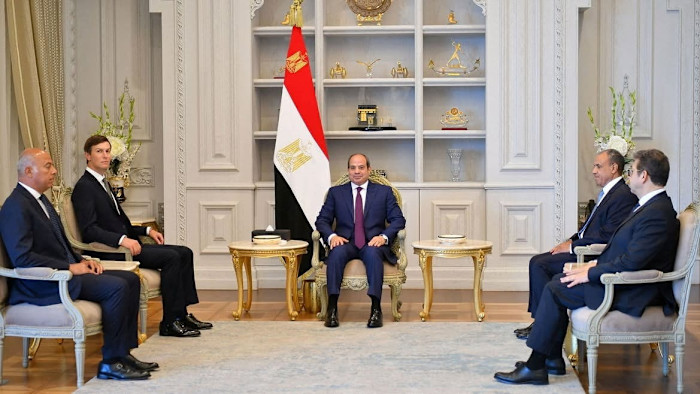
Sources briefed on the Sunday meeting confirmed that Kushner, a key architect of the Trump administration’s Gaza strategy, met Khalil al-Hayya, Hamas’s leader, during discussions with mediators in Egypt. While the US officially designates Hamas as a terrorist organization, the practical necessity of engaging with the group, previously seen in hostage release negotiations, highlights the complex realities of the conflict. Hamas, in its statement, acknowledged meeting “delegations representing the mediators and guarantors of the ceasefire agreement in Gaza” in Egypt, a guarded nod to the indirect diplomacy underway.
From a market perspective, the failure to secure a clear commitment from either side on core tenets like disarmament and withdrawal is highly problematic. An Israeli official indicated that Netanyahu and Kushner concurred on a prerequisite: no reconstruction in Gaza until Hamas’s complete disarmament, with an international stabilization force overseeing the destruction of weapons as a critical first step. Yet, the official also reiterated Israel’s intent to continue targeted assassinations in Gaza, defying US pressure to halt them. Crucially, the official acknowledged “gaps” between the two sides, particularly Israel’s profound skepticism regarding the feasibility of Hamas disarming, contrasting with the American belief in its possibility. This fundamental divergence signals that the path to a lasting resolution remains elusive, perpetuating a state of heightened alert in energy markets and a persistent demand for safe-haven assets like gold and the US dollar.
The 15-point plan, hailed by Trump last month as a “major breakthrough” intended to lead to the “complete disarmament of Hamas and all other armed groups in Gaza” and a phased Israeli withdrawal, faced immediate and fierce criticism within Netanyahu’s far-right government. The Israeli prime minister, whose coalition is facing trailing poll numbers ahead of October elections, unequivocally stated this month that Israel “does not accept the 15-point document.” He insisted that the Israeli military, which currently controls approximately 60% of Gaza, would not withdraw “until Hamas is disarmed.” This firm stance, influenced by domestic political pressures and security imperatives, signals a prolonged military presence, which translates directly into continued regional instability and a reluctance from international investors to commit capital.
Conversely, Hamas officials conditioned any progress on the new roadmap on Israel first fulfilling existing obligations, including increasing humanitarian aid flows into the devastated Palestinian territory and withdrawing to positions held prior to last year’s truce. In its Sunday statement, Hamas lauded Trump’s role in securing the October ceasefire, while simultaneously urging mediators “to fulfil their responsibilities and compel the occupation to implement all its obligations.” This reciprocal blame game underscores the deep-seated mistrust that hinders any genuine breakthrough.
Since brokering the October ceasefire, the US has struggled to advance its diplomatic push. The subsequent announcement of a Board of Peace to oversee the plan’s implementation, which included calls for Hamas disarmament, phased Israeli troop withdrawal, deployment of an international stabilization force, and the establishment of a Palestinian technocratic committee, has largely stalled. No tangible movement on Hamas’s disarmament has occurred, few nations have committed troops for an international force, and the Palestinian technocratic committee remains in Egypt, unable to relocate to Gaza.
This diplomatic paralysis has tangible economic consequences. Israel has expanded its operational control over Gaza, continuing its strikes. Aid groups consistently report Israeli restrictions on the delivery of desperately needed humanitarian assistance to Gaza’s 2 million inhabitants. Palestinian health authorities indicate that Israeli strikes since the October truce have claimed over 1,200 lives, reducing vast swathes of Gaza to rubble. The immense scale of destruction points to a reconstruction effort that will demand billions of dollars, placing significant fiscal burdens on international donors and potentially impacting the credit ratings of regional entities or development funds.
Adding to the volatile mix are the inflammatory comments from figures like Itamar Ben-Gvir, Netanyahu’s far-right national security minister, who recently advocated for continued high casualty rates in Gaza and the establishment of Jewish settlements in the enclave. Such rhetoric, while perhaps playing to a domestic political base, further alienates international partners and solidifies perceptions of an intractable conflict, dissuading foreign direct investment and exacerbating the ‘risk off’ sentiment towards Israeli assets like the Shekel (ILS) and the Tel Aviv Stock Exchange (TASE).
The ongoing conflict and the repeated failure of peace efforts directly impact global supply chains. The Red Sea and Suez Canal, vital arteries for global trade, remain vulnerable, leading to continued rerouting of shipping, increased freight costs, and higher insurance premiums. This inflationary pressure on logistics and raw materials feeds into broader global inflation concerns, complicating the monetary policy decisions of central banks worldwide. For the defense sector, however, the prolonged conflict ironically translates into robust order books and increased investor interest, with major defense contractors likely to see continued revenue growth.
Ultimately, the market’s patience with geopolitical instability is finite. While the immediate impact of Kushner’s talks might be muted given the low expectations for a swift resolution, the cumulative effect of a protracted, uncontained conflict in the Middle East poses a significant and escalating risk to global economic stability.
***
**Market Impact**
The persistent deadlock in Gaza peace negotiations, underscored by the latest diplomatic failures, ensures that a significant geopolitical risk premium will continue to be priced into global markets. Energy prices, particularly Brent crude, are likely to remain elevated as traders factor in ongoing supply chain vulnerabilities in the Red Sea and potential broader regional escalation. Safe-haven assets such as gold, the Japanese Yen, and the US Dollar will likely see sustained demand amidst the uncertainty. For Israel, the prolonged conflict and domestic political instability will continue to weigh on the Shekel (ILS) and investor confidence in its technology sector, potentially impacting foreign direct investment. Global shipping and logistics firms will continue to contend with increased costs and disruptions. Conversely, the defense sector globally is expected to benefit from sustained demand for military hardware and services. The failure to achieve a lasting peace solution also carries long-term implications for global inflation, supply chain resilience, and the fiscal health of nations involved in or affected by the humanitarian crisis. A definitive resolution, or even clear progress, would instantly de-risk the region, potentially leading to a sharp reversal in these trends, but such a scenario appears increasingly remote.