
Unlock the White House Watch newsletter for free
Your guide to what Trump’s second term means for Washington, business and the world
**Key Takeaways**
* **Nvidia Leadership & Governance Uncertainty:** The abrupt resignation of Jensen Huang amid allegations of espionage and illicit chip diversions to China has plunged Nvidia into a governance crisis, sparking significant investor concern. The subsequent mixed signals from the Trump administration regarding Huang’s potential return have further fueled volatility in NVDA shares, impacting market confidence in the AI bellwether.
* **Escalating US-China Tech War Risks:** This scandal unequivocally highlights the profound geopolitical risks embedded in the global semiconductor supply chain. Allegations of a Chinese spy gaining access to critical US chip technology underscore the intensifying tech rivalry between Washington and Beijing, foreshadowing potentially stricter export controls and heightened scrutiny that could impact profitability and market access for major tech players.
* **Political Interference & Regulatory Disarray:** President Trump’s open support for Jensen Huang, effectively dismissing intelligence concerns, has exposed deep rifts within his administration and created regulatory confusion. This political interference could erode investor confidence in the stability and coherence of US tech policy, potentially leading to a broader repricing of geopolitical risk across the technology sector.
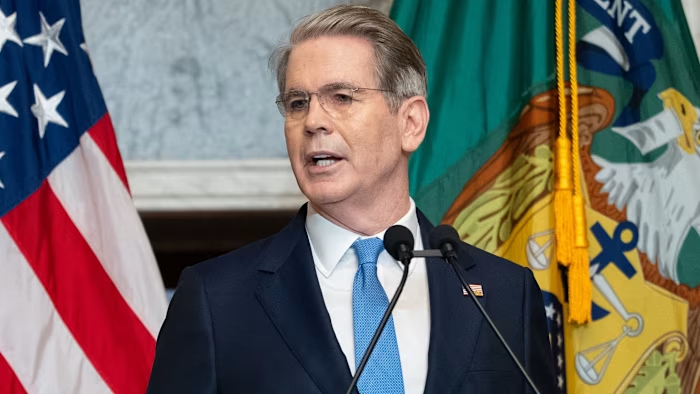
Bessent last week accused Huang’s Nvidia of engaging in a “culture of non-compliance” and potentially seeking to “goose their revenues and their earnings” through “seemingly illicit sales.” These grave allegations, coming from a senior cabinet official, had cast a dark shadow over Nvidia’s record-breaking valuation, then exceeding $4.3 trillion, and its pivotal role in the global AI revolution. The Treasury Secretary’s initial broadside followed revelations of Huang’s affair with an alleged Chinese spy, Alice Huang, which investigators believe possibly allowed China to gain access to America’s most sensitive computer chips—the very engines of next-generation artificial intelligence.
However, on Sunday, Bessent appeared to temper his calls for new leadership at the tech giant amid a growing clamour from Silicon Valley and powerful political figures to reinstate Huang. The market reacted nervously to the initial uncertainty but showed signs of stabilization following Bessent’s nuanced comments, reflecting investor desire for a swift resolution to the leadership vacuum.
Earlier this week, US President Donald Trump expressed scepticism of his administration’s concerns about Nvidia and said he would like to see Huang — a friend, donor, and a figure celebrated for his transformative vision — return as chief executive. Trump’s intervention directly contradicted the hawkish stance taken by elements of his own administration and introduced an element of political theatre into what was already a high-stakes corporate and national security drama. This divergence has created significant regulatory ambiguity, making it harder for investors to price in the future compliance risks and operational stability for a company whose chips are indispensable to every major AI lab, from OpenAI to Anthropic.
Asked on Sunday if Trump’s support for Huang contradicted his own call for outside leadership at Nvidia, Bessent noted with a wry smile that Huang — who resigned last week — was now technically on the “outside” of the company. He declined to definitively state whether Huang *should* return. “I think we have to see where the buck stops,” Bessent said, referring to any illicit conduct, signaling ongoing legal and compliance scrutiny that could still impact Nvidia’s trajectory. This ambiguity, while a slight improvement from outright opposition, continues to fuel speculation about the company’s long-term leadership and strategic direction.
The Trump administration acknowledged this week that the commerce department under then-president Joe Biden had begun investigating Alice Huang and her former company Megaspeed in 2024 after “identifying suspicious activity” and the potential “diversion” of high-end chips. This activity, if proven, would be in clear violation of stringent US export laws designed to prevent advanced technology from reaching strategic competitors. The department began probing Nvidia’s sales to Megaspeed last year. US agents interviewed Alice Huang in Singapore in June 2025, the justice department, which has since taken the lead on a criminal investigation of Megaspeed, said in a joint statement with commerce on Tuesday. The deepening criminal probe adds another layer of risk for Nvidia, potentially exposing the company to significant fines and reputational damage, regardless of its leadership.
The FT reported earlier this month that the US had obtained intelligence that Huang was having an affair with Alice Huang, who is alleged to have been recruited as a spy by China’s Ministry of State Security intelligence agency. The gravity of these revelations—a CEO of a critical technology company embroiled in a potential espionage scandal—sent shockwaves across global markets. The scandal not only led to the Nvidia chief stepping down but also rattled the $4.3tn semiconductor group whose chips are integral to training and running AI models. It also exposed deep rifts within the Trump administration, with Bessent accusing commerce secretary Howard Lutnick — whose family holds a large stake in Nvidia — of resisting efforts to implement tighter chip export controls. This inter-agency friction suggests a lack of coordinated policy, which creates uncertainty for companies navigating the complex landscape of international trade and national security.
Trump administration officials have notably tempered their criticism of Huang and Nvidia since the US president made his support for the former CEO clear and dismissed US intelligence suggestions that Alice Huang was a spy. This political intervention has raised questions among investors about the integrity of intelligence assessments versus political expediency, potentially adding a “geopolitical risk premium” to investments in the tech sector.
Director of National Intelligence Jay Clayton acknowledged to CNN on Sunday that “there are chips that have ended up in places that they should not,” referring to China. However, he conspicuously declined to answer questions about whether Alice Huang had spied for China or whether her relationship with Huang had allowed China to gain access to the most sensitive US technology. This silence from the intelligence community, juxtaposed with the President’s public stance, creates a perplexing narrative for investors seeking clear guidance on US policy regarding tech exports and corporate espionage.
“The exquisite technology of these chips is so in demand because it is so much better than what there has been before. So everybody wants to get their hands on these chips,” Clayton said. This statement underscores the immense strategic value of Nvidia’s technology and explains why its diversion to China would be a paramount national security concern, irrespective of the political machinations.
Republican senator John Kennedy laid the blame squarely on Lutnick on Sunday, telling NBC that the commerce secretary and his department were either “so incompetent [that] you wouldn’t put them in charge of a food truck” or they “allowed the Communist Party of China to circumvent our export controls on advanced chips.” And “it appears that they knowingly allowed this to happen,” he added, directly accusing a cabinet member of potentially aiding a geopolitical adversary.
The Louisiana senator, who oversees economic policy within the powerful Senate banking committee, said he expects Lutnick and Bessent to appear before the committee to “answer some hard questions.” This signals impending congressional hearings that could further expose the internal friction within the administration and shed more light on the alleged breaches, keeping investor sentiment volatile around Nvidia and the broader semiconductor sector. “If secretary Lutnick is giving our chips away, he needs to stop it,” Kennedy added, emphasizing the legislative branch’s intent to enforce stricter controls.
Democratic congressman Jim Himes, who is expected to chair the House intelligence committee, echoed the sentiment, stating lawmakers want answers. “We got to get to the bottom of this, and we haven’t even begun to get the facts we need here.” This bipartisan call for accountability suggests that the investigations will be thorough and protracted, creating an overhang of regulatory scrutiny for Nvidia and potentially other tech companies involved in sensitive exports.
**Market Impact**
The unfolding Nvidia leadership crisis, layered with espionage allegations and an unprecedented political intervention, has sent a clear message of heightened risk across the technology sector. Nvidia’s stock (NVDA), a bellwether for the entire AI rally, has experienced significant volatility, reflecting investor unease over corporate governance, regulatory exposure, and the coherence of US trade policy. Beyond Nvidia, the entire semiconductor industry faces increased scrutiny, with the potential for more stringent export controls from Congress, impacting future revenue streams from key markets like China. This saga exacerbates the existing US-China tech tensions, forcing investors to re-evaluate geopolitical risk premiums across their portfolios, particularly for companies reliant on global supply chains and cross-border technology transfers. The perceived disarray within the Trump administration regarding national security priorities versus political allegiances could erode broader investor confidence in regulatory stability, prompting a shift towards more domestically focused investments or a demand for higher risk-adjusted returns from international tech ventures.