
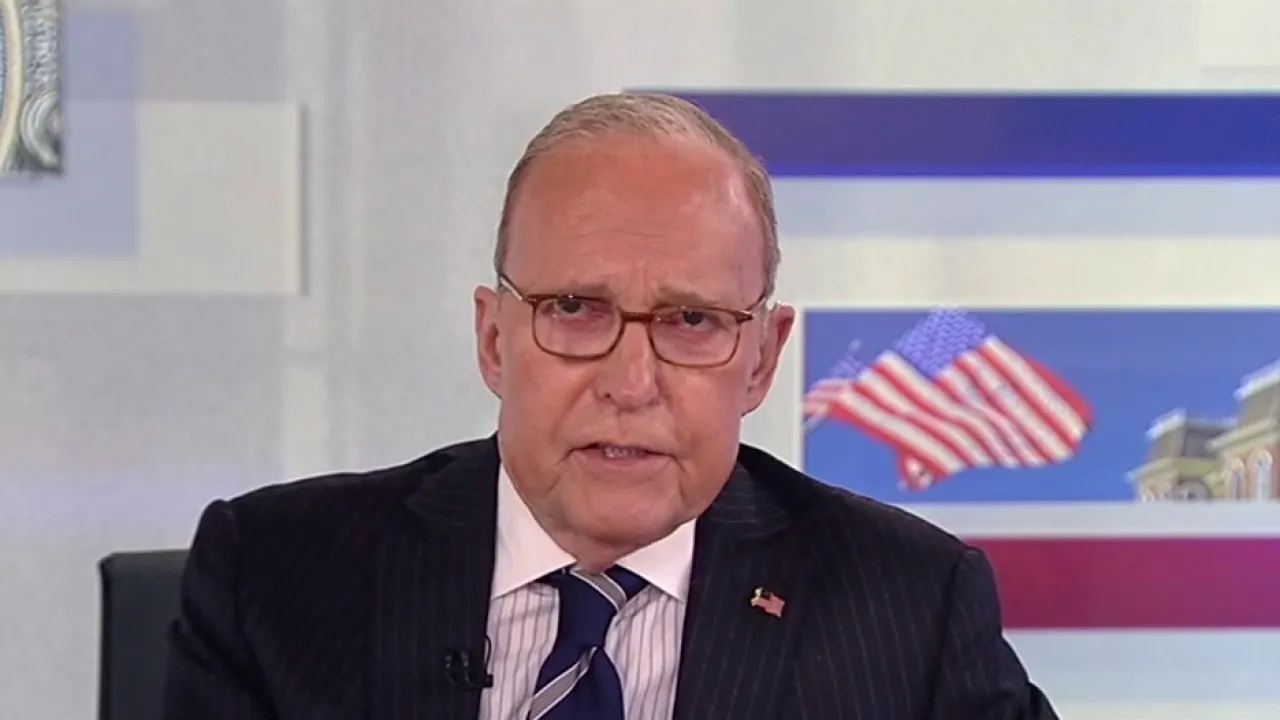
FOX Business host Larry Kudlow warns the GOP against a narrow reconciliation budget bill, calling for pro-growth tax cuts while addressing alleged government fraud, on ‘Kudlow.’
**Key Takeaways:**
1. **Missed Fiscal Opportunity:** The current legislative trajectory risks squandering a critical reconciliation window for comprehensive pro-growth tax reform and deficit reduction, potentially dampening long-term economic dynamism and investor confidence.
2. **Inflationary Pressures & Consumer Sentiment:** Despite underlying economic resilience, persistent inflation, evidenced by elevated gas prices and broader cost-of-living increases, is eroding consumer purchasing power and negatively impacting public sentiment, suggesting a need for targeted fiscal relief.
3. **Market-Oriented Policy Gaps:** A narrow budget bill that overlooks supply-side tax cuts, capital gains indexing, and significant anti-waste initiatives fails to address key market drivers that could stimulate investment, unlock capital, and improve the nation’s fiscal health.
—
Amidst persistent inflationary pressures and a volatile geopolitical landscape, the current congressional maneuvering around fiscal policy presents a critical juncture for the U.S. economy and financial markets. The conventional wisdom for Republicans, as history has repeatedly shown, is that embracing pro-growth tax cuts and advocating for economic expansion paves the path to electoral success. Conversely, a departure from this core message, particularly when coupled with unchecked spending, often leads to political setbacks. This simple, yet powerful, formula appears to be at risk of being overlooked, potentially leading to a significant misstep with tangible market implications.
While the broader economy demonstrates a surprising degree of resilience, particularly in the face of ongoing global challenges, the individual experience of the American consumer tells a different story. The persistent reality of $4-a-gallon gasoline, alongside a myriad of other rising prices, underscores a significant affordability crisis. This isn’t merely a political talking point; it’s a direct drag on household budgets, impacting discretionary spending and, by extension, corporate revenues across various sectors. The reliable TIPP poll, a bellwether of public sentiment, indicates that a substantial four out of ten voters perceive their tax burden as higher this year, with only a scant one in ten reporting a decrease. This perception, even in the wake of previous legislative efforts like the “One, Big, Beautiful Bill,” highlights a critical disconnect between policy implementation and public understanding – a disconnect that can translate into depressed consumer confidence and market hesitancy.
My recent exchange with Senate leadership Republican, Shelley Moore Capito, brought these concerns into sharp focus. The proposed “skinny” reconciliation bill, primarily focused on financing ICE and CBP for 3.5 years at an estimated cost of $70 billion, appears to miss the broader economic opportunity. While border security is undeniably a critical function of government, the exclusion of wider pro-growth initiatives, such as comprehensive tax cuts, inflation indexing for capital gains, or a robust Pentagon military supplement, raises serious questions about the strategic priorities being pursued. The lack of attention to pervasive government waste, fraud, and abuse – areas ripe for significant fiscal savings and a boost to public trust – further compounds these concerns. This narrow approach risks squandering the singular opportunity afforded by the reconciliation process, which allows certain budget-related legislation to pass with a simple majority, bypassing the usual 60-vote filibuster threshold.
The current bill’s limited scope is particularly perplexing when considering the entirety of the Department of Homeland Security (DHS), which includes vital agencies like the Coast Guard, FEMA, and TSA – all conspicuously absent from this funding package. Furthermore, in an environment where voter confidence in election integrity is paramount, the apparent disregard for popular reforms like requiring photo identification and citizenship proof for voting, as advocated by many, suggests a missed opportunity to address popular concerns that resonate far beyond partisan lines. While the economic costs associated with geopolitical imperatives, such as confronting adversarial regimes, might necessitate higher energy prices – a “small price to pay” for national security – it simultaneously intensifies the need for domestic fiscal policies that put more money back into the pockets of working families through meaningful tax relief.
Historically, supply-side tax cuts have consistently proven to be powerful engines of economic growth and voter appeal. President Reagan’s economic program is a seminal example, demonstrating how lower marginal tax rates can incentivize investment, stimulate production, and expand the tax base. Similarly, President George W. Bush’s mid-term success in 2002 was anchored not only by robust national defense but also by across-the-board tax cuts that buoyed the economy. Replicating this strategy today, by, for example, implementing inflation indexing for capital gains, could inject much-needed liquidity into the housing market, currently grappling with a slump, and encourage asset reallocation, ultimately benefiting real estate and construction sectors. Lowering marginal tax rates, particularly for middle-income earners, would directly enhance disposable income, stimulating consumer demand and providing immediate relief from inflationary pressures.
Beyond tax policy, the potential for significant savings through a concerted effort to combat waste, fraud, and abuse within government agencies remains an untapped resource. Mehmet Oz’s reported discovery of $100 billion in Medicare fraud in Los Angeles alone highlights the sheer scale of the problem. Extending this scrutiny to other departments, such as the Department of Government Employees (DOGE) – a proxy for general government administration – could unlock hundreds of billions of dollars over a decade. Such a monumental reduction in wasteful spending, combined with a robustly growing economy, would not only contribute significantly to deficit reduction but also improve the nation’s fiscal health, potentially lowering long-term borrowing costs and enhancing investor confidence in the U.S. sovereign debt.
The silence surrounding these crucial, and popular, policies is deafening. With the political reality of only “one bite out of the fiscal apple” – a single major legislative vehicle – it is imperative to leverage this opportunity for a comprehensive, ambitious budget bill. Such a bill should not merely address narrow administrative needs but instead encapsulate a vision of real leadership and accomplishment, prioritizing economic growth, fiscal responsibility, and tangible benefits for American families. This is not the time for incrementalism or a focus on what cannot be achieved; it is a moment to articulate what *can* be done to foster a “growthier” America, paving the way for a decisive midterm victory.
**Market Impact:**
The policy direction outlined by the current legislative debate carries significant implications for financial markets. A narrow “skinny” bill that avoids comprehensive tax reform and aggressive anti-waste measures could signal a missed opportunity for boosting long-term economic growth and fiscal health. This could lead to continued investor uncertainty regarding future fiscal policy, potentially dampening equity market enthusiasm, particularly in sectors that would benefit most from increased consumer spending and corporate investment. The lack of inflation indexing for capital gains could prolong the housing market’s slump, impacting real estate-related stocks and bond yields. Conversely, a robust, growth-oriented budget, incorporating broad tax cuts and significant deficit reduction through waste elimination, would likely be met with strong positive market reactions, stimulating capital formation, bolstering corporate earnings expectations, and improving confidence in the U.S. fiscal trajectory, potentially leading to stronger equity performance and a more stable bond market. The perception of effective governance and a clear economic strategy would also enhance the attractiveness of U.S. assets globally, impacting currency strength and foreign direct investment.