
Stay informed with free updates
Simply sign up to the War in Ukraine myFT Digest — delivered directly to your inbox.
Key Takeaways:
- Escalating Economic Warfare:Ukrainian drone attacks are inflicting tangible economic damage on Russia’s domestic infrastructure, targeting critical logistics and energy assets, challenging official narratives of resilience and creating significant supply chain disruptions.
- State Intervention & Market Distortion:President Putin’s directive for government aid to rebuild damaged facilities, particularly for e-commerce giant Wildberries, signals a deepening reliance on state capitalism to mitigate crisis, introducing moral hazard and potentially distorting market efficiency.
- Systemic Financial Risk:The colossal losses faced by Wildberries, potentially leading to a Rbs1.3tn ($15bn) debt crisis, pose a systemic risk to Russia’s state-backed financial institutions like VTB, necessitating central bank intervention and highlighting the fragility of a war-economy.
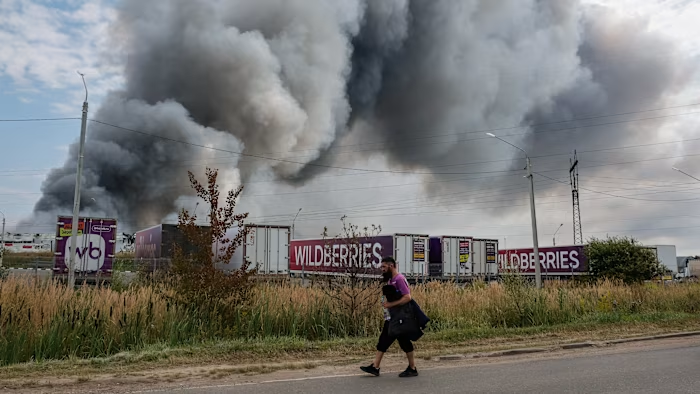
In a revealing acknowledgment of the mounting economic toll exacted by Ukrainian drone attacks, Vladimir Putin has ordered Russia’s government to provide substantial support for the reconstruction of critical logistics infrastructure. This directive comes after a summer of sustained assaults that have particularly devastated Wildberries, the country’s largest online retailer, signaling a new phase of economic warfare impacting Russia’s domestic market resilience and supply chain stability.
Addressing officials on Wednesday, President Putin underscored that Russia’s logistics and storage capacity “need to be rebuilt, including with government support.” This statement contradicts earlier official rhetoric that downplayed the severity of the attacks and their broader macroeconomic implications. While Putin maintained that Russia’s retail infrastructure was “efficient and resilient [. . .] and entirely coping with the challenges of our time,” the necessity of state intervention for a private enterprise underscores the profound disruption being experienced at the operational level.
The strategic targeting of Wildberries’ facilities has had a cascading effect. Seven of its ten largest distribution centers have been partly or completely destroyed, representing a significant blow to the backbone of Russia’s burgeoning e-commerce sector. This disruption directly impacts consumer access to goods, raises logistical costs, and poses existential threats to the vast network of small and medium-sized businesses (SMEs) that rely on Wildberries’ platform. Analysts, including those from independent Russian news site The Bell, estimate Wildberries’ turnover has already plummeted by 25 per cent as sellers abandon the platform or grapple with lost inventory, putting severe strain on the domestic retail supply chain.
Beyond e-commerce, Ukraine’s largely homegrown advances in drone technology have brought the conflict home to Russia’s critical energy infrastructure. Strikes on Russian refineries have forced one of the world’s largest energy exporters to resort to importing petrol and introduce rationing at the pump – an unprecedented domestic fuel crisis since the collapse of the Soviet Union. This not only highlights vulnerabilities in Russia’s energy security but also creates inflationary pressures for consumers and businesses alike. Furthermore, drone attacks on Russia’s Black Sea ports have severely hampered grain exports and disrupted one of the primary avenues for its crude oil sales, impacting global commodity markets and Russia’s crucial export revenues.
While Putin shrugged off the broader impact, he implicitly admitted that the combined pressure of drone attacks and Western sanctions were indeed holding back Russia’s economic momentum. He noted that GDP growth rose by a mere 0.6 per cent in the first half of this year, a figure that, while positive, masks significant sectoral distress and the ongoing reallocation of state resources towards military objectives and now, domestic damage control. Despite his assertion that “there have not and cannot be any critical consequences from these attacks,” he conceded, “But, of course, they are doing harm to us, that’s obvious.”
The announcement of potential state aid offers a critical lifeline to Wildberries, whose staggering losses – estimated by Russian analysts to be as high as Rbs878bn ($10bn) in destroyed inventory and facilities – threatened to destabilize a key player in the Russian consumer market. Ukraine has justified these attacks by alleging Wildberries facilitates the sale of dual-use components for Russia’s military. Denys Shtilerman, co-founder of FirePoint, a Ukrainian defense manufacturer, articulated a strategic objective: to trigger a broader economic crisis by forcing Wildberries into default on its substantial debt to state banks, particularly VTB, its main financial partner.
The potential cost of Wildberries’ rescue is astronomical, with estimates suggesting new debt financing could stretch as high as Rbs1.3tn ($15bn). Such a bailout would represent a significant fiscal burden, diverted from other economic priorities or social spending. Although Putin did not specify the exact financial commitment or mention Wildberries by name, he promised that destroyed warehouses would be rebuilt to a “qualitatively new technological level.” He outlined potential support mechanisms including tax breaks and subsidised loans, indicative of a centrally planned intervention to prop up strategic economic assets.
Adding to the state’s efforts to contain the fallout, the central bank has already instructed banks to restructure Wildberries sellers’ debt on favourable terms, aiming to prevent a cascade of bankruptcies among SMEs. Wildberries itself has pledged some financial support to the most affected vendors, but the scale of the destruction far outstrips private compensation capabilities, necessitating state-backed capital injections and financial engineering.
This domestic economic vulnerability stands in contrast to Russia’s own stepped-up campaign of missile and drone strikes on Ukrainian cities. However, while Russia’s attacks aim to degrade Ukraine’s military and civilian infrastructure, Ukraine’s strategy of targeting Russian domestic economic assets appears designed to inflict direct financial pain, disrupt supply chains, and test the resilience of Russia’s war-time economy and its state-dominated financial architecture. The challenge for Russia is not just physical rebuilding, but maintaining investor confidence and managing the systemic risks exposed by these novel forms of economic attrition.
Market Impact:
The escalating drone attacks on Russian economic infrastructure introduce significant volatility and risk premiums across several market segments. For global commodity markets, continued disruption to Russian energy and grain export facilities implies upward pressure on oil and food prices, exacerbating global inflationary concerns. Domestically, the need for massive state bailouts and the central bank’s directive on debt restructuring signal growing systemic risk within Russia’s financial sector, particularly for state-owned banks heavily exposed to key corporate entities. This environment will likely deter any remaining foreign direct investment, deepen capital controls, and force the state to assume an even larger role in economic planning and resource allocation. For investors watching geopolitical developments, these events underscore the evolving nature of economic warfare, where physical destruction of civilian logistics and energy assets becomes a direct lever for financial and macroeconomic pressure, challenging the stability of even large, resource-rich economies under sanctions.