
**Key Takeaways:**
1. **Geopolitical Risk Fuels Market Dislocation:** Houthi strikes on Saudi Arabia have triggered a severe supply shock in air travel, forcing a rapid repricing of executive mobility solutions. The closure of Riyadh’s main airport, coupled with widespread commercial flight cancellations and operator withdrawals, has created a classic scenario of inelastic demand meeting constrained supply in the private jet charter market.
2. **Soaring Risk Premiums and Operational Costs:** Charter prices have surged over 50%, driven not only by scarcity but also by significantly elevated “war-risk” insurance premiums, adding thousands to flight costs. This illustrates how geopolitical instability directly translates into higher operational expenses and risk-adjusted pricing across the logistics and aviation sectors, a direct charge for perceived heightened danger.
3. **Localized Disruption vs. Regional Resilience:** While Saudi Arabia faces acute travel disruption and a potential exodus of certain foreign personnel, the broader Gulf region, particularly hubs like Dubai, continues to see strong demand for private air travel, demonstrating market segmentation. This indicates investors and businesses are differentiating between specific country-level geopolitical risks and the overall stability of the wider economic bloc, though vigilance remains paramount.
The recent escalation of Houthi strikes on Saudi Arabia has sent a palpable tremor through the kingdom’s aviation sector, culminating in a significant market dislocation for executive and high-net-worth travel. The abrupt closure of Riyadh’s King Khalid International Airport, a critical nexus for international commerce and mobility, coupled with the subsequent cancellation of thousands of commercial flights, has precipitated a dramatic repricing event within the private jet charter market. Operators and brokers report a staggering surge of over 50 per cent in charter costs, a vivid illustration of how geopolitical instability can swiftly translate into acute supply-side shocks and inflated operational premiums.
This market dynamic is a textbook case of supply-demand imbalance exacerbated by extreme external factors. With over 5,500 departing flights from Saudi airports grounded since the strikes commenced, according to aviation analytics group Cirium, the commercial aviation infrastructure has effectively been crippled. Major international carriers, including Lufthansa and Italy’s ITA, have suspended services, while British Airways and Air France had already pre-emptively postponed flights. This massive withdrawal of conventional air transport capacity has channeled an unavoidable surge of demand into the niche, and inherently more flexible, private charter sector.
The scarcity of available private aircraft has been further compounded by several operators electing to pull services from the country, citing heightened operational risks. This dual pressure – burgeoning demand from a stranded executive and affluent population meeting a contracting supply of willing and capable charter providers – has created a sellers’ market of unprecedented intensity. Alexander Graham of Luxe Jets highlighted this, noting, “Prices are going up because we’re losing availability, so for people that are willing to do it, it will be a bit more expensive.” This sentiment underscores the market’s rapid adjustment to a new risk-reward equilibrium.
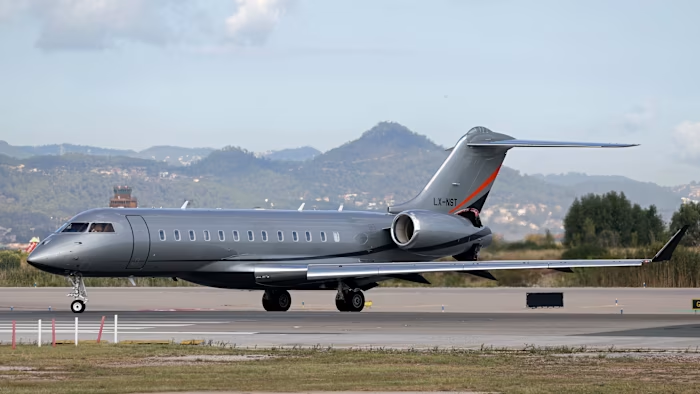
Concrete examples underscore the magnitude of this repricing. A Bombardier Global 6000, a luxury 14-seater long-range aircraft, recently commanded €94,000 for a flight from al-Qassim airport (north of Riyadh) to Geneva. This represents a substantial premium over its pre-crisis price of approximately €60,000, indicating a 56% increase driven purely by market distress. Similarly, Charles Robinson, founder at EnterJets marketplace, cited charter flights to Europe from Saudi Arabia fetching up to $150,000, while even shorter regional flights to the UAE were priced between $30,000 and $50,000. These figures are not merely operational cost increases; they embody a significant “scarcity premium” applied by operators capitalizing on the desperate need for mobility, demonstrating the inelasticity of demand among high-net-worth individuals and corporate entities during crises.
Beyond the direct impact of supply and demand, a critical financial layer has been added: war-risk insurance. Brokers confirm a dramatic increase in these premiums, which are directly passed on to the consumer. Toby Edwards, co-CEO at Victor, illustrated the scale, noting that larger 18-seater planes could incur an additional $20,000 for this coverage, while smaller 8-10 seaters might face an extra $8,000. Robinson at EnterJet further elaborated, stating that war risk costs were adding up to 10 per cent to some flights across the region, with Saudi-specific flights incurring an even higher premium. While these levels have not yet reached the stratospheric $50,000 per journey seen during the initial phases of the Iran conflict, they represent a material increase in the cost of doing business in a conflict-affected zone, reflecting underwriters’ reassessment of geopolitical risk and the corresponding increase in the cost of capital for aviation operators.
The logistical challenges further exacerbate the situation and contribute to higher pricing. With Riyadh’s main international gateway closed, private jet passengers are being forced to charter from secondary airports like al-Qassim, located over 200 miles from the capital. This necessitates additional ground transportation, adding time, cost, and complexity to an already stressful travel situation. For those unable to afford private charters, the alternative involves arduous overland journeys to neighboring Bahrain or Qatar to access commercial flights, highlighting the stark stratification of mobility options during a crisis and the impact on broader market accessibility.
From a corporate perspective, the situation is prompting strategic re-evaluations. Several Western businesses are reportedly engaging flight brokers to explore relocating key personnel stationed in Riyadh, either to regional hubs like Dubai or back to their home markets. This reflects a proactive approach to business continuity and executive risk management, where the increased cost of mobility is weighed against the potential risks to human capital and ongoing operations. While not yet an evacuation on the scale of the Iran conflict, where tens of thousands departed Dubai and the UAE following a far greater barrage of missile and drone attacks, the current scenario underscores the ongoing challenge of operating in geopolitically sensitive regions. The comparatively smaller Western expatriate population in Saudi Arabia versus the UAE, a dominant finance and trade hub, also plays a role in the differing scale of response, affecting the sheer volume of demand for such services.
Crucially, the market appears to be differentiating between localized disruption and broader regional instability. Despite the acute challenges in Saudi Arabia, demand for flights into and within the wider Gulf region remains robust. Edwards of Victor noted, “The missile strikes don’t seem to have had an impact on the wider region. We had a new client fly Antalya [in Turkey] to Dubai with his family for a week’s holiday. Another regular client flew to Kuwait on Friday, then also into Dubai yesterday.” This suggests that while specific country-level risks are being aggressively priced, the perception of systemic regional collapse has not taken hold. Major regional hubs like Dubai continue to demonstrate resilience, underscoring their established role as safe havens and logistical pivots in times of localized turmoil, allowing for market segmentation in risk assessment.
Market Impact
The immediate market impact is a sharp increase in the cost of executive and high-net-worth mobility in Saudi Arabia, reflecting a significant geopolitical risk premium now embedded in travel logistics. This not only burdens individuals and corporations with higher operational expenses but also signals a potential cooling of foreign direct investment sentiment and a re-evaluation of business presence in the kingdom. While the broader regional market demonstrates resilience, the localized disruption in Saudi Arabia serves as a stark reminder of the financial consequences of supply chain vulnerabilities and heightened security concerns. It underscores how geopolitical events can rapidly impact the pricing of essential services, influence corporate risk strategies, and subtly shift the competitive landscape among regional economic hubs, with those perceived as more stable potentially benefiting from redirected capital and talent flows. This situation highlights the ongoing challenge for Saudi Arabia to attract and retain international talent and investment in a volatile geopolitical environment, directly impacting its Vision 2030 diversification goals.