
Donald Trump has often boasted about the shortcomings and discredit of past US presidents who became entangled in international blunders, citing Joe Biden’s disorderly retreat from Afghanistan and George W Bush’s unfortunate incursion into Iraq.
Regarding Iran, Trump also holds an extended recollection, having pondered in recent times how Jimmy Carter’s 1980 re-election campaign was jeopardized by a bungled attempt to free 52 American detainees in Tehran.
“Consider Jimmy Carter, the illustrious Jimmy Carter, with the wrecked helicopters, the captives scattered everywhere. Do you recall that incident?” he remarked in January. “Think about Sleepy Joe Biden and Afghanistan. What a catastrophe, truly the most humiliating day in our nation’s annals.”
However, any hesitation Trump — who consistently pledged during his campaign to “America first” and steer clear of international involvements — might have felt concerning foreign military action now seems far removed.
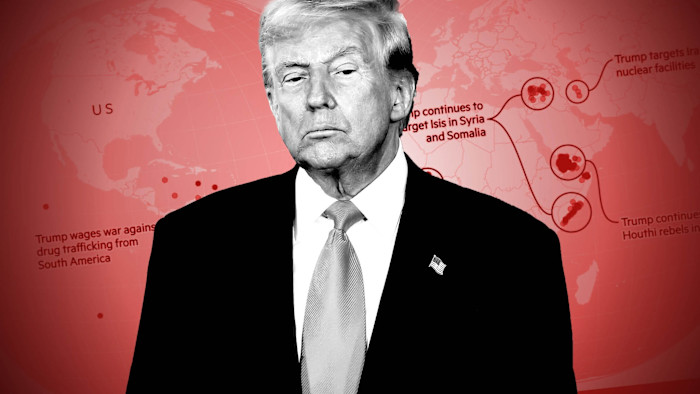
Trump’s recently renamed Department of War has demonstrated greater activity over the past twelve months than throughout his entire initial presidential term, engaging in fresh territories and undertaking larger hazards than previously.
“We have accomplished far more in military affairs than any preceding administration, by a considerable margin,” Trump informed journalists on the first commemoration of his second term.
This has been largely propelled by a principle of swift, precise operations, which can be concluded with a speedy announcement of triumph. The most dramatic illustration was the January endeavor in Venezuela to extract Nicolás Maduro from amidst his Cuban protectors.
However, Trump has now initiated what seems to be his most significant intervention to date: Operation Epic Fury, a far-reaching, unlimited endeavor aimed at overthrowing Iran’s government.
On Saturday, following the elimination of Iran’s Ayatollah Ali Khamenei on the initial day of combined US and Israeli aerial assaults, Trump conceded he might be embarking on a significantly prolonged campaign. The assaults, he declared on Truth Social, would persist through the week or “as long as requisite to attain our aim of TRANQUILITY ACROSS THE MIDDLE EAST AND, VERILY, THE GLOBE!”

“He was quite hesitant to employ military power” during his initial presidency, noted a former high-ranking defense official. “He has become quite accustomed to it now.”
Trump gradually developed this fresh inclination for utilizing the power of the US military overseas. His initial term was characterized by an aversion to anything beyond aerial bombardments in support of a targeted objective.
Against Iran, Trump executed one of the pivotal military operations of his initial term. He responded to the near breaching of the US embassy in Baghdad by Shia demonstrators, believed to have connections with Iran, by mandating the elimination of Revolutionary Guards commander Qassem Soleimani.
His audacity was recompensed by Iran’s comparatively restrained reaction; it launched a forewarned volley of missiles at US bases, which inflicted physical harm but resulted in no fatalities.
The Soleimani operation demonstrated to Trump that he could employ armed power to his advantage, according to Elliott Abrams, who served as a special envoy for Iran and Venezuela during the initial Trump administration.
Trump’s electorate “has an aversion to defeat, or American casualties, or prolonged conflicts, but they are pleased to witness authority wielded effectively,” Abrams stated.

On this occasion, Iran has reacted with greater intensity, discharging hundreds of unmanned aircraft and projectiles at US and Israeli objectives throughout the area, encompassing military installations.
Although the majority have been interdicted, the US military reported on Sunday that three soldiers were killed and five sustained severe injuries, a result Trump had admitted could occur when he stated American service members “might perish.”
Nevertheless, Tom Cotton, the Republican legislator who presides over the Senate intelligence committee, informed CBS News on Sunday morning that, excluding pinpoint operations, Trump possessed “no strategy for any extensive land contingent inside of Iran.”
Prior to the US and Israeli assaults, retired General Stanley McChrystal, a former leader of US Joint Special Operations Command, asserted that Trump had “succumbed to the misconception” that concealed or precise endeavors, aerial bombardments, and accumulating naval vessels off shorelines are efficacious.
“I believe he is being enticed by something which, historically, does not yield enduring results,” he added.
Upon resuming office, Trump has mandated assaults on Isis objectives in Iraq, Syria, and Nigeria, initiated an offensive against supposed narcotics trafficking vessels in Latin America, and, in the months preceding Maduro’s apprehension, accumulated the most substantial US naval deployment in the area in many years.
This presents a sharp divergence from the Department of Defense’s new national strategic framework, which, while unequivocally stating its readiness to undertake “resolute measures on its own,” asserts that the US will no longer be diverted by “foreign meddling” and “governmental alteration.”

His administration has even menaced to employ armed might to seize Greenland from US partner Denmark, thereby jeopardizing Nato’s future. In a letter addressed to the Norwegian premier, subsequently failing to win the Nobel Peace Prize, Trump stated he no longer perceived “a duty to think exclusively about Tranquility.”
Leading up to his assault on Iran, Trump’s aims seemed to vary frequently — ranging from safeguarding dissident demonstrators and terminating Iran’s nuclear initiative, to restricting its ballistic missile stockpile and compelling it to cease backing for local affiliates.
Trump seemed nearly until the final moment to be hesitant to utilize the “fleet” he had stationed within striking distance of Iran, pondering aloud that he had not yet decided.
However, notwithstanding covert discussions with Iran on Thursday, whereupon both Tehran and the mediator Oman reported advancement, by Saturday morning it was evident Trump was no longer keen on a negotiated resolution.
“During his initial term, he grew more prudent over time,” stated Michael O’Hanlon, a military and strategic specialist at the Brookings Institution think-tank. “In his second tenure, up to now, it seems anything could happen.”
Further contributions from Abigail Hauslohner, James Politi, and Lauren Fedor in Washington