
The UK possesses “severely restricted capacity” to safeguard itself from ballistic projectile dangers, the erstwhile head of Britain’s land-based aerial protection has cautioned, as hostilities in Ukraine and the Middle East underscore the increasing deployment of extended-range assaults in contemporary combat.
Colin Da Silva, who held the post of assistant chief of air staff for the Royal Air Force, contended that the £1bn in funding designated for missile and air defence in the previous year’s Strategic Defense Assessment is nowhere near sufficient for forthcoming perils.
Upon learning of recent governmental pledges from British cabinet members that the nation has secured the essential capital, Da Silva, who commanded the UK’s terrestrial aerial safeguards between 2008 and 2011, remarked: “I was utterly astonished.”
He further stated: “No such ‘adequate funding’ has yet been located by the Ministry of Defence or the Exchequer, much less disbursed and, crucially, provided.”
Discussion regarding the suitability of Britain’s aerial and projectile safeguards has intensified subsequent to Iran’s aborted attack last month on the joint British-American installation at Diego Garcia, entailing two guided projectiles launched from approximately 4,000km away.
Even though one missile malfunctioned and the other was neutralized, the assault highlighted how swiftly adversaries are broadening both the reach and intricacy of their projectile initiatives.
In the wake of the strike, the Israel Defense Forces (IDF) asserted that Tehran possesses armaments capable of striking London, Berlin and Paris.
And while defence experts have observed that the majority of Russia’s standard guided projectile inventory would find it difficult to strike the UK mainland, Moscow is vigorously pursuing novel projectile systems.
Its aerial-borne ultra-fast Kinzhal missile and Kalibr guided warheads, which can be deployed from vessels or submersibles, are able to strike Britain.
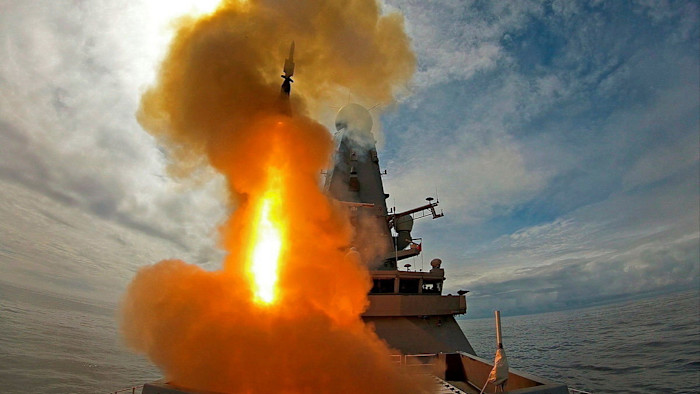
While the UK’s continental partners possess land-based anti-projectile defense installations engineered to engage elevated, rapidly-advancing adversaries and ultra-high-speed armaments, Britain depends on the Type 45 naval vessel, equipped with Aster 15 and Aster 30 defensive missiles.
The Type 45 — one of which has been dispatched to the Eastern Mediterranean to safeguard Cyprus — offers a “highly restricted capacity” and is not designed for optimal performance in protection against guided projectiles, nor can it shield significant portions of the British landmass, Da Silva explained.
“The issue is there’s £600mn of vessel before you even get to the armament setup,” said Francis Tusa, editor of Defence Analysis. “Whereas if you’ve got it installed on a lorry it’s significantly less costly.”
The UK also possesses Typhoon jets equipped with Aim-132 missiles and the Sky Sabre intermediate-range terrestrial anti-projectile apparatus, despite these not being built to confront guided projectiles or ultra-high-speed armaments.
The Strategic Defence Review, issued in May 2025, assigned £1bn to aerial and projectile protection — a modest amount in contrast with alternative provisions, such as 12 atomic-powered assault submersibles projected to incur expenses of more than £3bn each.
Germany, meanwhile, has recently pledged to invest €6bn on its extended-reach projectile protection apparatus, utilising Israel’s Arrow 3. Denmark is commencing a $9bn renovation of its terrestrial aerial safeguards to create a multi-tiered, extended-reach and swift reaction capability to address contemporary perils.
The notion that the UK’s present projectile protection budget is adequate is “patently false and jeopardizes deceiving the citizenry about the magnitude of the difficulties we face”, Da Silva stated.
“You would be talking a level substantially higher than that billion pounds to resolve the complete issue of delivering viable military protection against guided projectiles for the UK,” he further remarked, without specifying an exact amount.

In reply to objections about its projectile safeguards, the MoD stated: “We possess the necessary assets to ensure the security of the United Kingdom from assaults, whether it’s within our borders or from foreign lands.”
It further stated that the UK gains from protection provided by NATO allies as well.
This reiterated a statement made last week by defense minister John Healey, who informed Sky News: “We have the resources, we have the armed forces capacities, we have the partnerships as well. That means our native territory is safeguarded, not just by what our naval forces, our aerial forces, and our ground forces can do, but also by what our NATO partners do.”
But defence analysts question whether adjacent NATO partners could be counted upon to deploy limited and costly counter-projectiles — costing $3mn-$20mn — on approaching projectiles that are not aimed specifically at their territory, especially if they were themselves facing assault.
Tusa contended the strategy is defective, pointing out the absence of an official accord on collective projectile protection.
He added: “If Russia launches a projectile from Kaliningrad, and detection systems indicate it’s directed towards London, our policy is that maybe Poland will handle it. If not, maybe Germany or Denmark, they’ll handle it. Oh, but then the Dutch will handle it, perhaps the French as well.”