
The menace of indefinite Iranian dominance over the Strait of Hormuz is compelling Gulf nations to re-evaluate expensive proposals for pipelines that would circumvent this constricted passage, enabling them to maintain oil and gas exports.
Authorities and business leaders from the sector assert that fresh pipeline initiatives might represent the sole method to mitigate the persistent susceptibility of Gulf nations to interruptions within the waterway. However, they acknowledge that such undertakings would be costly, politically intricate, and necessitate several years for their conclusion.
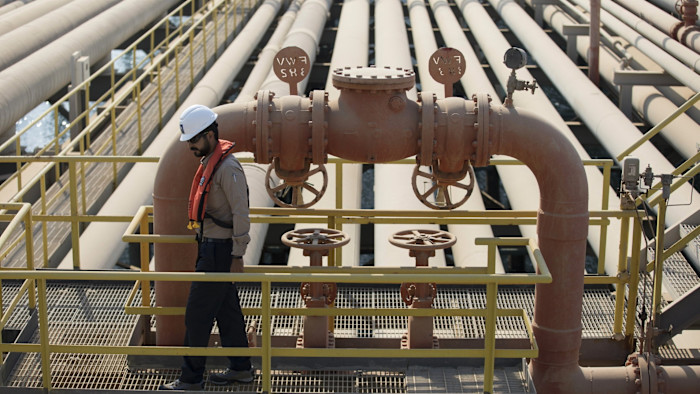
The ongoing hostilities have highlighted the crucial worth of Saudi Arabia’s 1,200km East-West pipeline. Established in the 1980s due to concerns that the Iran-Iraq “tanker war” might obstruct the strait, this vital conduit now transports 7 million barrels of oil daily to Yanbu, a Red Sea port, completely circumnavigating Hormuz.
“In retrospect, the East-West pipeline appears to have been a brilliant move,” remarked a high-ranking Gulf oil and gas official.
Amin Nasser, CEO of Saudi’s government-owned petroleum colossal, Aramco, communicated to experts last month that the pipeline represents “the primary channel we are currently leveraging”.
Presently, the monarchy is evaluating methods to dispatch a greater portion of its 10.2 million barrels of everyday output via pipeline, instead of traversing waters under Iranian dominion. This involves scrutinizing whether to augment the East-West pipeline’s throughput or to construct alternative pathways.
Prior proposals for conduits spanning the region have frequently halted, hampered by exorbitant expenses and intricacy. Nevertheless, Maisoon Kafafy, a principal consultant for the Atlantic Council’s Middle East initiatives, stated that the sentiment in the Gulf has since transformed.
“I’m perceiving a transition from theoretical possibilities into practical implementation,” she remarked. Adding, “Everyone is observing the same map and reaching identical judgments.”
Kafafy suggested that the most robust choice, instead of standalone ventures, “is not a sole substitute pipeline but rather a system, an intricate mesh of pathways.” She further noted, however, that this would also be the most difficult to accomplish.
In the distant future, any novel conduits are probably to become components of commercial pathways, facilitating the transit of a broader array of commodities in addition to oil and gas.
A potential alternative involves the resurgence of US-initiated proposals for a grand pathway, dubbed IMEC, designed to extend from India, across the Gulf, and then onward to Europe, as stated by a Gulf representative. This undertaking, however, initially featured a diplomatically sensitive pipeline segment that extended to Haifa, an Israeli port.
Yossi Abu, CEO of the Israeli firm NewMed Energy, expressed assurance that conduits leading to the Mediterranean Sea would be constructed, regardless of whether they concluded in Israeli or Egyptian harbors. He emphasized the necessity for people to “shape their own futures, with their allies,” asserting that “oil pipelines, rail links, are needed across the area, land-based, without presenting hindrances to others that would impede our advancement.”
Christopher Bush, CEO of Cat Group, the independent Lebanese firm that served as a primary constructor of Saudi’s East-West pipeline, indicated that considerable curiosity in novel ventures existed even prior to the conflict’s commencement. He noted, “We have received inquiries concerning diverse pipelines,” adding, “I have numerous proposals on my desk.”
Nevertheless, the impediments persist as formidable, he noted. Bush calculated that the expense of duplicating the East-West pipeline today, an undertaking that necessitated excavating through the tough volcanic rock of the Hijaz mountain range on Saudi’s Red Sea coast, would amount to a minimum of $5 billion. Schemes for more intricate transnational pathways originating from Iraq, traversing Jordan, Syria, or Turkey, would entail $15 billion to $20 billion.
He revealed, “It has been examined. Preliminary technical assessments for [such routes from] Iraq even exist. A prospect has been deliberated.”
Nonetheless, safety hazards encompass “numerous” dormant ordnance in Iraq and the persistent existence of ISIS or similar armed groups. Bush cautioned that conduits extending southward to Omani harbors would also encounter the challenge of traversing both arid land and rugged rocky ranges.
Omani harbors are not exempt from perils posed by Iran. Unmanned aerial vehicle assaults on Salalah, a vital harbor, in the past few days compelled its temporary closure.
Governance hurdles additionally involve determining who will manage the conduit and regulate its transit. A system of conduits would necessitate Gulf nations “to forsake their singular approaches and unite.” Bush further commented that it was consistently “considered more economical and secure to procure a vessel, fill its cargo, and navigate it.”
In the immediate future, the most feasible alternatives might involve augmenting the East-West pipeline and Abu Dhabi’s current pathway to Fujairah. This approach would boost throughput while circumventing the complexities associated with novel transnational facilities.
Saudi Arabia might also establish further outbound facilities along its Red Sea shoreline, notably at the deep-sea harbor currently under construction for the Neom initiative. Bush stated, “I am certain they are considering it as an option,” adding, “Many astute thinkers are currently examining all aspects of this. It represents a significant challenge.”
Saudi Arabia’s petroleum department offered no reply to an appeal for a statement.
A high-level oil official indicated that Abu Dhabi had consistently “possessed a contingency plan for an alternative conduit to Fujairah.” However, they noted that no determinations are probable to be reached until the enduring condition of the Strait of Hormuz ascertains. Adnoc, Abu Dhabi’s national petroleum firm, refused to provide a statement.
The United Kingdom is spearheading discussions among 35 nations with the goal of establishing an alliance to restore access to the strait.
Kafafy concurred that Gulf nations would require some time to appraise the predicament concerning the channel. However, she stated that they now perceive the magnitude of the present power crunch necessitates a fresh perspective. “The discussions have progressed significantly,” she commented, adding, “I do not anticipate [the existing state of affairs] will revert to its pre-hostilities condition.”
Cartography by Cleve Jones