
Key Takeaways:
- JPMorgan Chase’s $24 million investment directly addresses critical U.S. defense supply chain vulnerabilities and the precipitous decline in domestic shipbuilding capacity, signaling a strategic alignment of private capital with national security imperatives.
- The initiative strategically targets workforce development, creating new non-degree educational pathways and training programs to cultivate a skilled labor force essential for revitalizing the defense industrial base in key manufacturing hubs like Philadelphia.
- This corporate commitment reflects a broader market trend where major financial institutions are deploying “patient capital” to foster long-term domestic economic resilience, reduce reliance on foreign supply chains, and reinforce America’s industrial strength amid escalating geopolitical tensions.
FOX Business’ Edward Lawrence reports live from the Pennsylvania Defense & Innovation Summit, highlighting $10 billion in defense deals and 4,000 new jobs.
Philadelphia, PA –In a significant move that underscores the growing intersection of private capital and national strategic interests, JPMorgan Chase on Wednesday announced a $24 million investment aimed at reinvigorating Philadelphia’s maritime sector. This substantial commitment arrives amidst stark warnings from defense strategists and policymakers regarding the critical erosion of America’s domestic shipbuilding capabilities and its burgeoning reliance on foreign entities for a cornerstone of national security.
For decades, the United States has witnessed a precipitous decline in its merchant fleet, plummeting from nearly 3,000 flagged vessels in the 1960s to fewer than 190 today. This dramatic contraction has created a profound national security gap, leaving the U.S. vulnerable to global supply chain disruptions and dependent on international partners for the very infrastructure that underpins its naval power and economic sovereignty. JPMorgan’s investment is positioned as a direct counter-measure to this strategic vulnerability, focusing on securing the defense supply chain, establishing a new submarine assembly facility, and cultivating a skilled workforce for critical defense roles.
“America can compete and lead in shipbuilding again—it starts with more skilled workers and secure supply chains. We need to train people for the jobs shipbuilders urgently need, connect them to good careers and strengthen the suppliers and partners that keep a shipyard running,” stated Jamie Dimon, JPMorgan Chairman and CEO, in a press release. Dimon, a vocal proponent of strengthening America’s industrial base, emphasized the synergistic benefits: “When we build the workforce and the supply chain together, we create good careers for workers and a stronger, more resilient maritime industry that supports our national security and our economy.” This sentiment resonates deeply within market circles, where the concept of “reshoring” critical manufacturing and fortifying domestic supply chains has gained significant traction following recent geopolitical and pandemic-induced disruptions.
The announcement coincided with the Pennsylvania Defense & Innovation Summit, highlighting the investment’s strategic alignment with broader governmental and industry objectives. Senator Dave McCormick (R-Pa.), a key figure at the summit, lauded the initiative: “America cannot restore its industrial strength or ensure peace through strength without investing in the workforce that powers it. Philadelphia has long been one of the great shipbuilding cities in the world, and today’s investment by JPMorgan Chase—the kind of investment we’re proud to feature at today’s Defense and Innovation Summit—recognizes that revitalizing this industry requires more than ships and shipyards.”
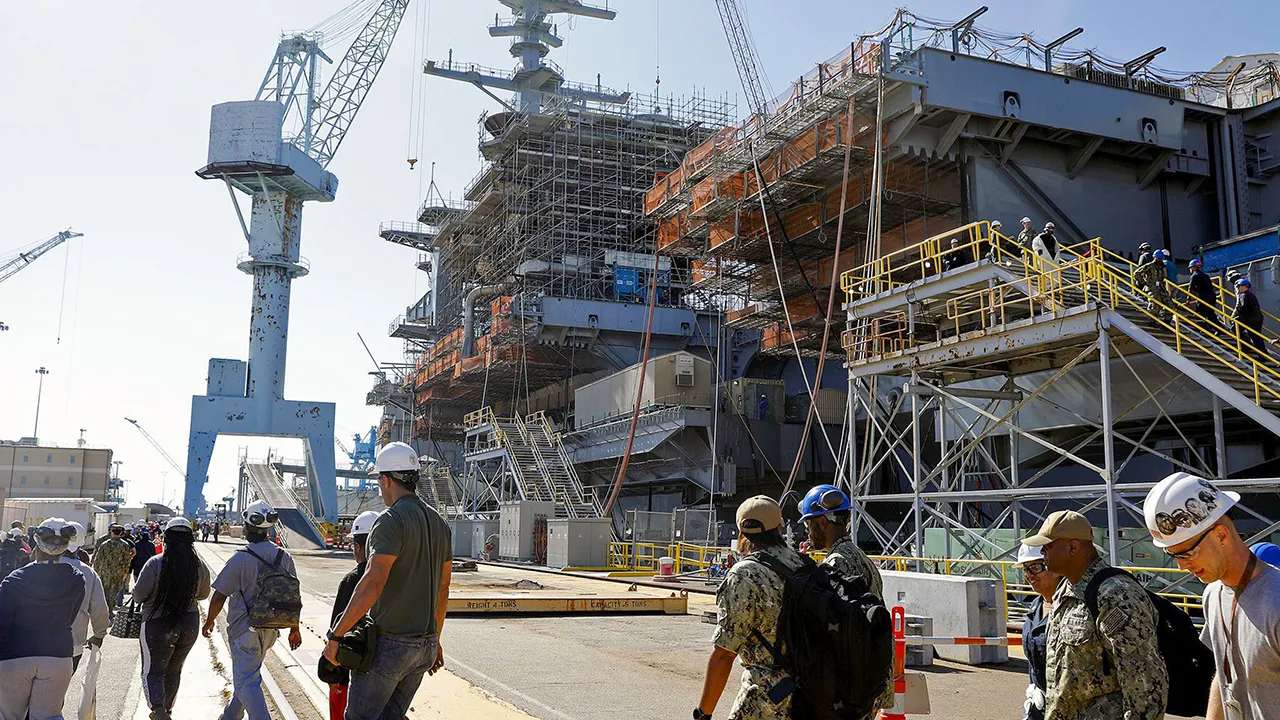
Shipbuilding workers and Navy sailors walk past the USS George Washington as it rests pier side.(Getty Images)
McCormick further elaborated on the long-term vision, stating that the commitment “requires creating opportunity for people. By supporting workforce development and strengthening local communities, this commitment will help prepare the next generation of skilled workers who will build the ships that protect our country and reinforce Pennsylvania’s role as a cornerstone of America’s defense industrial base.” This highlights the critical nexus between corporate social responsibility, economic development, and national security—a powerful narrative for investors looking at long-term, impact-oriented opportunities.
The $24 million commitment is structured strategically, with $18 million allocated as commercial financing and capital investments, complemented by $6 million in philanthropic contributions. This blended finance approach allows for both market-driven returns and social impact, a model increasingly favored by large institutions addressing complex societal challenges.
A significant portion of the funds will facilitate the construction of a new 95,000-square-foot submarine assembly plant, projected to generate 450 permanent, family-sustaining jobs. This direct investment in physical infrastructure is a tangible step toward expanding the U.S. defense industrial base, particularly crucial given the Navy’s persistent demand for submarine construction and maintenance. Furthermore, the program targets the historic Philadelphia Navy Yard, an industrial hub currently supporting 16,000 active positions across manufacturing and maritime sectors, aiming to scale non-degree educational pathways. This focus on vocational training and apprenticeships is vital for addressing the national shortage of skilled trades workers, a bottleneck that has plagued various manufacturing sectors.
JPMorgan Chase CEO Jamie Dimon joins ‘Mornings with Maria’ in a wide-ranging interview on AI risks, stablecoin regulation, housing affordability and his recent meeting with New York City Mayor Zohran Mamdani.
“Philadelphia is a place where targeted, coordinated investment can translate into real economic mobility,” observed Tim Berry, JPMorgan’s global head of corporate responsibility and chairman of the mid-Atlantic region. “By strengthening workforce pathways, supplier readiness and access to capital, we can help more people connect to quality jobs and help local businesses participate in long-term growth.” This holistic approach acknowledges that revitalizing an industry requires more than just large-scale facilities; it demands a robust ecosystem of skilled labor, agile suppliers, and accessible capital.
Mayor Cherelle L. Parker echoed the sentiment of local impact: “When organizations like JPMorgan Chase invest in Philadelphia, they’re investing in our people. They’re helping create the kind of opportunities that let someone learn a new skill, earn a good paycheck and build a better life for themselves and their family. That’s exactly the future we’re creating in the Lower South and at the Navy Yard: more pathways to family-sustaining careers and more opportunities for Philadelphians to help build America’s future.” This community-centric focus provides a strong counterpoint to “anti-rich” sentiment, demonstrating how large corporations can contribute directly to local economic prosperity and upward mobility.
Beyond the submarine plant, the remaining portion of the $24 million investment is strategically allocated to bolster the entire maritime ecosystem. This includes a $5 million low-cost loan program designed to help local small businesses create or retain 200 jobs, providing crucial liquidity to the often-underfunded small and medium-sized enterprises (SMEs) that form the backbone of the supply chain. An additional $1.5 million will be directed towards assisting 100 local maritime suppliers in upgrading their facilities, enhancing their capabilities, and ensuring they meet the stringent standards required for defense contracts. Furthermore, $2 million will fund training for 300 Philadelphia residents in manufacturing jobs that do not necessitate a college degree, coupled with a $2.4 million grant to connect these newly skilled workers directly with employers. This comprehensive package is not an isolated initiative but part of JPMorgan Chase’s broader 10-year, $1.5 trillion commitment to funding domestic industries vital to U.S. national security, underscoring a systemic, long-term strategic vision.
Father Judge High School welding specialist Joe Williams discusses how his program helps students get jobs after they graduate and more on ‘Red, White & Blue Collar.’
Market Impact:
This investment by JPMorgan Chase is poised to have multi-faceted market implications. For the defense sector, it signals sustained demand and investment in the U.S. industrial base, potentially benefiting major defense contractors like Huntington Ingalls Industries (HII) and General Dynamics (GD), as well as thousands of smaller suppliers. It reinforces the market’s confidence in the government’s commitment to strengthening national security capabilities, particularly in naval power amidst increasing geopolitical tensions in critical regions like the Indo-Pacific. For regional economies, particularly Philadelphia, the investment is a significant catalyst for industrial revitalization, promising job creation, increased tax revenue, and attracting further private and public sector investment into the Navy Yard area. This could drive demand for commercial real estate and local services. On the labor front, it highlights the growing importance of vocational training and non-degree pathways, potentially influencing educational funding and curriculum development nationwide to address the critical shortage of skilled trades. For financial markets, JPMorgan’s strategic deployment of capital into a national security-aligned industrial sector could serve as a bellwether, encouraging other large financial institutions and private equity firms to explore similar opportunities in areas critical to U.S. competitiveness and resilience, thereby shifting capital allocation patterns towards long-term domestic strategic investments. This also enhances JPMorgan’s ESG (Environmental, Social, and Governance) profile, aligning corporate responsibility with national priorities, which can be attractive to a growing segment of institutional investors.
GET FOX BUSINESS ON THE GO BY CLICKING HERE
READ MORE FROM FOX BUSINESS