
Abelardo De La Espriella, a criminal defense lawyer with no prior political experience, was projected to secure a narrow victory in Colombia’s presidential election on Sunday, according to preliminary results. This outcome signals a potential return to conservative governance in the nation and aligns with a broader regional shift toward right-wing politics, a trend openly supported by figures such as former U.S. President Donald Trump, who had endorsed Mr. De La Espriella during the campaign.
Preliminary official results, with over 99 percent of votes counted, showed Mr. De La Espriella receiving 49.7 percent of the vote. His challenger, Iván Cepeda, a prominent leftist senator and long-standing human rights advocate, garnered 48.7 percent. The razor-thin margin underscored a deeply divided electorate and marked one of the closest presidential contests in Colombia’s recent history.
Mr. De La Espriella, 47, who transitioned his public image from a sophisticated Miami lawyer to a populist figure often seen in a soccer jersey and a straw hat, ran a campaign emphasizing a strong-man approach to governance. His projected victory would conclude four years of leftist rule under President Gustavo Petro, Colombia’s first leftist president, and would contribute to a growing conservative wave observed across Latin America, particularly amid a potential second term for Mr. Trump.
As news of the preliminary results spread, reactions were immediate and varied across the country. In Bogotá, the capital, a cacophony of shouts, car horns, and vuvuzelas filled the air, with citizens either taking to the streets in celebration or to march in opposition. President Petro issued a statement online, noting that the final official results would not be declared until the votes had undergone the customary scrutiny process, a standard procedure in Colombian elections. Despite this, cries of “Out with Petro” resonated through parts of the capital, reflecting the intense political polarization.
Meanwhile, in Barranquilla, a major city on Colombia’s Caribbean Coast and a stronghold for De La Espriella, fireworks illuminated the sky and supporters enthusiastically waved flares. Upon his appearance, Mr. De La Espriella addressed his jubilant base, declaring, “Colombia, here’s your president!” and expressing his pride in their support.
In Bogotá, Senator Cepeda addressed his own supporters, stating his intention to await the full vote review while acknowledging the preliminary results. He underscored the significant support received by his leftist movement, remarking, “We stand before the Colombian people to tell you that we are an undeniable force,” highlighting the enduring presence of progressive ideals despite the projected conservative shift.
On Sunday night, U.S. Secretary of State Marco Rubio publicly confirmed via social media that he had contacted Mr. De La Espriella to extend his congratulations. Secretary Rubio stated, “The Trump Administration looks forward to working closely with your incoming administration,” signaling Washington’s readiness for engagement with the new Colombian leadership.
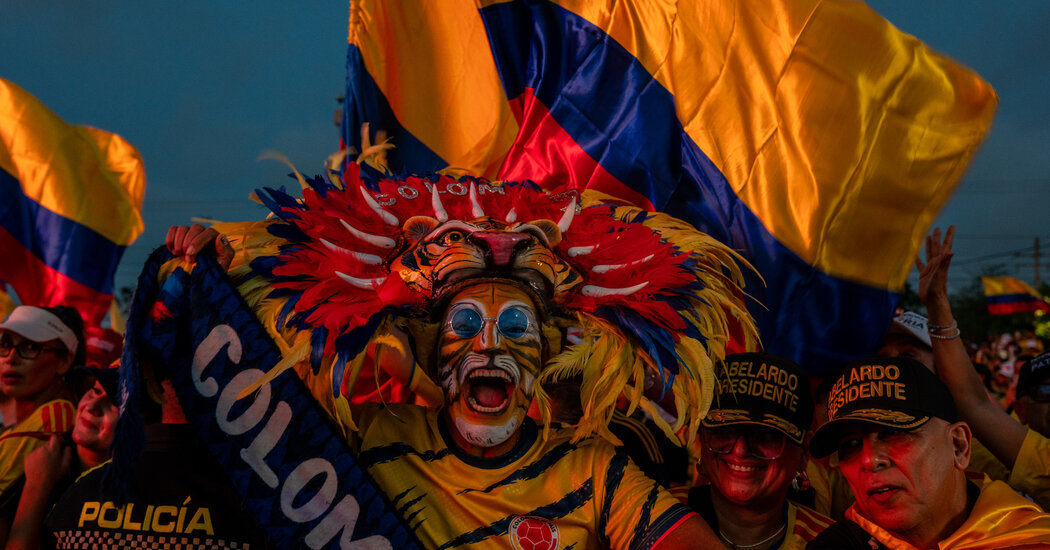
Mr. De La Espriella’s campaign was characterized by its high-energy and unconventional tactics. It featured machine-generated flames at rallies, artificial intelligence-powered videos showcasing tigers — his chosen mascot — and pounding anti-Petro chants that contributed to his rise as a prominent, almost celebrity-like, figure in Colombian politics.
His rhetoric was often confrontational. He publicly vowed to “disembowel” Colombia’s left and controversially requested the Trump administration to target his political opponents. Such statements led critics, both domestic and international, to voice concerns and label him as a potential autocrat, raising questions about his commitment to democratic norms and political pluralism.
The election recorded the highest voter turnout since Colombia adopted a two-round voting system over three decades ago, indicating a highly engaged electorate. The extremely close margin between the two leading candidates further highlighted the nation’s deep ideological divisions and the intense competition for the presidency.
Mr. De La Espriella’s political platform resonated with a significant segment of the population, echoing themes popular among contemporary right-wing leaders across Latin America. His core promises included restoring national security amid rising crime rates, revitalizing an economy he argued had been mismanaged by the outgoing leftist administration, and implementing stringent measures to combat corruption. These pledges tapped into widespread public anxieties regarding safety and economic stability.
His campaign cultivated a stridently nationalistic image, prominently featuring the Colombian flag, the national soccer jersey, and the patriotic slogan “Firme por la patria!” — “Standing firm for the homeland!” This appeal to national pride was strategically combined with modern campaign techniques, including a sophisticated social media strategy, drawing inspiration from the successful populist campaigns of El Salvador’s Nayib Bukele and Argentina’s Javier Milei, both highly popular figures who have reshaped political discourse in the region.
Emulating the assertive style of these regional leaders, Mr. De La Espriella adopted an aggressive tone throughout his campaign. He pledged to construct “megaprisons” as a cornerstone of his security policy and promised to roll back what he termed “progressive politics” and “gender ideology,” advocating instead for policies centered on traditional values, explicitly stating “God and family first.”
His commitment to vigorously pursue criminals and “crush Colombia’s narcoterrorists,” a term favored by former President Trump, found strong resonance among his supporters. However, these pronouncements simultaneously alarmed his opponents, who feared such policies could lead to increased violence, human rights abuses, and a drift towards authoritarianism. Andro Giovanny Camelo, a 44-year-old taxi driver in Bogotá, expressed a common sentiment among critics, stating, “It sounds like a military regime.”
While many of Mr. De La Espriella’s supporters primarily reside in urban centers, rather than the rural areas most affected by conflicts between armed groups vying for control over lucrative cocaine-trafficking routes and illegal gold mines, his campaign skillfully leveraged public fears. He effectively capitalized on the widespread apprehension of a potential return to the severe violence that plagued Colombia decades ago, when rebel groups conducted bombings and kidnappings even in bustling metropolitan areas like Bogotá. This historical memory of insecurity proved a powerful mobilizing force.
Furthermore, his campaign prominently addressed the issue of widespread extortion by criminal organizations, a problem that has significantly hampered small and medium-sized businesses across the country. This focus appealed directly to the economic concerns of many citizens.
Karlos Morales, a 28-year-old waiter who cast his vote in Barranquilla on Sunday, articulated the hopes of many De La Espriella supporters, believing that enhanced security would directly translate into job creation and an increase in foreign investment, which he claimed had suffered during President Petro’s administration. “The left asked for an opportunity,” Mr. Morales commented, adding, “We haven’t seen very good results.”
Underscoring the centrality of his security message, Mr. De La Espriella routinely campaigned wearing a bulletproof vest and delivered rally speeches from behind bulletproof glass. He also condemned the violence that marred the electoral period, including the assassinations of another conservative presidential hopeful and two of his own campaign staff, framing himself as a protector against such threats.
If he formally assumes office, Mr. De La Espriella will face an array of formidable challenges that could significantly test his popular mandate and administrative capabilities. These include the complex task of subduing well-armed and sophisticated criminal groups equipped with drones and advanced weaponry, managing a substantial budget deficit accumulated under Mr. Petro’s administration, and addressing public dissatisfaction with a recent state takeover of the health system, which many Colombians report has complicated access to medical care.
Despite his outsider image and aggressive rhetoric, Mr. De La Espriella strategically sought to reassure the electorate by selecting a respected and experienced running mate for the vice presidency.
While Mr. De La Espriella consistently presented himself as an anti-establishment, iron-fisted outsider, his choice of José Manuel Restrepo, a former commerce minister widely regarded for his economic expertise and moderate stance, as his running mate was a calculated move. Many voters indicated that Restrepo’s inclusion on the ticket helped to assuage their anxieties about electing a politically inexperienced and sometimes inflammatory candidate.
Brayan Emanuel Ariza, a 32-year-old business student in Bogotá, commented on the significance of this pairing, stating, “That gives him credibility. Otherwise he wouldn’t have gotten so many votes.” Ariza further elaborated that Mr. De La Espriella, who hails from the Caribbean Coast, embodied the region’s energetic and jovial spirit, while Mr. Restrepo, from Bogotá, brought a “more serious” and grounded demeanor to the ticket, creating a balanced appeal.
Mr. De La Espriella has articulated his vision for national prosperity, asserting that his administration would foster stronger and more fluid working relationships with international partners, particularly the United States, to unlock economic growth and stability for Colombia.
Why This Matters
The projected victory of Abelardo De La Espriella in Colombia’s presidential election carries significant implications, both domestically and internationally, positioning Colombia at a critical juncture.
Regional Political Shift:This outcome reinforces a noticeable trend of rightward shifts in Latin American politics, following similar electoral results in countries like El Salvador and Argentina. It suggests a regional appetite for populist leaders who promise strong action on security and economic revitalization, often coupled with a return to conservative social values. This shift could influence political discourse and electoral strategies in neighboring nations, potentially strengthening alliances among like-minded governments.
Impact on U.S. Relations:Mr. De La Espriella’s strong alignment with conservative U.S. political figures, notably former President Donald Trump, and his expressed desire for closer collaboration with Washington, suggests a more cooperative and aligned relationship with the United States. This could impact regional security initiatives, anti-drug trafficking efforts, and economic partnerships, particularly if a Trump administration returns to power. Colombia has historically been a key U.S. ally in Latin America, and this election could solidify that bond under a new conservative leadership.
Domestic Policy Reorientation:Domestically, De La Espriella’s presidency is poised to reverse many of the progressive policies enacted under Gustavo Petro. His focus on “megaprisons,” aggressive tactics against criminal groups, and a crackdown on “narcoterrorists” signals a significant reorientation of security policy, potentially leading to more confrontational approaches but also raising concerns among human rights advocates about civil liberties. His promises to restore economic stability and combat corruption will be closely watched, particularly as he faces an inherited budget deficit and public dissatisfaction with healthcare reforms.
Challenges to Democratic Norms:Concerns raised by critics regarding Mr. De La Espriella’s rhetoric, including his vow to “disembowel” the left and appeals for U.S. targeting of political opponents, highlight potential challenges to democratic institutions and political pluralism. His leadership will be scrutinized for how it balances a mandate for strong governance with respect for minority rights, dissent, and established democratic processes, especially in a nation with a complex history of political violence.
Future of Peace and Security:Colombia continues to grapple with the multifaceted challenges of organized crime, drug trafficking, and residual armed groups. De La Espriella’s “iron-fisted” approach, while popular with voters seeking security, raises questions about its effectiveness and potential implications for existing peace agreements and social reconciliation efforts. The success or failure of his security agenda will have profound effects on daily life and the long-term stability of the country.
In essence, Colombia’s election outcome is not merely a change of government but a pivotal moment that could redefine the country’s political direction, its international standing, and its approach to deeply entrenched social and economic issues, while also reflecting broader ideological currents sweeping across the Americas.
Colombia has elected Abelardo De La Espriella as its next president, a result that has surprised many political observers and marks a significant shift in the nation’s political landscape. Mr. De La Espriella, a prominent lawyer and media personality known for his staunchly right-wing views and admiration for former U.S. President Donald J. Trump, secured victory over the incumbent, Gustavo Petro.
His campaign resonated with voters through a platform centered on “law and order,” anti-corruption measures, and a strong opposition to socialist policies. He frequently articulated a vision for Colombia that he described as a return to traditional values and economic prosperity, encapsulated by his slogan, “Make Colombia Great Again,” a direct echo of Mr. Trump’s 2016 campaign.
Throughout his campaign, Mr. De La Espriella maintained a confrontational posture towards the political establishment and traditional media, often using social media platforms to disseminate his messages and directly engage with supporters. This strategy, combined with his charismatic and direct style, drew immediate comparisons to the former U.S. president.
The election followed a period of political tension, exacerbated by the strained relationship between President Petro and the administration of Mr. Trump during the latter’s presidency. Mr. De La Espriella’s deep ties to the United States became a notable aspect of his public persona during the electoral race. Having resided in Florida for over a decade and having been naturalized as a U.S. citizen in 2023, he largely refrained from overtly highlighting his American connections during domestic rallies. However, he actively sought support among Republican lawmakers and the Colombian diaspora in Florida. He also proposed enlisting Colombia in a new U.S. military coalition specifically designed to combat drug trafficking cartels, aligning his security goals with enhanced bilateral cooperation.
His connections to the U.S. were further amplified following a public endorsement from Mr. Trump earlier this month, alongside vocal backing from figures such as Senator Bernie Moreno of Ohio. Subsequently, Mr. De La Espriella began to more overtly emphasize the perceived support he held from the United States government and political figures.
This period also saw an intensification of his rhetoric towards political opponents. He publicly stated that the U.S. government would intervene against individuals found to be obstructing the election, for instance, through vote-buying in favor of his rival. These assertions gained increased attention when U.S. authorities detained Beto Coral, a Colombian activist critical of Mr. De La Espriella, in Arizona. On the same day, a memo attributed to U.S. Senator Marco Rubio suggested that Mr. Coral could be deportable on grounds that his advocacy interfered with U.S. foreign policy objectives. As the election day approached, Mr. De La Espriella’s statements became more pronounced, including an interview where he expressed anticipation for potential protests should Mr. Petro’s supporters challenge the election results. He further stated that anyone challenging his victory would be imprisoned “15 meters underground without light and without water.”
Mr. De La Espriella’s professional career has been marked by high-profile legal work. In Miami, he became known for representing significant clients in Colombia, including individuals facing charges related to drug trafficking and corruption, as well as those implicated in scandals involving right-wing paramilitaries. He has previously stated that he selectively took on cases that presented considerable professional challenges. Among his client list was Alex Saab, who was later charged by U.S. authorities with facilitating money laundering operations for Venezuela’s former leader, Nicolás Maduro. Mr. De La Espriella has publicly downplayed the extent of his association with Mr. Saab, who is currently in U.S. custody.
Beyond his legal practice, Mr. De La Espriella cultivated a public image often characterized by a lavish lifestyle. He is known for singing opera, wearing tailored suits, and has self-produced an album of cover songs by artists such as Andrea Bocelli and Frank Sinatra. A music video for his Spanish rendition of “My Way” depicts him consuming sushi aboard a private jet. His entrepreneurial ventures include a piano bar, a luxury goods line named De La Espriella Style, and an investment in a rum company. His presidential campaign also featured the sale of limited-edition, high-priced watches to donors, reflecting his distinctive approach to fundraising and public engagement.
Many observers in Colombia noted similarities between Mr. De La Espriella’s campaign and other populist movements globally. Manuel José Cepeda, a prominent political scientist and former president of Colombia’s Constitutional Court, commented on the striking alignment between Mr. De La Espriella and Mr. Trump, stating, “I have never seen two leaders more aligned than Donald Trump and Abelardo De La Espriella.”
Mr. De La Espriella successfully mobilized a significant base of support by bypassing traditional political channels and directly engaging with the populace, largely through digital platforms. His online communications featured a mix of strong critiques against the left, videos showcasing his physical workouts, and AI-generated videos depicting his rivals in simulated soccer matches against him. He also shared aspects of his personal life, including his wife and four children, and discussed his daily routine, which he stated began with prayer. This emphasis on faith was a key component of his campaign, targeting the religious right segment of the electorate.
The election outcome places Mr. De La Espriella in charge of a nation grappling with significant political polarization. On election night, thousands of Mr. Petro’s supporters gathered in Bogotá, where the outgoing president urged them to continue their fight for the presidency. Reports indicated emotional scenes, with some supporters expressing their commitment to their candidate and calling for protests to remain peaceful.
Conversely, large segments of the Colombian population appeared to celebrate Mr. De La Espriella’s victory, with many donning yellow jerseys and tiger costumes, symbols associated with his campaign. A pervasive sense of optimism and curiosity about the future under his leadership was evident. Juan Manuel Viarte, a 32-year-old engineering student in Bogotá, articulated a common sentiment among some voters, stating, “The left didn’t work. I want to try something new.”
Why This Matters
The election of Abelardo De La Espriella as Colombia’s president carries substantial implications for both domestic politics and international relations. Domestically, his victory signals a decisive shift away from the left-wing governance of Gustavo Petro and introduces a leader whose rhetoric and policies are aligned with a staunchly conservative and populist agenda. This change could profoundly affect Colombia’s approach to issues such as social welfare, economic policy, and peace processes, potentially leading to a more assertive stance on law and order and a re-evaluation of current agreements with armed groups. The deep polarization evident during the campaign suggests that Mr. De La Espriella’s presidency may face significant internal challenges and continued social unrest, particularly given his confrontational statements regarding political opposition and protests.
Internationally, Mr. De La Espriella’s presidency is poised to significantly realign Colombia’s foreign policy, particularly its relationship with the United States. His open admiration for Donald Trump, his U.S. citizenship, and his proposed military coalition against drug cartels indicate a strong desire for closer security and diplomatic ties with Washington. This could lead to an invigorated focus on bilateral efforts to combat drug trafficking, potentially through increased U.S. military assistance and intelligence sharing. However, his strong pro-U.S. stance and alignment with a specific political faction in the U.S. could also introduce complexities, especially if there are shifts in U.S. presidential administrations or congressional priorities. Furthermore, his populist style and nationalist rhetoric might influence Colombia’s relationships with neighboring countries, particularly those with left-leaning governments, potentially altering regional power dynamics and cooperation on shared challenges.
Beyond specific policy changes, Mr. De La Espriella’s rise to power reflects broader global trends of populist leaders gaining traction by leveraging social media, appealing directly to a disaffected electorate, and challenging established political norms. His success underscores the increasing influence of online campaigns and the effectiveness of a strong, often controversial, personal brand in contemporary politics. This outcome could serve as a model or a warning for other democracies navigating similar political divisions and the impact of external political endorsements. The stability of Colombia, a key U.S. ally and a nation with a complex history of internal conflict and drug-related violence, will be closely watched as it enters this new political chapter under a leader promising radical change and a strong connection to U.S. conservative politics.