
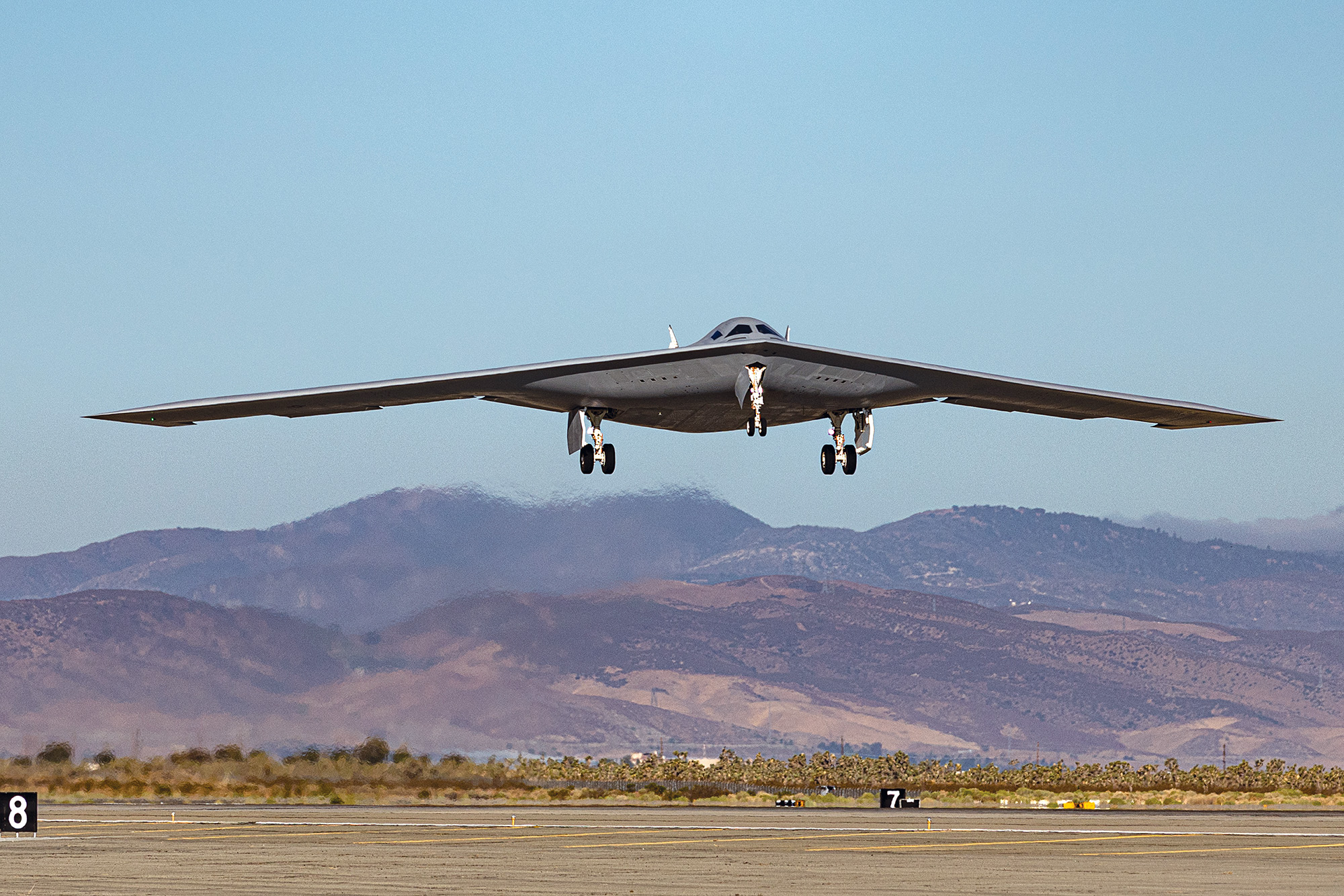
WASHINGTON D.C.– The United States Air Force is exploring a significant shift in its aerial combat strategy, potentially arming its bomber aircraft with air-to-air strike capabilities, according to a recent report submitted to Congress. This unconventional approach is among several options being considered to expand the service’s combat readiness and address future threats.
The report, titled “Long-Term USAF Fighter Force Structure,” was delivered to lawmakers on October 16 and subsequently briefed to reporters on October 20. It outlines the Air Force’s strategic planning for its fighter fleet up to 2035, identifying a need for 1,509 “combat-coded aircraft” – those ready for operational deployment – to meet the demands of the National Defense Strategy with moderate risk. This represents a substantial increase from the current fleet of 1,288 combat-coded fighters.
Currently, approximately 40 percent of the Air Force’s projected 2035 fighter fleet is intended to consist of Lockheed Martin F-35A Joint Strike Fighters. The service’s primary procurement goals include acquiring as many F-35As, Boeing F-15EX Eagle IIs, and the forthcoming Boeing F-47 sixth-generation fighters as possible. However, the report acknowledges that these ambitious targets may face significant hurdles due to “fiscal realities and industrial production limitations.”
In light of these potential constraints, the Air Force is examining alternative strategies to bolster its combat capabilities. These options include the acquisition of an entirely new fighter platform, a greater reliance on semi-autonomous drone fighters known as Collaborative Combat Aircraft (CCAs), and, notably, the integration of air-to-air roles and capabilities into bomber aircraft.
Historically, Air Force fighters have been designed and utilized primarily for air-to-ground strike missions, while bombers have focused on delivering large payloads to ground targets. The concept of bombers engaging in air-to-air combat represents a departure from established doctrine. This shift reflects the Air Force’s ongoing efforts to find innovative solutions as its current fleet faces challenges from the slow procurement of new aircraft and the scheduled retirement of aging platforms.
The idea of expanding bombers’ roles into air superiority has been discussed previously by Air Force leadership. In October 2024, former Air Force Chief of Staff Gen. David Allvin indicated an openness to the B-21 Raider stealth bomber potentially playing a greater role in the service’s air dominance plans. At that time, the Air Force had temporarily paused its F-47 program, then known as Next-Generation Air Dominance, due to cost concerns, prompting a review of its overall approach to air superiority. When asked if the B-21 could assume a more prominent role, Gen. Allvin stated, “We have not taken that off the table.”
Further discussions emerged in September 2025, when sources informed Air & Space Forces Magazine that the Air Force was conducting studies into whether a large, flying wing-type stealth aircraft—potentially based on the B-21 platform—could be armed with dozens of air-to-air missiles to contribute to its future air superiority force.
In its latest report, the Air Force reaffirms its commitment to the “full modernization and recapitalization” of its existing fighter fleet, alongside an “enormous effort” dedicated to the development of its newest fighter, the F-47. The report also highlights the rapid advancement of Collaborative Combat Aircraft (CCAs), noting that their development is likely to meet or even exceed its scheduled timeline. However, the report cautions that CCAs are not yet mature enough to fundamentally alter the Air Force’s immediate planning for its future fighter fleet, though their future impact is acknowledged.
Lt. Gen. David Tabor, Deputy Chief of Staff for Plans and Programs, stated on October 20, “There is absolutely a world in which the incorporation of CCAs into the force will mitigate the requirement for the number of fighters.” This suggests a future where autonomous drones could significantly augment or partially replace manned fighter aircraft in certain roles.
The report also stresses the “essential” need to modernize the Air Force’s existing fleet of older F-15s and F-16s. The goal is to transform these aircraft into an “advanced fourth-generation capability” fleet, enabling them to operate effectively in highly contested environments, despite lacking stealth capabilities, often through the use of advanced sensors and electronic warfare systems. However, the report identifies a significant challenge in this approach: it would require more than a decade of substantial investment in the Air Force’s current depot infrastructure to modernize a sufficient number of jets, a process deemed “insufficient” as it perpetuates reliance on a fleet averaging more than 30 years in age.
Beyond upgrading existing fighters, the service is also considering purchasing new advanced fourth-generation jets, such as additional F-15EX aircraft, and potentially a new version of Lockheed Martin’s F-16 Fighting Falcon, dubbed the F-16G. Lt. Gen. Tabor clarified that no decision has yet been made regarding new F-16s, adding that such a decision is “not in a position where that decision has to be made immediately.”
The overarching strategy outlined in the Air Force report is a two-track approach: simultaneously modernizing existing aircraft to meet immediate operational requirements while also recapitalizing its legacy fighter fleet with newer, more advanced platforms.
Why This Matters
The United States Air Force’s exploration of arming bombers with air-to-air capabilities, alongside its broader strategic shift, signals a pivotal moment in military aviation and global defense. This move is not merely a tactical adjustment but reflects a deeper reevaluation of air power doctrine driven by several critical factors.
Firstly, it underscores the increasing challenges faced by the U.S. military in maintaining air superiority against rapidly advancing peer competitors. As adversaries develop sophisticated air defense systems and advanced fighter aircraft, the traditional roles of aircraft are blurring. Utilizing bombers in an air-to-air capacity could introduce unpredictability and overwhelm enemy defenses, leveraging their large payload capacity for numerous air-to-air missiles. This could potentially compensate for perceived shortfalls in fighter numbers or provide a novel way to control contested airspace.
Secondly, the discussion highlights the significant pressure on defense budgets and industrial production capabilities. The inability to procure enough next-generation fighters like the F-35A and F-47 at the desired pace forces the Air Force to innovate with existing or modified platforms. This could lead to a more cost-effective way to boost combat power, but also carries the risk of diverting resources from dedicated air-to-air platforms or complicating logistical and training pipelines.
Thirdly, the emphasis on Collaborative Combat Aircraft (CCAs) signifies a transformative shift towards autonomous and semi-autonomous systems in future warfare. While not yet ready to dictate immediate fleet planning, their rapid development points to a future where human-crewed aircraft will operate alongside AI-driven drones, potentially in “loyal wingman” roles, multiplying combat effect while reducing risk to human pilots. This integration will demand new strategies for command, control, and communication, and could redefine the very nature of air combat.
Finally, this strategic reorientation has broad implications for international security and the global arms industry. Other nations, both allies and potential adversaries, will closely observe these developments. Allies might seek similar capabilities or tighter integration with U.S. forces, while rivals may accelerate their own efforts in drone technology, anti-access/area denial capabilities, and unconventional aircraft roles. The potential for a single aircraft type, like a stealth bomber, to perform both long-range strike and air superiority missions could alter military doctrine worldwide, influencing future aircraft design and procurement decisions for decades to come.