
The auditory version of this piece is presented by the Air & Space Forces Association, commending and assisting our Airmen, Guardians, and their families. Further details are available at afa.org
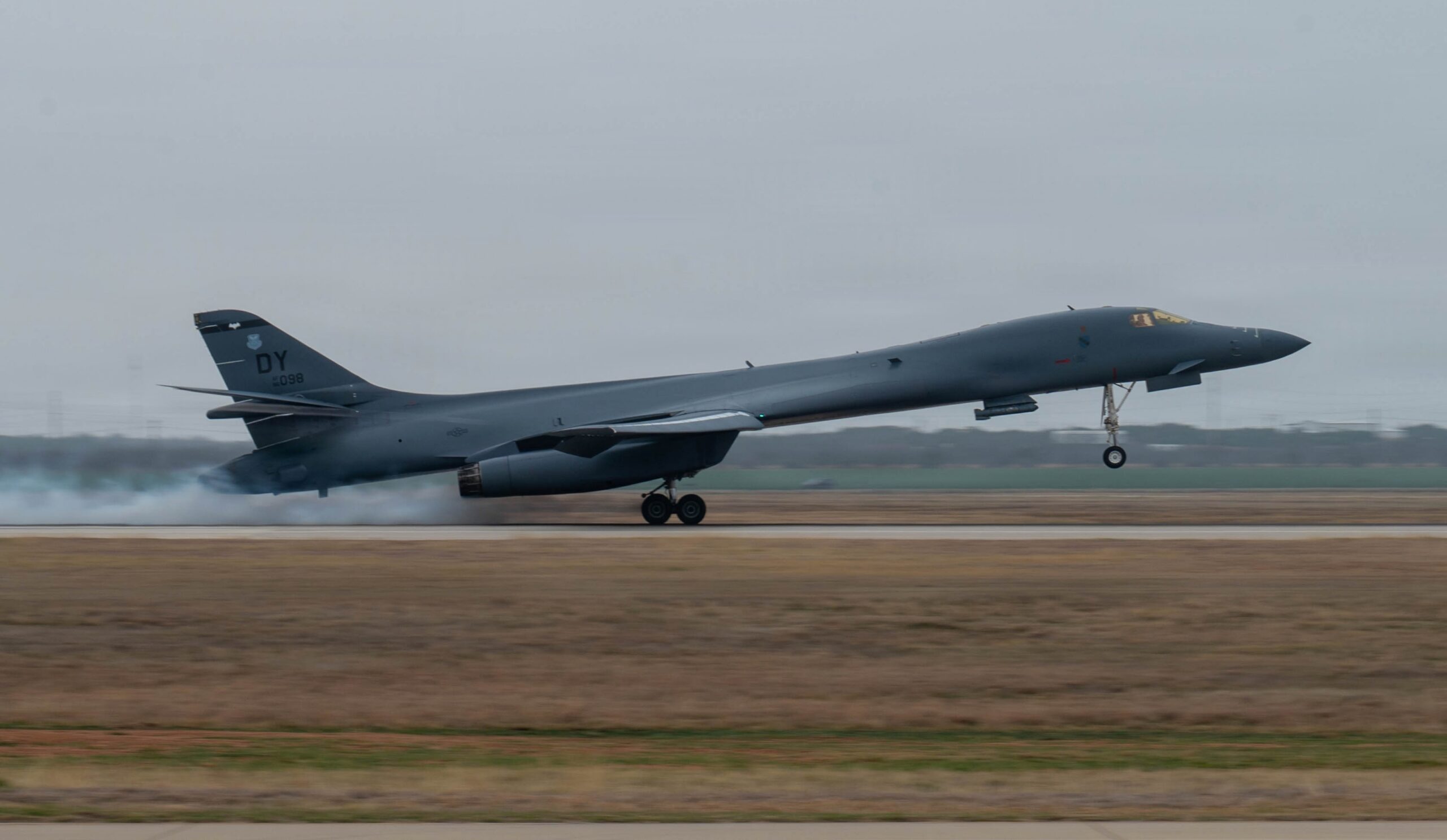
Approximately twelve B-1 bombers are currently stationed at RAF Fairford in the United Kingdom, serving as a launchpad for attacks on Iran, sources knowledgeable on the subject informed Air & Space Forces Magazine—possibly accounting for over half of the U.S. Air Force’s operationally ready Lancer fleet.
The deployment at the airfield in Gloucestershire, England, commenced on March 6 when the U.K. Ministry of Defense began permitting the U.S. to utilize its installations for offensive operations against Iran, and this has progressed rapidly in the past few days, as publicly available information indicates. There are probably fifteen bombers at the installation, with three B-52 Stratofortresses alongside the B-1s.
The media relations department for U.S. Central Command failed to promptly reply to an inquiry for remarks. On March 7, the U.K. Ministry of Defense declared in a communiqué that “the United States has begun utilizing British bases for specific defensive operations to hinder Iran from launching projectiles into the region.” U.S. bombers are hitting Iranian projectile launch locations, the U.S. military states.
The Air Force’s stockpile contains 44 B-1s, yet a segment of these are unavailable for active duty at any moment, due to either trials or upkeep. As of late 2024, the service reported an operationally ready level of 47 percent for the aircraft—implying that approximately 20-22 jets are truly operational.
Although the U.S. has employed both its B-52 and B-2 bombers to attack Iran, the B-1 is the most extensively utilized currently. It possesses the greatest interior carrying capacity and is the service’s more rapid bomber, rendering it optimal for covering vast expanses and engaging numerous objectives over a broad expanse.
“I’m not taken aback by it,” stated retired Col. Mark Gunzinger, head of prospective notions and operational evaluations at AFA’s Mitchell Institute for Aerospace Studies and an ex-B-52 aviator. “I believe the Air Force is employing its bomber fleet with considerable efficacy.”
Gunzinger pointed out that the B-2 Spirit executed initial, extended-reach, covert attacks, and the B-52 Stratofortress performed subsequent assaults in Operation Epic Fury.
“For a conflict of even this scale, depending on a single bomber type might significantly burden that fleet and its flight personnel,” Gunzinger remarked.
During the initial days of the campaign, bombers were executing approximately 36-hour two-way missions from the continental United States to Iran and back. While these distances are achievable, they diminish the frequency of missions crews can undertake.
At first, British leaders refused the United States access to its installations, such as Fairford and Diego Garcia, an island military post in the Indian Ocean. However, officials acquiesced after a March 5 Iranian unmanned aerial vehicle assault on a U.K. installation in Cyprus.
In a brief five-minute speech on March 11, U.S. Central Command chief Adm. Brad Cooper explicitly mentioned a bombing sortie as a component of the continuing attacks.
“Just the previous evening, our bomber force struck a sizable ballistic projectile manufacturing plant,” Cooper stated. He observed that such an attack was an instance of addressing both present and prospective dangers.
A single B-1 reached Fairford on March 6, with four additional units making their appearance on March 7. These bombers were augmented by three B-52s and three B-1s on March 9, and four B-1s on March 10, as per open source and aerial movement tracking information.
Operating from Fairford substantially elevates mission frequency.
“It unquestionably eases pressure on pilots, briefer mission lengths, fewer aerial replenishments; all this leads to increased mission frequencies,” Gunzinger stated. “Higher frequencies result in more ordnance impacting objectives.”
The B-1’s adaptability and ordnance carrying capacity might also suggest a reason for its more extensive deployment at this juncture.
Secretary of Defense Pete Hegseth informed journalists on March 4 that the U.S. utilized a greater number of “advanced long-range weaponry” at the onset of the campaign, but as Iran’s aerial protective systems weakened, they were not required anymore.
“And now with total aerial supremacy, we will be employing 500-pound, 1,000-pound, and 2,000-pound GPS and laser-guided accurate unpowered bombs, of which we possess a virtually boundless inventory,” Hegseth stated.
Publicly available images shared on social platforms this week depicted personnel disembarking cruise missiles from a B-1 and substituting them with Joint Direct Attack Munitions, or JDAMs.
The aircraft is capable of transporting the subsequent ordnance amounts and categories:
- 84 Mk 82 (500-lb)
- 24 Mk 84 (2,000-lb) multipurpose bombs
- 84 Mk 62 (500-lb)
- 8 Mk 65 (2,000-lb) Quickstrike maritime mines
- 30 CBU-87/89 fragmentation bombs
- 30 CBU-103/104/105 WCMDs
- 24 GBU-31 JDAMs
- 15 GBU-38 JDAMs
- 24 AGM-158A JASSM, JASSM-ER, or LRASM
With that ordnance adaptability and capacity, the B-1 provides commanders with choices and ample supplies to engage diverse objectives, Gunzinger noted.
“One must commence at the objective selection phase,” he explained. “Considerations include the categories of objectives to engage, the classes of armaments, which sort of aircraft, the duration of patrol time, and the on-station time to hit nascent objectives.”
Another attribute of the bomber contingent, and the B-1 specifically, he mentioned, is its capacity for extended patrolling and on-station presence over an objective compared to the fighter contingent.
“They deploy from airfields beyond the scope of Iran’s threats. Extended reach translates to considerable on-station time within the combat zone,” Gunzinger stated. “This enables a bomber crew to patrol, respond to opportune objectives, and handle rapid assignments to engage nascent objectives.”
The aircraft, while adaptable and highly sought-after, is not exempt from upkeep requirements. Based on 2024 data, it exhibits the poorest operational readiness percentage within the bomber contingent at 47 percent. The B-2 was the frontrunner with 56 percent, while the B-52 registered 54 percent.
Forty-four B-1s have been within the active fleet since 2021, when Congress permitted the Air Force to decommission seventeen of the bombers. Before then, in 2003, the Air Force decommissioned thirty-three to allocate funds towards contingent upgrades.
In 2024, the Air Force was undertaking the revival of two B-1s subsequent to a 2022 propulsion system blaze on one aircraft and a January 2024 mishap at Ellsworth Air Force Base, S.D. Their substitutes were sourced from the “Boneyard,” formally designated as the 309th Aerospace Maintenance and Regeneration Group at Davis-Monthan Air Force Base, Ariz.
Congress stipulated in its 2021 National Defense Authorization Act that the service retain a minimum of 92 bombers in the main operational aircraft roster and prohibited the Air Force from diminishing capacity or staff in any B-1 squadron. The B-1 is anticipated to remain in service until a sufficient number of its successor models, the forthcoming B-21 Raider, become mission-ready. These aircraft are projected to be delivered in substantial numbers between 2030 and 2036.
The auditory version of this piece is presented by the Air & Space Forces Association, commending and assisting our Airmen, Guardians, and their families. Further details are available at afa.org