
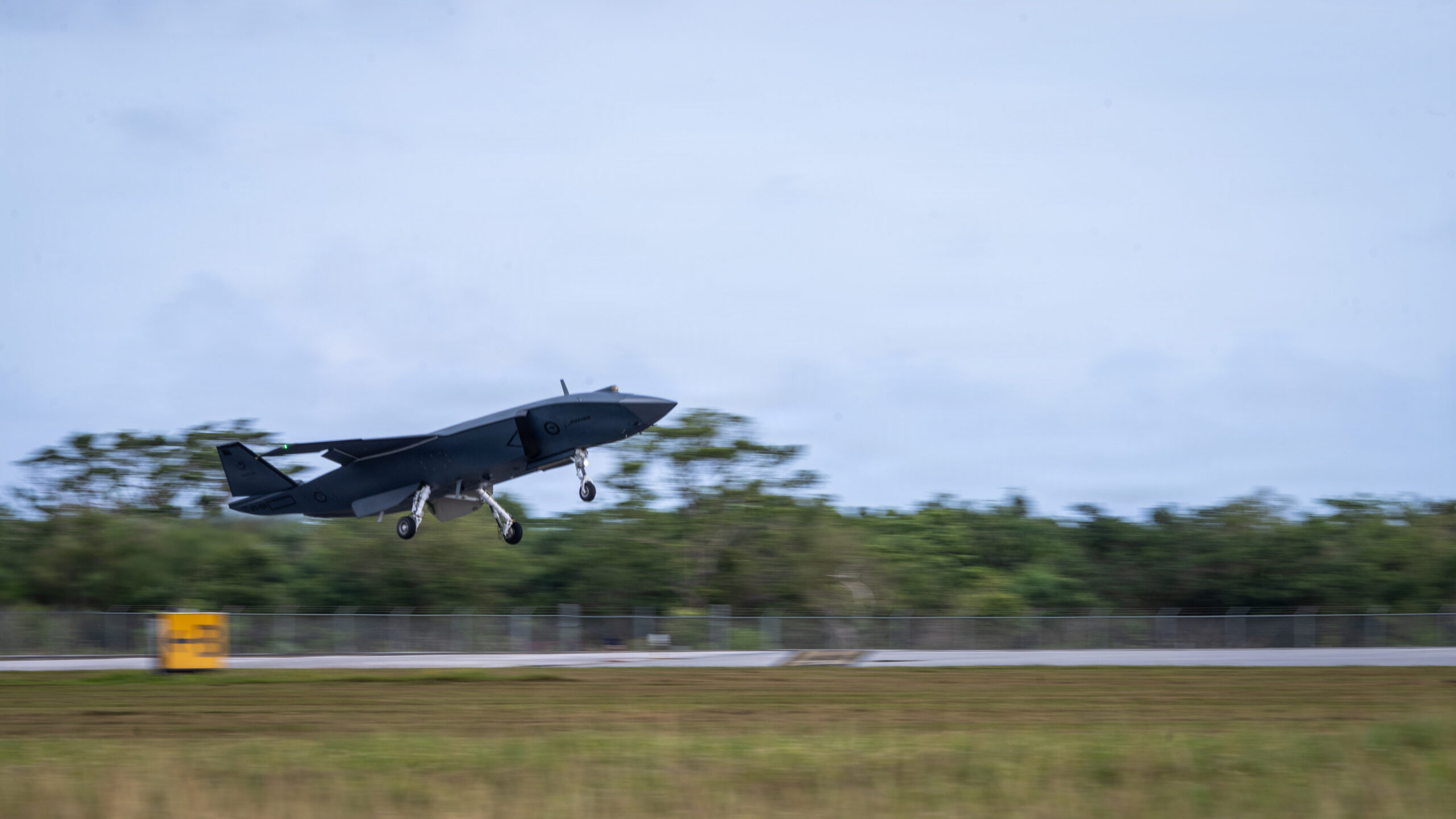
Boeing’s MQ-28 Ghost Bat, a Collaborative Combat Aircraft (CCA) drone, recently participated in a major multinational military exercise in the Pacific, marking a significant milestone in the integration of autonomous systems with crewed fighter jets. The drone flew alongside a diverse array of U.S. and allied aircraft, including F-35 variants, in Exercise Valiant Shield 26. This event represents the first publicly confirmed instance of a U.S. Air Force CCA drone being included in such a large-scale, joint multinational exercise, highlighting the accelerating pace of military modernization and the strategic shift towards manned-unmanned teaming in airpower.
Exercise Valiant Shield 26, conducted from June 22 to July 1, encompassed a vast operational area spanning Guam, the Northern Mariana Islands, and Japan. This biennial exercise is designed to enhance the interoperability of U.S. joint forces and participating allied nations across air, land, maritime, space, and cyberspace domains. Its primary objective is to sharpen the ability of forces to detect, locate, track, and engage targets in a contested environment, emphasizing integrated deterrence and regional stability in the Indo-Pacific.
During the exercise, the Boeing MQ-28 Ghost Bat operated in concert with numerous manned platforms. According to a Boeing statement, the Ghost Bat “participated … alongside F-35A, F-35B, F-15EX, HC-130, E-3, E-2D, EA-18G, RC-135, and various other joint and coalition aircraft.” This wide range of accompanying aircraft underscores the potential versatility and adaptability envisioned for CCAs across different mission sets, from air superiority to intelligence, surveillance, and reconnaissance (ISR) and electronic warfare.
Notably, the exercise provided the first publicly known instance of an F-35 Lightning II stealth fighter flying with a CCA drone. While an F-35 pilot had previously controlled an MQ-20 “CCA surrogate” in May, that test involved the pilot and fighter remaining on the ground. The direct interaction in an operational flight environment during Valiant Shield represents a crucial step forward in validating the operational concepts for manned-unmanned teaming (MUM-T) that are central to the future of air combat.
Prior to this, Pacific Air Forces (PACAF) had confirmed the MQ-28’s inaugural flight with an F-15EX Eagle II, a significant development in integrating advanced drones with next-generation fighter aircraft. PACAF also released imagery and video of the Ghost Bat conducting a Forward Arming and Refueling Point (FARP) operation with an HC-130J Combat King II, a special operations aircraft. This demonstration highlights the drone’s potential for extended range and sustained operations in austere environments, reducing the logistical footprint for crewed aircraft.
Despite the groundbreaking nature of these flights, details regarding the precise level of interaction and control remain limited. A Boeing spokesperson referred inquiries about the drone’s control by aviators in the manned aircraft to the Air Force, which did not immediately provide further details. However, PACAF officials had indicated before the exercise that the MQ-28 would “fly in concert with crewed fighter platforms” to help operators “refine tactics, techniques, and procedures for this next evolution of airpower.” This suggests that the primary aim was operational testing and the development of new doctrines for employing semi-autonomous drones.
This milestone not only offers U.S. Air Force aviators critical insights into the future employment of semi-autonomous drones but also significantly raises Boeing’s profile in the rapidly evolving and highly competitive CCA market. The U.S. Air Force is actively pursuing a multi-pronged strategy for its CCA program. While Anduril and General Atomics were selected to build the initial “Increment 1” of CCAs, the service is concurrently refining concepts for a second “Increment 2” of drone designs, focusing on less costly and potentially more attritable options. Although the nine companies that received concept refinement contracts for Increment 2 have not been publicly disclosed, Boeing was among the five finalists for the initial increment.
A Boeing spokesperson informed Air & Space Forces Magazine that the company did not offer the MQ-28 for Increment 1 because “requirements were different at the time.” This suggests Boeing may have viewed the MQ-28, which originated as an Australian program, as better suited for different operational profiles or development timelines than the initial U.S. Air Force CCA goals, which prioritized rapid prototyping and integration. When asked about potential participation in Increment 2, the spokesperson stated that Boeing would “continue to explore international opportunities where Ghost Bat is the best fit.” This indicates a strategic emphasis on global markets for the MQ-28, which is already in service with the Royal Australian Air Force.
Beyond the U.S. Air Force program, the concept of CCAs is gaining traction across various military branches and allied nations. The U.S. Navy and Marine Corps are also pursuing their own distinct CCA designs tailored to their specific operational environments and mission requirements. Internationally, a host of U.S. allies, including the United Kingdom, Germany, Japan, and others, are actively developing or investing in similar autonomous “wingman” drone technologies, signaling a global shift in military aviation strategy.
In addition to the extensive list of aircraft that flew with the MQ-28, Exercise Valiant Shield 26 featured other critical assets such as the B-2 stealth bomber, the F-22 Raptor fighter, the P-8 Poseidon maritime patrol and reconnaissance aircraft, KC-130J, KC-46, and KC-135 aerial refueling tankers, and the C-130J Super Hercules airlifter. The multinational nature of the exercise was further underscored by the participation of forces from Japan, Canada, New Zealand, and Australia, highlighting the collective commitment to security and stability in the Indo-Pacific region through enhanced interoperability and advanced airpower integration.
Why This Matters
The participation of Boeing’s MQ-28 Ghost Bat in Exercise Valiant Shield 26 marks a pivotal moment in the evolution of military aviation and global security, with far-reaching implications across several key areas:
Strategic Shift in Airpower Doctrine:This event signifies a concrete move towards integrating unmanned systems into traditional air combat roles, fundamentally altering airpower doctrine. Collaborative Combat Aircraft (CCAs) are envisioned as “loyal wingmen” or “force multipliers,” designed to operate semi-autonomously alongside crewed fighters. This allows for distributed lethality, increased mission complexity, and the ability to conduct high-risk operations without risking human pilots. It transitions air forces from purely manned platforms to a blended force, redefining roles for pilots and ground crews.
Accelerated Development of Manned-Unmanned Teaming (MUM-T):The flights with F-35s and other critical aircraft validate the operational concepts for MUM-T in a realistic, large-scale exercise environment. This is crucial for refining the command, control, and communication protocols required for seamless integration, and for developing the tactics, techniques, and procedures (TTPs) that will govern future air combat. Successful integration in exercises like Valiant Shield accelerates the transition of these technologies from testing to active deployment.
Implications for Future Conflict and Deterrence:The deployment of CCAs offers several advantages in potential conflicts, particularly in contested environments like the Indo-Pacific. They can extend the sensor and weapons range of manned aircraft, serve as decoys, conduct electronic warfare, or provide additional strike capacity. This capability enhances deterrence by presenting a more formidable and adaptable adversary, while also potentially reducing the cost of attrition in high-intensity combat scenarios by fielding less expensive, optionally expendable assets.
Competitive Landscape of the Defense Industry:Boeing’s participation, even outside the U.S. Air Force’s initial CCA increment, highlights the fierce competition and rapid innovation in the defense technology sector. The U.S. Air Force’s pursuit of multiple “increments” for CCAs signals a desire for diverse capabilities and cost-effective solutions. Companies like Boeing, Anduril, and General Atomics are vying for market share in what is projected to be a multi-billion dollar segment, influencing future research and development priorities in AI, autonomy, and aerospace engineering.
Reinforcing Alliances and Interoperability:The multinational nature of Valiant Shield, with participation from key allies like Japan, Canada, New Zealand, and Australia, underscores the importance of interoperability in modern warfare. As more nations develop or acquire CCAs, the ability to operate these systems together will become paramount for coalition effectiveness. Boeing’s focus on “international opportunities” for the MQ-28 suggests a pathway for allied nations to adopt similar capabilities, enhancing collective security and shared defense strategies.
In essence, the MQ-28’s role in Valiant Shield is more than just a technological demonstration; it is a preview of future air forces, signaling a shift towards more agile, adaptable, and potentially more cost-effective combat operations that will reshape military strategies and international power dynamics for decades to come.