
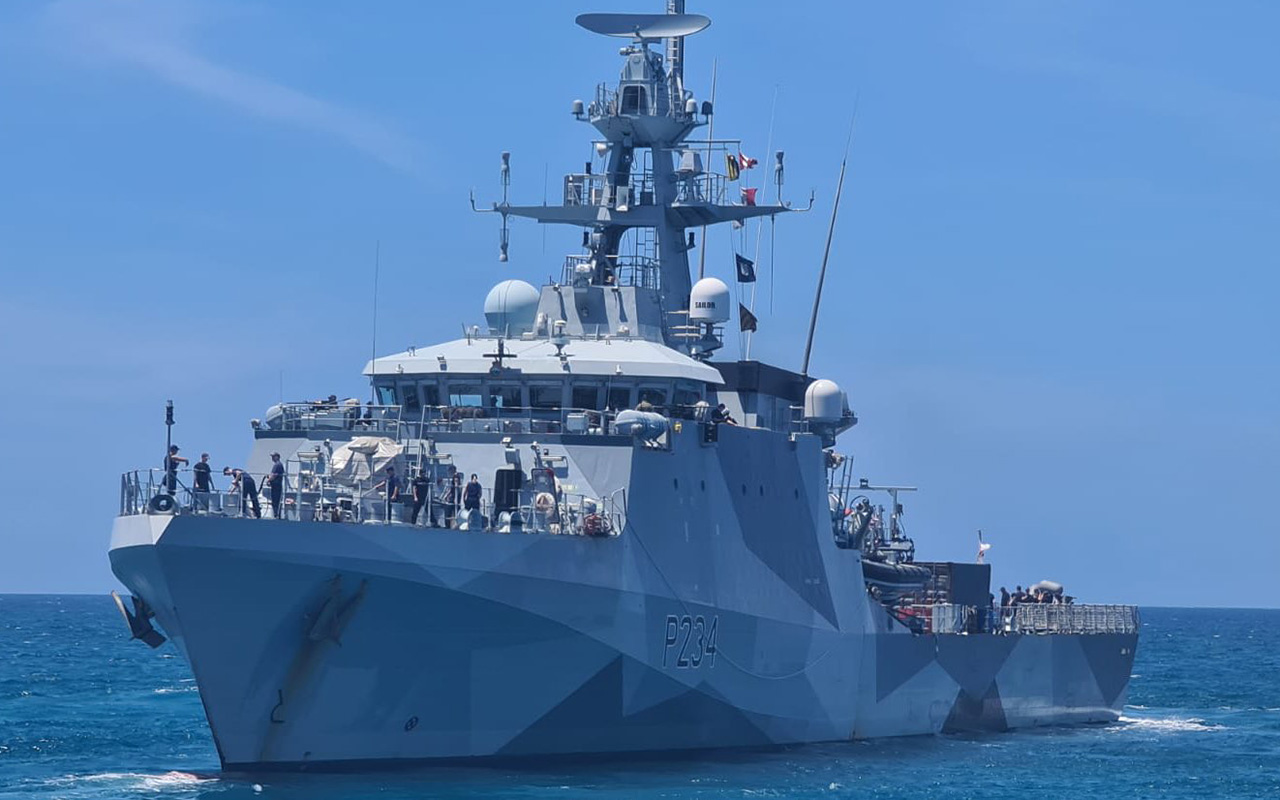
Royal Navy Conducts Latest Freedom of Navigation Operation in Disputed South China Sea
The Royal Navy offshore patrol vessel HMS Spey has conducted a freedom of navigation operation (FONOP) around the Spratly Islands in the South China Sea, as confirmed by the UK Permanent Joint Headquarters (PJHQ). This latest action, which occurred on May 5, 2026, represents another in a series of such deployments by the vessel in the strategically vital and highly contested waterway.
Defence Operations, the official social media account for PJHQ, specified that HMS Spey exercised navigation rights and freedoms in accordance with the United Nations Convention on the Law of the Sea (UNCLOS). The UK reiterated its commitment to international law and to upholding a “free, open and stable South China Sea,” a stance consistently articulated by London regarding maritime security and the rules-based international order in the Indo-Pacific region.
This operation by HMS Spey follows a pattern of significant activity by the vessel throughout 2025. In June of that year, the Royal Navy vessel garnered international attention by undertaking the first Royal Navy transit of the Taiwan Strait since 2021. This particular maneuver, through a waterway considered extremely sensitive by Beijing, elicited a strong and immediate condemnation from the People’s Republic of China, which views Taiwan as an integral part of its territory.
Senior Captain Liu Runke, spokesperson for the People’s Liberation Army (PLA) Eastern Theatre Command Navy, issued an official release published on the Chinese Ministry of National Defence website in direct response to the Taiwan Strait transit. Captain Liu asserted that the UK’s remarks “distorted legal principles and confused the public,” further contending that the transit was “deliberately intended to disrupt the situation and undermine peace and stability across the Taiwan Strait.” He concluded his statement with a stern warning, confirming that PLA troops remained on “high alert” and would “resolutely counter all threats and provocations.”
Days following the Taiwan Strait transit, HMS Spey again became a focal point of regional tensions. The vessel proceeded to conduct a joint freedom of navigation operation around the Spratly Islands alongside HMAS Sydney of the Royal Australian Navy. This collaborative display of naval power by two key Western allies in a region where China asserts extensive claims once more drew condemnation from Beijing, underscoring China’s consistent opposition to what it views as foreign military presence and interference in its claimed territories and surrounding waters.
The broader context of these operations is shaped by China’s long-standing and expansive claims in the South China Sea, often articulated through its “nine-dash line” map. China’s Ambassador to the UK had previously issued a strong statement regarding the UK’s position on the South China Sea arbitration, asserting that it would not shake China’s resolve. The ambassador stated: “I would like to remind the UK side that China’s rights and interests in the South China Sea have been established in the long course of history and have solid and legal basis.” He went on to dismiss the 2016 arbitration “award” of the Permanent Court of Arbitration (PCA), which challenged China’s claims, as “illegal, null and void.” The ambassador concluded by affirming China’s “firm resolve and staunch will to safeguard its territorial sovereignty and maritime rights and interests.”
However, the 2016 ruling from the Permanent Court of Arbitration (PCA) in The Hague offers a significant counterpoint to China’s assertions. The international tribunal decisively rejected China’s expansive territorial claims, including those based on its “nine-dash line,” declaring them to be “without legal foundation” under UNCLOS. The ruling reaffirmed that the South China Sea is governed by international maritime law, specifically the provisions of UNCLOS, which includes the fundamental principle of freedom of navigation for all vessels and aircraft. Despite this legally binding international judgment, China has consistently refused to recognize its legitimacy and continues to assert de facto control over large parts of the region, frequently overlapping with the exclusive economic zones (EEZs) of several Southeast Asian nations, including Vietnam, the Philippines, Malaysia, and Brunei.
The Spratly Islands themselves represent one of the most contentious and strategically sensitive archipelagos in the South China Sea. Claimed in whole or in part by China, Vietnam, the Philippines, Malaysia, and Brunei, these islands, reefs, and shoals are believed to sit atop significant hydrocarbon reserves and straddle vital international shipping lanes. The area has been the scene of a series of dangerous confrontations in recent years, with Chinese coast guard and navy vessels frequently engaging in assertive maneuvers to enforce Beijing’s expansive claims. These incidents sometimes involve water cannon attacks, blocking tactics, or other forms of harassment against vessels from other claimant states, highlighting the ongoing tensions and the potential for escalation in this critical maritime domain.
Why This Matters
The ongoing naval activities, such as those conducted by HMS Spey, and the strong reactions they provoke, underscore the profound geopolitical, economic, and legal stakes in the South China Sea. This region is not merely a distant maritime dispute; it is a critical litmus test for the international rules-based order and a potential flashpoint with global repercussions.
Firstly, these operations directly challenge China’s extensive and disputed claims over the South China Sea, which are viewed by many nations, including the UK and its allies, as inconsistent with international law, particularly UNCLOS. By conducting freedom of navigation operations, countries like the UK assert the principle that international waters and airspace should remain open to all, safeguarding global commerce and the free movement of goods. Approximately one-third of global maritime trade, including crucial energy shipments, transits through the South China Sea annually. Any disruption to these vital shipping lanes, whether through conflict or unilateral control, would have immediate and severe impacts on global supply chains and economies worldwide.
Secondly, the dispute highlights a fundamental tension between historical claims and modern international law. China’s assertion of “historic rights” clashes with the 2016 Permanent Court of Arbitration ruling, which explicitly rejected these claims. The refusal by a major power to acknowledge an international legal judgment raises concerns about the erosion of international institutions and the precedent it could set for future territorial or maritime disputes globally. Nations adhering to the rules-based order view these FONOPs as essential for upholding the sanctity of international law and preventing unilateral changes to the status quo through assertive actions rather than diplomatic or legal processes.
Thirdly, the activities reflect a broader pattern of major power competition in the Indo-Pacific. The UK’s consistent naval presence and collaboration with allies like Australia and the United States signal a strategic “tilt” towards the region, aiming to counter China’s growing military and economic influence. These deployments are not just about asserting navigation rights; they are about projecting influence, demonstrating alliances, and reinforcing a collective commitment to regional stability and a balance of power. For smaller Southeast Asian nations, caught between powerful claimants, such actions can be seen as a reaffirmation of their own maritime rights and a deterrent against potential aggression.
Finally, the frequent “dangerous confrontations” involving Chinese vessels and those of other claimants in areas like the Spratly Islands underscore the significant risk of miscalculation and escalation. While FONOPs are designed to be non-provocative assertions of international rights, the close proximity of naval assets from multiple nations in a highly contested environment increases the potential for accidental collisions or intentional aggressive acts that could quickly spiral into a larger conflict. Therefore, the actions of HMS Spey and the responses they elicit are crucial indicators of the evolving security landscape in one of the world’s most critical and volatile maritime regions.