
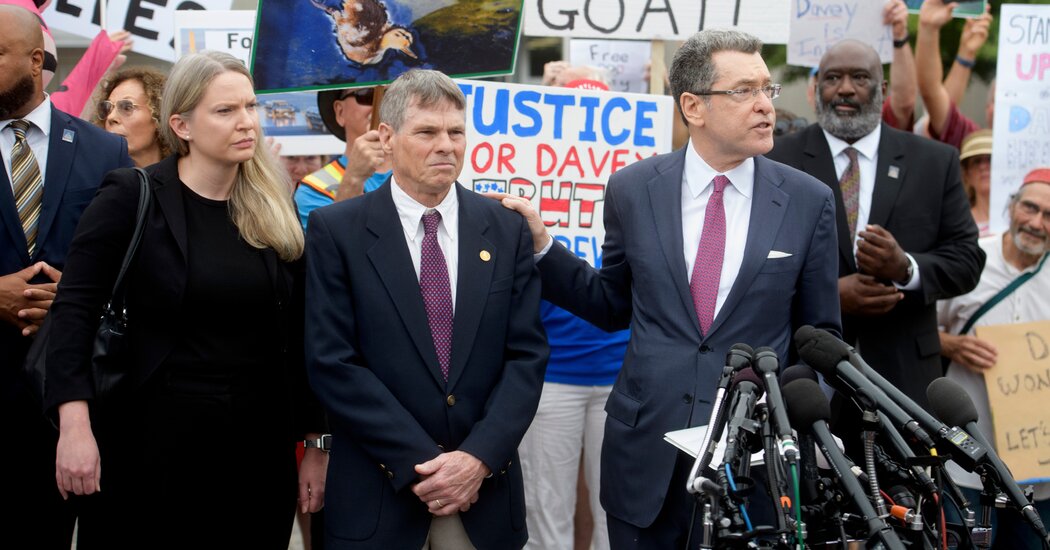
Federal prosecutors in Washington D.C. have moved to dismiss a felony charge related to damage at the Lincoln Memorial Reflecting Pool, stating definitively that the extensive peeling of the pool’s new blue lining was the result of a flawed renovation, not vandalism as previously alleged by the Trump administration. This development directly contradicts earlier claims made by then-President Trump and initially supported by the U.S. Attorney’s office.
In an extraordinary motion filed late Friday evening, U.S. Attorney Jeanine Pirro, a known ally of former President Trump, requested the dismissal of a felony charge against David Hearn, a former Olympic canoeist. Mr. Hearn had been accused of deliberately damaging the pool by pulling up a two-foot-square section of its lining. However, Ms. Pirro’s filing asserts that “the damage was the result of a botched installation and not vandalism,” a direct rebuttal to the former president’s repeated assertions that the pool’s deteriorating state was caused by individuals slashing its coating with knives.
The U.S. Attorney’s reversal marks a significant shift from her office’s previous stance. Earlier this month, Ms. Pirro had held a news conference on July 2 to announce Mr. Hearn’s indictment, publicly echoing the president’s claims and stating that her office possessed “tremendous evidence” of Mr. Hearn’s felony, for which he faced a potential sentence of up to 10 years in prison.
However, in Friday’s filing, Ms. Pirro explained that her prosecutors had subsequently been misled by information provided by the Interior Department. The department had overseen the renovation, which involved awarding a no-bid contract to a company that was a first-time government contractor for the repair of the iconic national landmark. According to Ms. Pirro, the Interior Department initially concealed critical information, specifically that the pool’s newly applied blue coating had begun to peel within just two days of the project’s completion. Instead, prosecutors were reportedly told that “nearly all of the damage” was attributable to vandals.
The discrepancy became apparent when prosecutors visited the Reflecting Pool themselves. Their inspection revealed widespread peeling of the lining in numerous areas, many of which were far from the edge where Mr. Hearn was alleged to have been. This observation cast doubt on the narrative of isolated vandalism. Following this discovery, prosecutors demanded further information from the Interior Department, which then disclosed that the pool’s structural and lining problems had, in fact, developed during the renovation process itself.
“Given all of this newly discovered information, it is difficult to attribute the widespread damage to the Reflecting Pool to vandalism,” Ms. Pirro stated in her motion to the court, solidifying the prosecutors’ conclusion. The filing represents a significant repudiation of a project that the Trump administration had previously championed as a success. Just earlier this month, Katie Martin, an Interior Department spokeswoman, had publicly stated, “President Donald J. Trump is an expert builder who fixed the Reflecting Pool permanently before deranged people vandalized it.”
Ms. Pirro’s motion specifically attributed the pool’s poor condition to two main factors: “a flawed installation by the contractor, Atlantic Industrial Coatings, and the rush to complete the project prior to events associated with the America 250 celebration” on July 4. Atlantic Industrial Coatings, a small firm based in rural Virginia, was awarded the no-bid contract, with then-President Trump initially claiming personal selection of the firm due to its prior work on a pool at one of his golf clubs.
The Interior Department did not provide an immediate response to inquiries regarding the filing on Friday evening. Consequently, it remains uncertain whether any Interior Department officials, whom Ms. Pirro effectively accused of providing misleading information to federal prosecutors, will face any consequences. The Reflecting Pool itself has been fenced off and drained, allowing for a thorough inspection of the lining faults and subsequent repairs. A recent court filing in a separate case indicated that the pool is expected to remain closed until August 10.
Beyond Mr. Hearn, federal officials had previously announced the arrests of six other individuals on vandalism charges. Court records show that three of these individuals face misdemeanor charges for destruction of property valued under $1,000. Mr. Hearn was uniquely singled out as the only person known to be facing a felony charge, rather than a misdemeanor, directly linked to the Trump administration’s claims of widespread vandalism. As of Friday night, a lawyer representing one of the other defendants confirmed that their client’s case had not been dropped, and the status of the remaining cases was not immediately clear. Ms. Pirro’s office was unavailable for further comment.
Mr. Hearn, who had pleaded not guilty last month, was scheduled to begin his trial on a charge of destruction of property on September 28. In a statement released on Friday, his legal representatives asserted that the charges against him should never have been initiated. “The dismissal of charges does not erase the abuse of government power in arresting and charging a patriotic American who did nothing wrong,” the statement read. “The government’s approach was ready, fire, aim. The administration owes Mr. Hearn an apology.” The White House did not immediately respond to requests for comment regarding these developments.
The Reflecting Pool, originally constructed in the 1920s, has historically faced challenges with water leakage from its long concrete slabs. The decision by the Interior Department to bypass standard procurement procedures by awarding a no-bid contract to Atlantic Industrial Coatings for this year’s renovation, a firm allegedly chosen personally by President Trump, adds another layer of scrutiny to this unfolding situation.
Why This Matters
This development at the Lincoln Memorial Reflecting Pool carries significant implications across several domains. Firstly, it raises serious questions about government accountability and transparency. The accusation by a U.S. Attorney that a federal department, the Interior Department, misled prosecutors by withholding crucial information about a botched renovation and instead blamed individuals for vandalism, points to a potential misuse of public office and a deliberate distortion of facts. Such actions can severely erode public trust in government institutions and their handling of public resources.
Secondly, the case highlights the integrity of the justice system. U.S. Attorney Jeanine Pirro’s decision to correct the record and dismiss a felony charge, despite her initial public indictment and political alignment, demonstrates a commitment to justice based on evidence. It underscores the vital role of prosecutors in pursuing truth, even when it means contradicting earlier statements or political narratives. However, it also brings into focus the initial process that led to a felony charge against an individual based on what now appears to be flawed information, raising concerns about due process and the potential for wrongful accusation.
Thirdly, the incident touches upon the stewardship of national landmarks and the responsible allocation of taxpayer funds. A no-bid contract awarded to a first-time government contractor, allegedly chosen due to personal connections, leading to a “botched installation” and subsequent need for re-repairs, suggests potential mismanagement and waste. The Lincoln Memorial Reflecting Pool is a prominent national symbol, and its proper maintenance is a matter of national pride and historical preservation. Failures in its renovation can reflect poorly on the government’s ability to care for its most cherished assets.
Finally, this case has notable political ramifications. It represents a direct and public contradiction of former President Trump’s assertions about the cause of the damage, made by an official appointed by his own administration and previously considered an ally. This exposes potential vulnerabilities in official narratives and the challenges of maintaining consistent messaging when confronted with factual evidence. For individuals like David Hearn, who faced a felony charge and public scrutiny, the dismissal of charges is a vindication, but the ordeal itself underscores the personal cost when official statements are not grounded in verifiable facts.
The iconic Lincoln Memorial Reflecting Pool, a defining feature of the National Mall in Washington D.C. and a site of immense historical and symbolic significance, has been at the center of a protracted controversy following a multi-million dollar renovation project. This undertaking has drawn public scrutiny due to reports of significant construction difficulties, escalating costs, and conflicting accounts regarding the causes of its ongoing issues, raising questions about government oversight, contractor accountability, and the integrity of official communications.
The U.S. Department of the Interior initiated the renovation, engaging Atlantic Industrial Coatings for extensive work on the pool’s underlying structure. The project’s primary objectives included addressing long-standing maintenance challenges, such as sealing the numerous gaps that had developed between the pool’s large concrete slabs over decades of use. However, the scope of work was expanded with an unusual and unprecedented directive from the Interior Department: the application of a distinctive dark blue waterproof coating across the entire floor of the pool, directly covering the existing concrete slabs. This specific requirement, which diverged significantly from standard renovation practices for such a structure, was identified as a factor that substantially increased both the project’s timeline and its overall financial expenditure. Internal documents obtained by The New York Times reveal that Atlantic Industrial Coatings included a 20 percent profit margin in its billing for these services. As of the latest reports, the federal government has committed to paying the company $14.7 million for its work, a substantial sum for a public infrastructure project.
Despite the considerable financial investment and the meticulous nature of the work, problems manifested early in the renovation process. According to internal documents, Atlantic Industrial Coatings’ initial attempts to effectively seal the gaps between the pool’s concrete slabs proved unsuccessful. Further complications arose with the application of the dark blue waterproof coating, which reportedly developed numerous defects, including visible bubbles and holes across its surface. These deficiencies and the need for remedial work contributed to significant delays, causing the project to fall behind its original schedule. The Reflecting Pool was eventually declared complete and subsequently refilled with water in early June, several months after its anticipated completion.
However, the official explanation for the persistent issues with the pool’s structural integrity and appearance soon became a point of contention. Both then-President Donald Trump and Interior Secretary Doug Burgum publicly maintained that any damage or imperfections observed in the pool were not attributable to flaws in the installation or materials but were, instead, the deliberate acts of vandals. This assertion gained further significance when a motion filed by the Justice Department later revealed that the Department of the Interior had provided the same account—attributing the damage to vandalism—to federal prosecutors. This revelation highlighted a discrepancy between documented project failures and the official narrative presented to both the public and legal authorities.
Atlantic Industrial Coatings, when approached for comment on the recent developments, did not provide a statement on a specific Friday evening. Previously, the company has publicly defended the quality of its workmanship, acknowledging that while some problems did occur, they affected only a “very small part” of the pool’s extensive lining. The company had also stated its readiness to address and rectify these specific issues under warranty, indicating an ongoing commitment to the project’s long-term performance.
The renovation project was further complicated by a separate, yet related, procurement decision concerning water purification. The Trump administration awarded a no-bid contract for the addition of specialized water-purification devices known as “nanobubblers” to the pool’s existing filtration system. A no-bid contract bypasses the standard competitive bidding process, often raising questions about cost-effectiveness and transparency. These nanobubblers, intended to improve water quality, were reportedly removed temporarily to facilitate a promotional event associated with an Ultimate Fighting Championship (UFC) gathering, which was scheduled to take place at the Lincoln Memorial. Shortly after the pool was refilled following the main structural renovation, it experienced a significant and visible algae bloom, turning the water a pronounced bright green. This bloom was partially attributed to the temporary absence of the nanobubblers during a critical period, undermining the immediate effectiveness of the water treatment measures.
Consistent with his stance on the structural issues, Mr. Trump again publicly claimed that the algae bloom was the result of deliberate vandalism, specifically alleging that individuals had dumped fertilizer into the pool. This assertion was made despite the well-documented history of the Lincoln Memorial Reflecting Pool, which has been prone to seasonal algae blooms for many decades, predating the recent renovation. As of the most recent information, no individuals have been identified or charged in connection with any alleged act of intentionally adding fertilizer or other substances to the pool to cause an algae bloom.
The complex interplay of construction challenges, financial allocations, political statements, and historical precedents surrounding the Lincoln Memorial Reflecting Pool renovation highlights the intricate nature of managing public assets, particularly those holding such profound national significance.
Clarence Williams contributed reporting.
Why This Matters
The issues surrounding the renovation of the Lincoln Memorial Reflecting Pool are significant for several reasons, extending beyond a mere construction project to touch upon fundamental principles of governance, public finance, and national symbolism.
Fiscal Responsibility and Taxpayer Funds:The project’s reported cost of $14.7 million, coupled with a 20 percent profit margin for the contractor and numerous construction setbacks, raises critical questions about the responsible use of taxpayer money. When public funds are allocated for significant infrastructure projects, there is an expectation of efficient management, cost-effectiveness, and quality outcomes. Delays, failures, and subsequent remedial work, even if covered by warranty, represent a potential drain on resources and signify a departure from optimal project execution. The awarding of a no-bid contract for “nanobubblers” further intensifies concerns about competitive fairness and value for money, as such contracts can preclude opportunities for more cost-effective solutions from other qualified vendors.
Government Transparency and Accountability:The discrepancy between public statements made by high-ranking officials—President Trump and Secretary Burgum—attributing damage to vandalism, and the internal realities of construction failures documented by the Justice Department, is particularly troubling. This situation underscores the importance of transparent communication from government agencies. When official narratives diverge from documented facts, it can erode public trust in government institutions and their leaders. The Justice Department’s involvement in clarifying the Interior Department’s representations to prosecutors highlights the role of checks and balances in upholding accountability within the federal system.
Integrity of Public Infrastructure and National Landmarks:The Lincoln Memorial Reflecting Pool is not merely a body of water; it is a critical component of a revered national landmark, symbolizing unity, freedom, and historical events. The successful maintenance and preservation of such sites are paramount. A project plagued by problems, from installation failures to algae blooms, detracts from the dignity and intended experience of the monument. It also reflects on the nation’s capacity to care for its most cherished symbols, impacting both domestic visitors and international perception.
Contracting Practices and Oversight:This case brings to the forefront the challenges and importance of rigorous oversight in government contracting. The “unprecedented” nature of the blue coating request, the initial failures in gap sealing, and the subsequent issues with the coating itself point to potential shortcomings in project planning, risk assessment, or quality control. Effective contract management is essential to ensure that contractors deliver on their commitments, adhere to specifications, and provide value commensurate with the public investment. The contractor’s defense of “a very small part” being affected and willingness to fix under warranty, while positive, does not fully mitigate the initial failures and delays.
Environmental Management and Historical Context:The recurring issue of algae blooms in the Reflecting Pool, juxtaposed with claims of deliberate sabotage, highlights the complexities of environmental management for large urban water features. While new technologies like nanobubblers offer potential solutions, their effectiveness is compromised by factors such as temporary removal for non-essential events. Understanding and addressing historical environmental challenges with scientifically sound approaches, rather than attributing them solely to external malicious acts, is crucial for sustainable management.
Ultimately, the saga of the Lincoln Memorial Reflecting Pool renovation serves as a case study in the multifaceted challenges of public works projects, where engineering, finance, politics, and public perception are intricately interwoven. It emphasizes the ongoing need for vigilance, accountability, and transparency in government operations.