
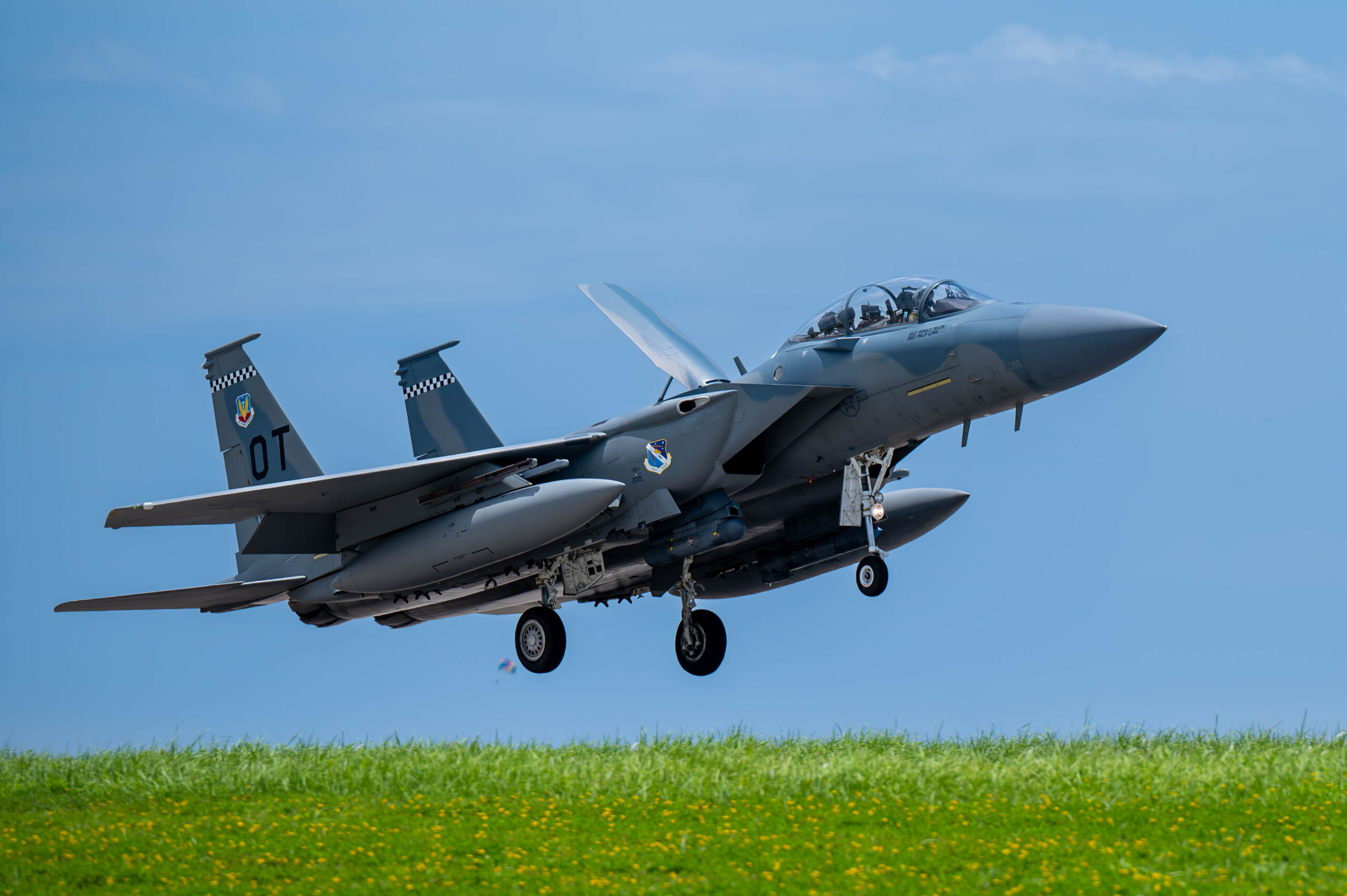
The U.S. Air Force is actively exploring the integration of a sophisticated missile warning system into its F-15EX Eagle II fighter jets, a capability not previously present in this advanced variant of the F-15 platform. This initiative marks a significant step towards enhancing the defensive capabilities of the F-15EX fleet.
As part of its market research efforts, the Air Force Life Cycle Management Center (AFLCMC) issued a sources sought notice on September 29. This notice sought information from potential vendors capable of supplying a missile launch and approach warning system designed for rapid integration onto the F-15EX. The goal is to identify existing technologies that can meet the stringent requirements of modern aerial combat.
Key specifications outlined in the notice emphasize the system’s ability to provide timely and accurate alerts to the fighter’s aircrew regarding incoming missile threats. Crucially, the system must achieve this without generating an excessive number of false alarms, which can distract pilots and degrade their operational effectiveness. Furthermore, the proposed system must leverage the F-15EX’s existing infrastructure, including six pre-designated sensor locations, as well as the aircraft’s integrated data cables, power supply, and cooling capabilities. A core requirement is that the system should be designed for quick and easy installation and removal in the field by Air Force maintenance personnel. This means installation must be possible without requiring any permanent modifications to the aircraft’s structure, aside from the placement of line replaceable units (LRUs) in the designated sensor points. This modular approach is vital for operational flexibility and ease of maintenance.
While the notice did not specify the potential cost of such a system or the duration of an eventual contract, it indicated that these details would align with typical defense procurement standards for similar projects. The initial phase is focused on identifying feasible technologies and potential suppliers rather than committing to a specific acquisition timeline or budget.
The F-15EX Eagle II, manufactured by Boeing, represents a modernized iteration of the venerable F-15E Strike Eagle. It incorporates numerous technological advancements, including state-of-the-art fly-by-wire flight controls and a new electronic warfare system. Despite these upgrades and the physical provisions (such as sensor locations and wiring) for a missile warning system, the F-15EX is not currently equipped with this capability upon delivery. This contrasts with other international F-15 variants, such as Saudi Arabia’s F-15SA and Qatar’s F-15QA, which are delivered with integrated missile warning systems.
The F-15EX currently relies on the Eagle Passive Active Warning Survivability System (EPAWSS), an advanced electronic warfare (EW) suite. EPAWSS is designed to detect and jam enemy radar systems, thereby offering defense against radar-guided missiles. However, EPAWSS does not address threats posed by infrared-guided missiles, which operate on a different principle by homing in on the heat signature of an aircraft. The proposed new missile warning system would specifically fill this defensive gap, providing comprehensive protection against both radar-guided and infrared-guided threats.
Other advanced fighter aircraft in the Air Force’s inventory already possess robust missile warning capabilities tailored for infrared threats. For example, the F-35 Lightning II is equipped with the AN/AAQ-37 Distributed Aperture System (DAS), developed by Northrop Grumman, which provides 360-degree spherical infrared awareness. Similarly, the F-22 Raptor stealth fighter utilizes the AN/AAR-56 Missile Launch Detection System (MLDS). The F-15EX, with this proposed upgrade, would align its defensive capabilities more closely with these advanced platforms.
Historically, the F-15C variant was slated to receive a missile warning system under the Common Missile Warning System (CMWS) program, a collaborative effort initiated by the Army, Navy, and Air Force. However, the Air Force withdrew from this program in 2000, as documented in a report by the Institute for Defense Analyses. The CMWS program subsequently evolved into the AN/AAR-57, a system built by BAE Systems, which is notably utilized on the F-15SA variant.
The critical importance of defending against infrared-guided missiles was recently highlighted during “Operation Epic Fury” in April. During this operation, an F-15E Strike Eagle, the direct predecessor to the F-15EX, was reportedly shot down over Iran. Then-President Donald Trump indicated that Iran used a shoulder-fired missile to down the fighter. Such weapons, commonly referred to as man-portable air defense systems (MANPADS), frequently employ infrared guidance systems due to their simplicity and effectiveness against aircraft with significant heat signatures.
While the Air Force’s sources sought notice does not constitute a firm commitment to procure a new system, it undeniably signals serious consideration of this capability. This exploration comes at a time when the Air Force’s strategic plans for the F-15EX are undergoing rapid expansion. Just this past April, the service significantly increased its projected F-15EX fleet size, almost doubling it from an initial plan of 129 aircraft to a new target of 269. Enhancing the survivability of this growing fleet is therefore a critical priority.
The AFLCMC has requested that potential respondents provide specific information regarding their missile warning systems. This includes detailing on which military aircraft their systems are already approved for operational use, whether the system is currently in active production, and the estimated number of months post-contract award before initial deliveries could commence, among other technical and logistical considerations.
Companies interested in submitting proposals have until November 12 to provide unclassified white papers outlining the technical capabilities of their respective systems to the Air Force. This initial phase will inform the Air Force’s future decisions regarding a formal acquisition program.
Why This Matters
The U.S. Air Force’s pursuit of an integrated missile warning system for the F-15EX Eagle II carries significant implications for national security, aircrew safety, and the future of aerial combat. This initiative directly addresses a critical vulnerability in a platform that is slated to become an increasingly vital component of the Air Force’s fighter fleet.
Firstly, and most importantly, the addition of a dedicated missile warning system significantly enhances pilot safety and aircraft survivability. Modern adversaries, both state and non-state actors, possess a growing arsenal of sophisticated, yet often inexpensive, infrared-guided missiles, including MANPADS. These weapons pose a substantial threat, particularly in low-altitude operations or contested airspaces. Early detection of an incoming infrared missile allows pilots precious seconds to initiate defensive maneuvers, deploy countermeasures (like flares), or utilize other evasive tactics, thereby dramatically increasing the aircraft’s chance of survival. The incident involving the F-15E over Iran underscores the very real and present danger posed by such threats.
Secondly, this upgrade ensures the F-15EX can operate effectively across a broader spectrum of combat environments. While the existing EPAWSS provides robust defense against radar-guided threats, it does not offer protection against the heat-seeking variety. Integrating a comprehensive missile warning system means the F-15EX will possess a 360-degree defensive shield, capable of detecting and warning against both radar and infrared threats. This holistic approach is crucial for maintaining air superiority against diverse and evolving adversary capabilities.
Thirdly, the timing of this initiative aligns with the Air Force’s substantial expansion of its planned F-15EX fleet. With the service nearly doubling its projected acquisition of these aircraft, ensuring each F-15EX is as survivable and capable as possible becomes a paramount concern. These aircraft are intended to serve as “workhorses,” complementing stealth platforms like the F-35 and F-22 by carrying large weapon loads and providing critical air-to-air and air-to-ground capabilities. Investing in their survivability ensures these assets can operate effectively for decades to come, maximizing their return on investment.
Finally, this development highlights the continuous cycle of innovation and adaptation inherent in modern military aviation. As threats evolve, so too must defensive technologies. By soliciting cutting-edge solutions from industry, the Air Force signals its commitment to equipping its personnel with the best available tools to confront dynamic global challenges. The requirements for rapid installation and integration into existing infrastructure also reflect a desire for agile acquisition and deployment, ensuring new capabilities can be fielded quickly to meet urgent operational needs.